
Prodrive Performance Pack: The Engineering Story Behind Subaru’s Legendary Performance Upgrade

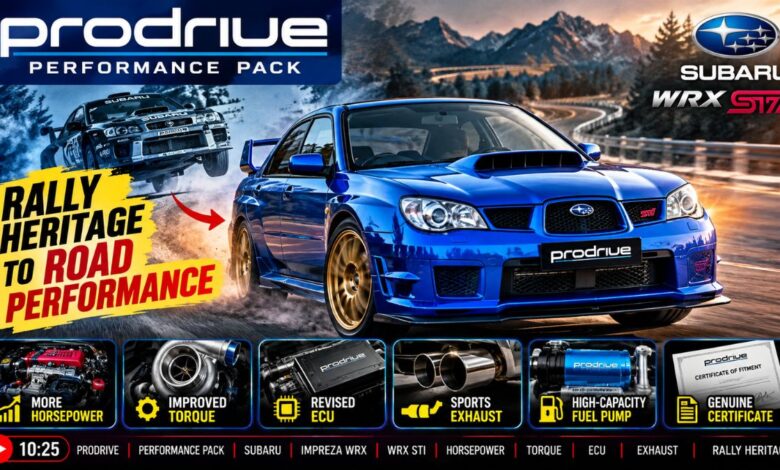
The Prodrive Performance Pack (PPP) is a performance upgrade program developed by British motorsport engineering company Prodrive, best known among enthusiasts for its association with Subaru’s rallying success. Introduced for selected Subaru Impreza WRX and WRX STI models, the package combined revised engine management with exhaust modifications to improve horsepower, torque, and acceleration. It was more than an aftermarket tuning kit: UK versions were offered through Subaru’s dealer network, with manufacturer warranty support under the original programs.
Today, the PPP remains relevant to enthusiasts assessing the originality, driving characteristics, and provenance of performance-era Subarus. Its real significance lies not simply in increased horsepower, but in how Prodrive brought motorsport-influenced engineering into an officially supported road-car upgrade.
What Is the Prodrive Performance Pack?
Prodrive developed the Performance Pack to improve selected turbocharged Subaru models’ performance without abandoning the fundamental character of their original engines.
Rather than replacing the engine or relying on extensive mechanical reconstruction, Prodrive focused on coordinating engine control settings with exhaust system changes. The objective was to increase usable power while preserving the everyday practicality expected of a road-going Subaru.
The package is commonly associated with the Impreza WRX and WRX STI, although later programs also covered the Forester 2.5 XT.
Importantly, PPP was not an identical upgrade fitted to every Subaru. Its specifications varied by model year, engine variant, and market. A 2002 STI package cannot automatically be treated as equivalent to a 2006 STI upgrade.
This distinction matters when researching specifications, purchasing an older vehicle, or evaluating claims about originality.
The Motorsport Background: Why Prodrive’s Name Mattered
Subaru’s relationship with Prodrive helped establish the credibility of its performance packages.
Prodrive was closely associated with Subaru’s World Rally Championship operations during an era when the Impreza became one of the most recognizable cars in international rallying. That connection gave the company an engineering identity that went beyond typical aftermarket modifications.
However, a motorsport connection should not be mistaken for evidence that a road-car upgrade used identical components or calibration to a competition vehicle.
The PPP was developed for production cars operating under different mechanical, environmental, and regulatory conditions.
From Rally Engineering to Road-Car Performance
Rally competition rewards responsive engines, predictable power delivery, and consistent performance under demanding conditions.
Those principles also influence the engineering of a fast road car, although the technical priorities differ.
Prodrive’s road-car approach emphasized improved torque delivery rather than focusing solely on maximum horsepower. The original STI product literature described increased torque availability across a broad section of the engine’s operating range.
For drivers, that meant stronger acceleration without constantly changing gears or running the engine near its maximum speed.
The engineering achievement was therefore as much about the shape of the torque curve as the headline power figure.
The Original 2002 Prodrive Performance Pack
One of the defining early releases arrived in October 2002, when Prodrive developed a package for the Subaru Impreza WRX STI Type-UK.
Contemporary reporting placed its original fitted price at £1,995, with approximately two and a half hours allocated for dealer installation.
The package increased output from 265 PS to 305 PS and raised peak torque from approximately 253 lb-ft to 299 lb-ft.
The performance figures were substantial for a relatively limited set of modifications.
According to contemporary UK launch specifications, the standard 2002 STI produced 265 PS, while the Prodrive-equipped version developed 305 PS. Peak torque increased from approximately 253 lb-ft to 299 lb-ft.
The reported 0–60 mph acceleration time improved from 5.2 seconds to 4.6 seconds. Acceleration from 0–100 mph was also reported to improve from 13.7 seconds to 12.2 seconds.
These figures reflected the original published specifications and performance assessments, not independently verified results for every surviving vehicle.
The 2002 brochure also identified a revised engine management system, a high-flow catalyst, stainless-steel sports exhaust silencers, and a certificate of fitment.
The certificate served a practical purpose: it confirmed the vehicle received the recognized package rather than a collection of unrelated modifications.
How the Prodrive Performance Pack Works
The package’s technical significance becomes clearer when its individual components are examined together.
Revised Engine Control Unit
The electronic control unit, commonly called the ECU, manages important aspects of engine operation.
Depending on the vehicle, these include fuel delivery, ignition timing, and turbocharger boost control.
A revised calibration can change how the engine produces power and responds to driver inputs. However, changing one parameter without considering the others can compromise reliability, emissions performance, or drivability.
Prodrive developed an integrated calibration suited to the intended hardware and operating conditions.
High-Flow Exhaust Components
The exhaust system was another central element.
The original package literature described using a high-flow catalyst and sports exhaust silencers. These components were designed to work with the revised engine management system.
Changes to exhaust flow can affect turbocharged engine performance, but the outcome depends on the entire system, not just the exhaust.
The PPP should therefore be understood as a matched engineering package, not simply a sports exhaust with a performance badge.
Fuel System Improvements
Certain later packages also included fuel-system upgrades.
For example, the 2006 STI documentation specified a high-capacity fuel pump alongside revised engine management and sports exhaust components.
This is an important model-year distinction. Owners should not assume every PPP installation includes the same parts.
Why Calibration Matters
A Prodrive technical document comparing UK and US Stage 2 packages explained that engine calibration differed between markets because of operating temperatures, fuel characteristics, and other environmental factors.
It specifically identified the greater temperature extremes encountered in the United States as a reason for adopting different tuning strategies.
That evidence challenges the assumption that a more aggressive engine map is automatically superior.
A calibration intended for one market may not suit another, even when the underlying engine hardware appears similar.
The 2003 Upgrade: A Faster Impreza WRX
In February 2003, Prodrive released another package for the updated Impreza WRX.
This version increased engine output to approximately 265 PS and produced 257 lb-ft of torque.
Contemporary figures put 0–60 mph at 4.8 seconds, compared with 5.6 seconds for the standard WRX.
The upgrade cost £1,600, including VAT and installation, and included revised ECU calibration and a free-flow exhaust system.
The most revealing performance improvement was not necessarily the standing-start acceleration.
Reported in-gear figures showed the WRX accelerating from 50–70 mph in fifth gear in 7.4 seconds, compared with 10 seconds before modification.
That improvement illustrates why torque delivery was central to the package’s engineering philosophy.
The 2006 Prodrive Performance Pack: A New Generation
By 2006, Subaru’s performance range had evolved, and Prodrive introduced revised packages for the 2.5-liter Impreza WRX, WRX STI, and Forester XT.
Top Gear covered the updated program in April 2006, reporting an installed price of £1,700 for the packages.
The new STI specification delivered 320 PS (316 bhp) and 450 Nm (332 lb-ft) of torque.
The official product brochure listed 280 PS as the standard engine output, meaning the upgrade added 40 PS.
Peak torque was achieved at 3,700 rpm, reinforcing the emphasis on accessible performance rather than peak power alone.
The 2006 STI Specifications
The 2006 Prodrive-equipped STI used a 2.5-liter turbocharged boxer engine producing 320 PS, equivalent to approximately 316 bhp.
Maximum torque reached 450 Nm at 3,700 rpm, while peak power was produced at 6,000 rpm.
The reported 0–60 mph acceleration time was approximately 4.8 seconds.
The package’s original installed price was £1,700.
The official 2006 STI brochure also recommended 18-inch wheels and tires to use the additional torque fully. That recommendation should not be confused with a claim that the wheels were necessarily included in every package.
The brochure listed the package under Subaru reference SACC 2612 and Prodrive reference PPP-STI-06.
These identifiers are particularly useful when checking historical documentation or assessing whether parts match the correct model year.
Was the Prodrive Performance Pack Factory-Fitted?
This question requires a distinction between a manufacturer-supported upgrade and equipment installed during vehicle assembly.
The PPP was offered through Subaru’s authorized dealer network in the UK. Contemporary material described installation after registration for certain versions.
Consequently, a vehicle advertised as having a PPP from new may have received its upgrade at a dealership rather than on the factory production line.
That does not automatically make the installation unofficial.
The essential questions are whether the correct package was installed, whether it was supplied through the recognized program, and whether its documentation survives.
Warranty Protection
Warranty support was one of the original program’s commercial advantages.
The 2002 STI package was reported as carrying Subaru’s three-year, 60,000-mile warranty, while the 2006 upgrades were also described as retaining standard warranty coverage.
This was a meaningful distinction from independent tuning products, which did not necessarily receive comparable manufacturer support.
Those historic warranty terms should not be interpreted as continuing coverage for vehicles sold decades later.
How to Identify a Genuine Prodrive Performance Pack
Authenticity is one of the most important considerations when evaluating a used Subaru advertised with PPP specifications.
An aftermarket exhaust, an ECU remap, or a Prodrive badge is not sufficient evidence on its own.
The original STI brochure explicitly listed a certificate of fitment as part of the program.
A documented vehicle may therefore provide stronger evidence of originality than one relying entirely on visual appearance.
Reliability: Does the PPP Damage the Engine?
No sound basis exists to claim that every Prodrive-equipped Subaru is inherently unreliable.
Similarly, an officially developed performance package does not guarantee that a surviving engine is mechanically healthy.
A turbocharged Subaru’s condition depends on factors that extend well beyond its original calibration.
Maintenance history, oil condition, cooling-system performance, fuel quality, previous modifications, and operating conditions can all influence long-term reliability.
A vehicle with many years of service may have undergone substantial mechanical changes since its original PPP installation.
What Owners Should Check
A sensible inspection should include an assessment of engine compression where appropriate, evidence of oil consumption, cooling-system condition, turbocharger operation, exhaust integrity, and any diagnostic fault codes.
The vehicle should also be checked for undocumented changes to boost control, fuelling, or engine management.
Importantly, a modern aftermarket remap may have replaced the original Prodrive calibration even if the vehicle retains its PPP exhaust.
Claims about specific failure rates or guaranteed engine longevity would require controlled reliability data. Such verified comparative figures were not established by the historical sources reviewed for this article.
Is the Prodrive Performance Pack Still Worth Having?
For an enthusiast considering a period-correct Subaru, the PPP offers three distinct attractions.
The first is measurable performance. Original figures show the packages delivered substantial improvements over the standard engines.
The second is historical authenticity. A documented Prodrive upgrade connects a road-going Impreza to a recognized period of Subaru’s performance-car development.
The third is the character of the modification itself. Unlike an unrestricted modern tuning project, the original PPP represented a defined combination of components and calibration.
Yet buyers should not assume the badge automatically makes a vehicle more valuable.
No reliable, comprehensive market dataset was established here to quantify a universal PPP resale premium.
A poorly maintained example with incomplete documentation may be less desirable than a standard car with a strong service history.
Condition, originality, and provenance remain more informative than a claimed horsepower figure.
Prodrive Performance Pack vs Modern ECU Remapping
Modern tuning technology allows specialists to modify engine parameters with considerable flexibility.
A contemporary remap may be tailored to a particular engine, fuel grade, turbocharger, or exhaust configuration.
That flexibility creates opportunities for different performance targets, but it also introduces variables absent from the original, standardized PPP specification.
The historical advantage of the Prodrive package wasn’t that it delivered the maximum possible power from a Subaru engine.
It was the combination of coordinated hardware, tested calibration, regulatory considerations, and official distribution.
For collectors, retaining the original specification can matter more than chasing extra horsepower.
For owners who prioritize performance over originality, a modern calibration may be attractive, but its quality depends on the tuner’s competence and the vehicle’s condition.
Don’t judge either approach solely by peak power.
Why the Prodrive Performance Pack Remains Significant
The PPP occupies an interesting place in British performance-car history.
It emerged when Subaru’s rally reputation strongly influenced the identity of its road cars. Enthusiasts wanted performance that reflected that motorsport association, but many also valued dealer support and everyday usability.
Prodrive supplied an answer built around engineering integration.
The 2002 STI package showed how a carefully coordinated set of changes could meaningfully increase acceleration. Later versions adapted that principle to new engines and vehicles.
The program also illustrates a broader shift in performance engineering: software calibration became an increasingly important way to shape a car’s character without replacing its fundamental mechanical architecture.
What survives today is therefore more than a collection of upgraded components.
A properly documented PPP Subaru represents a particular relationship between manufacturer, motorsport specialist, dealership, and customer.
That relationship helps explain why the package still attracts attention long after its original launch.
Conclusion
The Prodrive Performance Pack was an important chapter in the development of Subaru’s performance road cars. By combining revised engine management, exhaust improvements, and selected supporting components, Prodrive delivered measurable gains while retaining the manufacturer-supported character of the original UK programs.
Its reputation rests on more than the 300 bhp figure associated with the early STI or the 316 bhp achieved by the 2006 version.
The deeper significance lies in its engineering philosophy: increase usable performance through a coordinated package rather than treating horsepower as an isolated objective.
For present-day owners and buyers, the most valuable lesson is equally practical. Verify the exact specification, establish the vehicle’s history, and judge its mechanical condition independently of its reputation.
A genuine, well-preserved PPP Subaru is an appealing piece of performance-car history. Its authenticity deserves the same attention as its acceleration.
(FAQs)
1. What does PPP stand for in Subaru cars?
PPP stands for Prodrive Performance Pack, a series of performance upgrades Prodrive developed for selected Subaru models, particularly the Impreza WRX and WRX STI.
2. How much horsepower does a Prodrive Performance Pack add?
The increase depends on the model and year. The 2002 STI package raised output from 265 PS to 305 PS, while the 2006 STI package increased power from 280 PS to 320 PS.
3. Is the Prodrive Performance Pack an official Subaru upgrade?
Subaru offered the historical UK packages through its dealer network and supported them under the manufacturer’s warranty arrangements. This distinguishes them from unrelated aftermarket tuning installations.
4. How can I tell whether my Subaru has a genuine PPP?
Look for a Prodrive fitment certificate, dealer installation records, correct model-specific components, and evidence of the appropriate ECU calibration. A specialist inspection can help establish whether the original specification remains intact.
5. Does the Prodrive Performance Pack increase a Subaru’s value?
A documented original package may appeal to enthusiasts, but there is no verified universal resale premium. Market value depends on condition, mileage, service history, originality, and demand for the particular model.