
Amcoder: The Truth Behind the Software Engineering Platform and Its Growing Digital Identity

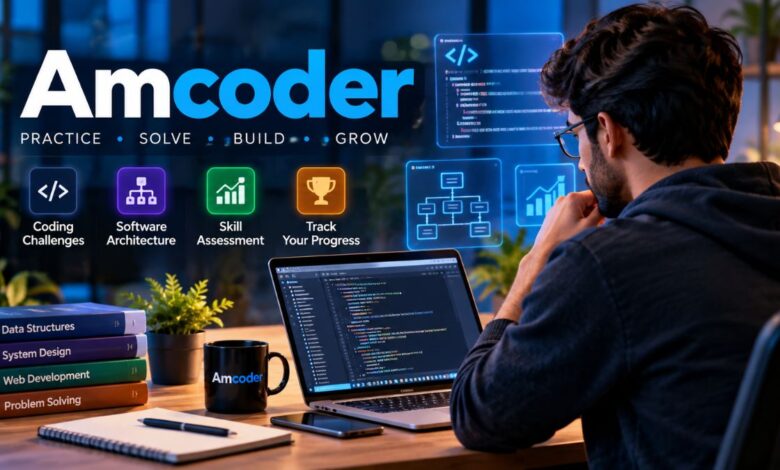
Amcoder is a technology-related name primarily associated with software development, programming education, and practical coding challenges. The AmCoder platform helps developers strengthen their technical abilities through structured problem-solving, software architecture exercises, and skill assessments. Unlike traditional learning resources that concentrate mainly on tutorials, its stated approach encourages hands-on practice and measurable progress. However, several independent technology companies and developer profiles use similar names, so it’s essential to distinguish them. Understanding what Amcoder is, how its platform works, and what information is publicly verified provides a clearer picture of its role in software engineering and digital skill development.
What Is Amcoder?
Amcoder, particularly the platform known as AmCoder, focuses on practical software engineering education and technical problem-solving. Its official website presents a system where developers select coding or software architecture challenges, complete focused work sessions, and receive assessments based on published criteria. The results are intended to contribute to a public record of demonstrated technical ability.
Although the name appears across different technology-related websites, Amcoder is not a single identifiable celebrity or universally recognized corporation. Several independent businesses and developer accounts use similar names.
The distinction matters. AmCoder’s publicly described platform focuses on developing and demonstrating engineering skills, while similarly named companies provide commercial software development services. Their activities should not be confused.
How Amcoder Approaches Software Engineering
Programming education has a persistent problem: understanding an explanation is not the same as solving an unfamiliar technical problem.
A student might complete tutorials covering functions, databases, and web applications yet struggle to decide how those components should work together. Professional software engineering requires more than recalling syntax. It involves interpreting requirements, considering constraints, testing assumptions and explaining technical decisions.
AmCoder’s stated model places independent problem-solving at the center of its experience.
Rather than presenting itself simply as a library of programming lessons, the platform encourages participants to complete technical assignments and have their work evaluated.
This distinction gives its approach a practical purpose. A completed challenge may reveal how a developer thinks through a problem, not merely whether they remember a particular programming command.
However, the platform’s published description alone cannot establish the quality of its assessment process.
Coding and Architecture Challenges
AmCoder identifies coding problems and architecture problems as two types of available exercises.
The distinction is significant.
Coding exercises generally require participants to produce a working implementation. Software architecture problems can require broader reasoning about how components interact, how data moves through a system, and why one design might be preferable to another.
For example, designing a service that must handle increasing traffic involves different decisions from writing a short function that processes an array.
These examples illustrate the difference between the disciplines; they are not a verified list of AmCoder’s current assignments.
The actual range of problems, supported programming languages, and difficulty levels must be checked against the accessible platform catalog.
Focused Working Sessions
According to its official description, AmCoder asks participants to solve problems in focused sessions while recording their approach and written explanation.
Time limits can reveal how someone prioritizes a task, but they also create an artificial constraint.
Real engineering projects frequently involve research, code review, team discussions, and requirements that change over several weeks. A timed exercise cannot reproduce all those conditions.
The most reasonable interpretation is that focused challenges can provide one form of evidence about technical problem-solving. They are not complete substitutes for professional experience.
The Role of Rubric-Based Assessment
One of AmCoder’s defining published features is its use of scoring rubrics.
A rubric explains the criteria against which work is assessed. In technical education, this can make evaluation more transparent than assigning a numerical grade without explaining the standard.
Consider two solutions that produce identical outputs.
One may be difficult to understand or modify, while the other uses a clearer structure and handles unusual inputs more reliably. Evaluating engineering quality may therefore require more than checking whether the software runs.
Building a Public Record of Technical Ability
AmCoder states that assessed results can be added to a public profile.
This matters because software engineering credentials are often hard to evaluate.
A course certificate establishes that someone completed a particular educational activity. A project portfolio displays work, but may not explain how much assistance the creator received. A coding assessment can add another perspective by documenting performance under specified conditions.
These forms of evidence serve different purposes.
A public technical profile could give developers a place to demonstrate repeated practice and improvements. However, its usefulness depends on the information displayed, the reliability of evaluation, and whether third parties understand the assessment system.
No verified evidence shows that employers widely recognize AmCoder profiles or that the platform improves job placement rates.
Nor should users assume that a public profile is automatically beneficial. Before submitting work, they should understand what information becomes visible and whether privacy controls are available.
Who Could Benefit From Amcoder?
The platform’s approach may suit different types of learners, but the right starting point depends on the challenges available.
Beginners Learning Programming
New programmers often benefit from guided explanations before attempting independent assignments.
For beginners, practical challenges can expose gaps in understanding that tutorials sometimes conceal.
Someone who has followed instructions to create a small application may discover that building a similar application without assistance requires deeper knowledge of program structure, data handling, and debugging.
AmCoder could support this kind of practice by matching available problems to a learner’s level.
It should not automatically be assumed to provide a complete beginner curriculum, individual tutoring or guaranteed progression through every programming subject.
Developers Strengthening Their Skills
Developers with some experience may use structured challenges to practice technical reasoning beyond their regular responsibilities.
For example, someone accustomed to frontend interfaces might want to build stronger knowledge of backend architecture.
A developer experienced in building individual features might instead want to practice evaluating system-level trade-offs.
Whether AmCoder can meaningfully support those goals depends on the specific assignments, their difficulty, and the feedback participants receive.
Candidates Preparing for Technical Interviews
Coding and architecture assessments overlap with some activities used in software engineering interviews.
Practicing under defined constraints may help candidates become more comfortable interpreting unfamiliar requirements and communicating solutions.
That potential benefit should not be confused with evidence of successful interview preparation.
No independently verified employment outcomes or placement statistics were established during this review.
Amcoder and the Confusion Surrounding Similar Names
To understand Amcoder, you must identify which organization or digital identity a search result represents.
Several technology-related entities use visually similar names, but their published activities differ.
AmCoder: Software Engineering Practice
The AmCoder platform at amcoder.in describes coding challenges, architecture problems, timed sessions, rubric-based evaluations, and public profiles.
Its central proposition concerns technical practice and evidence of skills.
AmCodr IT Solutions: Commercial Software Development
AmCodr IT Solutions Pvt. Ltd. is a separately identified software development company based in Ahmedabad, India.
Its official company history states that it was established in 2016 and identifies Sukunj Mendpara, Miral Viroja and Ravi Bhalodiya as its founders.
The company describes activities including web application development, mobile application development, and custom software solutions.
Its business model is therefore different from the engineering-practice platform associated with AmCoder.
The company’s founding information comes from its own published account; it should not be attributed to AmCoder.in.
AmcoderZ Infotech: Digital Product Development
AmcoderZ Infotech separately describes itself as a provider of mobile applications, web development, custom software, healthcare-related applications, and Internet of Things integrations.
Its website also lists technologies such as Flutter, React Native, Laravel, and Node.js.
Those descriptions establish its stated service offerings, but they do not independently verify every commercial achievement or customer outcome.
The reviewed official sources provide no reliable evidence that AmcoderZ and AmCoder.in are the same organization.
Amcoder as an Online Developer Identity
The name also appears in developer communities.
For instance, a GitHub account using the handle amcoder publicly identifies its owner as Andy Miller and lists programming repositories.
A shared name does not establish a connection between that individual and the educational platform or similarly named software businesses.
This is why identifying the exact website or account is essential before publishing claims about ownership, founders, or professional history.
What Is Still Unknown About AmCoder?
The most important limitations concern details that cannot be established from the available official material.
The platform’s homepage describes what users are intended to do, but independently verified documentation does not answer several questions.
Founders and Company History
We could not confirm a founding date or founder biography for the AmCoder. In platform.in platform could not be established from the sources reviewed.
It would be misleading to assign the history of AmCodr IT Solutions or another similarly named business to this platform.
Its ownership structure, development timeline and organizational background should remain unconfirmed until reliable documentary evidence becomes available.
Pricing and Accessibility
The platform states that visitors can explore its problem catalog without creating an account and invites them to start with a free problem.
That wording does not establish that all submissions, assessments, or account features are free.
The full pricing structure, subscription terms and any usage restrictions require direct confirmation.
During the review, the homepage content displayed a “Request failed (404)” message in the problem-listing area. This observation does not prove that the entire service was unavailable or that the issue was permanent.
Performance and Financial Information
Verified financial data has not been publicly disclosed in the sources examined.
There is also insufficient independently established evidence to report active user totals, completion rates, revenue, assessment accuracy, or employer adoption.
Promotional descriptions cannot substitute for independently audited figures.
How to Evaluate Amcoder Before Using It
Anyone considering a technical learning platform should evaluate the experience rather than rely solely on its advertised features.
First, review the available exercises. Their relevance depends on whether they match the user’s experience, preferred technologies, and learning goals.
Next comes the assessment process. A useful evaluation should clearly explain weaknesses so a participant can improve their next solution.
Privacy deserves equal consideration, particularly where platforms create public records of submitted work. Users should avoid uploading confidential employer code, private credentials or proprietary information without authorization.
Finally, it is sensible to verify payment terms, cancellation conditions, account requirements, and access to previous submissions before committing to a paid service.
These checks are not accusations against AmCoder. They are ordinary due diligence for any platform handling technical work and user information.
The Larger Question: Can Coding Scores Measure Engineering Ability?
AmCoder’s stated emphasis on recorded problem-solving raises a useful question about how software developers are evaluated.
Technical ability is difficult to reduce to a single score.
A programmer may perform well on short algorithmic exercises but struggle to maintain a large application. Another may be skilled at investigating production failures, documenting systems, and collaborating with colleagues without excelling under timed conditions.
Neither example invalidates technical assessments. It shows why their scope matters.
A carefully designed coding exercise can reveal strengths and weaknesses within a specific domain. A software architecture challenge may demonstrate how someone reasons about competing requirements.
Yet professional engineering also demands communication, sound judgment, security awareness, and the ability to adapt as requirements change.
The strongest evidence of capability therefore comes from several sources: completed work, sound explanations, independent reviews, relevant experience and consistent performance.
AmCoder’s assessment model can be evaluated within that broader framework, rather than treated as a definitive measure of professional competence.
Conclusion
Amcoder is best understood as an ambiguous technology-related name, with AmCoder. in representing a clearly identifiable software engineering practice platform.in representing a clearly identifiable software engineering practice platform.
Its published approach centers on coding and architecture challenges, focused working sessions, assessment rubrics and public records of results.
Those features describe a potentially useful method for practicing technical skills, but independent evidence is still needed to establish the platform’s assessment quality, adoption, pricing and professional outcomes.
Equally important is the distinction between AmCoder, AmCodr IT Solutions, AmcoderZ Infotech and individual developer accounts using similar names.
For readers researching the platform, the most reliable starting point is its own documented functionality, followed by careful examination of what can—and cannot—be independently verified.
(FAQs)
1. What is Amcoder?
Amcoder is a name associated with several technology-related identities. AmCoder.in specifically presents itself as a software engineering practice platform offering coding and architecture challenges with rubric-based assessments.
2. Is AmCoder free to use?
Its homepage says you can explore a problem catalog without an account and start with a free problem. The complete pricing structure and availability of paid features have not been independently verified.
3. Who founded AmCoder?
The founder and launch date of the AmCoder. inin platform could not be reliably established from the official sources reviewed. Founders of similarly named companies should not be attributed to it.
4. Can Amcoder help someone become a software engineer?
Practical exercises can support technical learning, but their value depends on task quality, feedback, and the learner’s existing knowledge. No verified evidence establishes that AmCoder guarantees employment or professional certification.
5. Is AmCoder the same as AmcoderZ or AmCodr IT Solutions?
No verified evidence shows they are the same organization. AmCoder.in presents engineering practice activities, while AmcoderZ and AmCodr IT Solutions separately advertise commercial software development services.