
Cidnet: The Truth Behind the Correctional Communication Platform Changing How Families Stay Connected

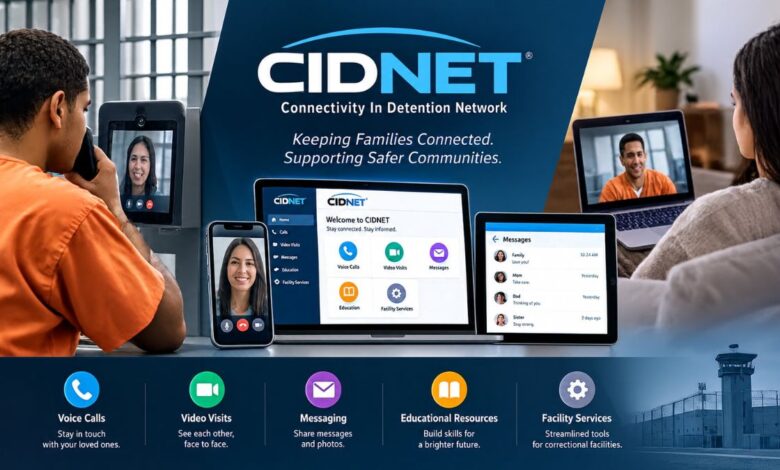
Cidnet is an American correctional communication and technology platform developed by Encartele, a Nebraska-based company. It allows incarcerated individuals to communicate with approved family members and friends through voice calls, video visits, and electronic messaging. Although it occasionally appears in searches framed around personal or company biographies, Cidnet is not an individual or celebrity. Encartele launched it in 2017 as part of its broader corrections business. Its significance lies in a sensitive industry where communication costs, institutional security, and the ability to maintain family relationships are closely connected. Understanding Cidnet requires examining both its commercial claims and the practical realities faced by its users.
What Is Cidnet?
Cidnet, also styled CID Net, is a specialized digital platform designed for American jails and other correctional facilities. Its name derives from Connectivity In Detention Network, reflecting its original emphasis on connecting people inside detention facilities with the outside world.
Unlike ordinary messaging apps, the system operates in an environment where communication is regulated, monitored, and requires institutional approval.
For incarcerated individuals, it can provide access to calls, messages, educational materials, and other digital services. For their families, it offers a way to stay in touch without relying entirely on traditional telephone infrastructure. Correctional administrators use the platform to oversee communications, manage devices, and integrate operational services.
Encartele describes the system as an Internet Applications Provider (IAP) rather than simply a telephone service. This distinction reflects a business strategy built around internet-based applications that can support multiple facility functions through a shared technical infrastructure.
The company states that its technology serves more than 450 correctional facilities across the United States. That figure is a company-reported measure of reach, not an independently audited count.
The Origins of Cidnet and Its Parent Company
Cidnet’s story begins with Encartele, a correctional technology business established in 2004. According to the company’s published history, Encartele emerged from combining call-center technology with inmate communication systems.
The business developed in Nebraska, where it still maintains its principal operations. Encartele identifies Scott Moreland as a business owner associated with its development and describes his background in computer science and military service. However, publicly available corporate history does not show that he personally invented every technology later introduced under the company’s brands.
A significant milestone came in 2017, when Encartele launched CID Net as its proprietary communications platform.
This distinction matters because online company listings sometimes associate the Cidnet brand with the parent’s 2004 founding date. The two dates describe different developments: Encartele’s establishment and the later introduction of its branded platform.
The company’s evolution reflects a broader shift in correctional technology. Earlier systems concentrated primarily on telephone connections. Newer platforms increasingly combine communications, administrative applications, data management, and digital services.
Cidnet developed within that transition rather than emerging as an independent consumer social network.
How Cidnet Communication Services Work
For families, Cidnet’s practical value depends on whether their loved one’s correctional facility participates in the system.
Users generally create an account, verify their identity, select the relevant facility, and request permission to communicate with an incarcerated contact. Facility personnel may need to approve the connection before certain services become available.
The platform offers three principal communication functions:
- Voice communication: Incarcerated individuals can call approved contacts.
- Video visitation: Families may schedule video conversations when the facility provides the service.
- Digital messaging: Approved users can exchange written messages and, where permitted, photographs.
A key limitation is that family members ordinarily cannot initiate a direct voice call to someone inside the facility. The incarcerated individual must begin that interaction.
Nor does registration guarantee immediate access. Cidnet’s published support guidance indicates that contact approvals commonly take one or two days, although actual processing depends on correctional staff and local procedures.
These restrictions distinguish the platform from conventional consumer communication services. The user relationship is not simply between an application provider and its customers. The facility retains substantial control over access and permitted activity.
The Technology That Makes Cidnet Different
Cidnet’s principal technical selling point is integrating communications into a broader internet-based system.
Its platform, identified as cidOS, is intended to bring different correctional applications together under a common administrative structure. The company describes functionality involving messaging, voice communication, video services, digital signage, monitoring tools, and facility management.
From an administrative perspective, consolidation could reduce the need to operate several disconnected systems. Staff may manage communication records and authorized devices through centralized controls rather than switching between separate platforms.
The system also supports specialized hardware designed for correctional environments, including wall-mounted devices, voice units, and tablets.
Educational applications form another part of the product offering. These include digital reading materials, training resources, and selected entertainment content.
However, the distinction between available technology and actual implementation is important. A capability the company advertises is not necessarily installed or accessible in every participating jail.
The precise services available to incarcerated individuals depend on the facility’s agreements, equipment, policies, and operational decisions.
Cidnet Pricing and the Reality Behind Its Affordability Claims
Perhaps the most distinctive part of Cidnet’s business model is how it charges for communications.
Traditional correctional telephone services have often charged by the minute. Cidnet instead describes a data-based billing system using a proprietary mechanism called the Data Token Access Protocol (DTAP).
Under this arrangement, users purchase data that can be consumed through supported applications. Cidnet calls an individual communication interaction a Cidnet Utilization Event (CUE).
The company presents this approach as a way to charge based on actual consumption rather than rounded telephone billing increments.
However, there is a difference between an innovative pricing model and one that is consistently less expensive.
Cidnet’s published customer terms identify a $2.99 data security token charge at purchase and a 5% merchant charge. The same terms state that purchased data tokens expire after two years. These conditions make transaction fees and usage patterns relevant when assessing total costs.
Consequently, families should consider the full amount paid rather than comparing an isolated usage rate with a traditional telephone charge.
A data-based model may offer advantages in some circumstances, but total cost depends on applicable charges, data consumption, and how often services are used.
Independent, comprehensive price comparisons covering all participating Cidnet facilities are not established by the sources reviewed. Claims of universal savings should therefore be treated cautiously.
Why Family Communication Matters Beyond Technology
The importance of correctional communication extends beyond the commercial services companies like Encartele provide.
Maintaining relationships during incarceration can affect children, partners, parents, and wider family networks. For individuals in custody, regular contact may help preserve relationships that become especially important during the transition back into society.
Research and advocacy from the Prison Policy Initiative have repeatedly highlighted the financial pressures associated with correctional communication services.
The organization also highlights concerns about video visitation systems replacing traditional in-person contact rather than supplementing it.
This raises a key policy question for companies operating in the sector: does additional technology meaningfully expand human connection, or does it sometimes introduce new barriers and costs?
Cidnet’s stated mission emphasizes accessibility and improved communication. However, its actual impact should be assessed using practical measures, including affordability, reliability, accessibility, and the preservation of alternative ways to maintain contact.
A successful correctional communications platform must serve more than the institution’s administrative priorities. It must also be usable by families with widely varying financial and technical resources.
Security, Privacy, and Institutional Oversight
Security is central to Cidnet’s design because correctional facilities operate under extensive communication restrictions.
The platform advertises administrative permission controls, audit records, communication monitoring, and encrypted storage. These features are designed to help authorized personnel supervise activities and investigate potential security incidents.
For ordinary users, privacy expectations matter most.
Cidnet explicitly informs families that correctional personnel may record and monitor communications. Messages and conversations should therefore not be assumed to have the confidentiality associated with private consumer messaging applications.
Sensitive or legally privileged communications require particular care. Users should consult the relevant facility about approved procedures for protected attorney-client contact rather than relying on ordinary family communication channels.
The company’s published security descriptions explain its intended safeguards, but they do not, by themselves, provide a complete independent assessment of the platform’s security performance.
Transparency about monitoring, access restrictions, and retained information remains essential in any system handling communications between incarcerated people and their contacts.
Cidnet’s Growth Across American Correctional Facilities
Cidnet is not merely a proposed technology. Publicly available facility information confirms that Encartele communication services have been implemented in operational correctional settings.
For example, Furnas County in Nebraska identifies Encartele as its inmate telephone service provider and directs users to Cidnet to add communication data and access messaging or video services.
Another documented example emerged in 2021, when Encartele announced the introduction of its CIDNET Letters application at Lee County Jail in Iowa. The application was designed to digitize incoming correspondence and make it available through the facility’s system.
That development shows how correctional technology can extend beyond telephone calls to mail handling and administrative operations.
Encartele reports that its network reaches more than 450 correctional facilities nationwide.
While this suggests substantial commercial reach, independent data establishing the exact active user count, annual communications volume, or company-wide customer retention rate were not identified in the reviewed sources.
The Wider Debate About Correctional Communication Costs
Cidnet operates in a sector where pricing has attracted significant regulatory scrutiny.
In July 2024, the US Federal Communications Commission adopted reforms intended to reduce the cost of communications for incarcerated people and their families.
The regulatory position subsequently changed. On October 28, 2025, the FCC approved a revised framework that raised certain permissible rate ceilings while addressing concerns raised about service provision and correctional security costs.
The Prison Policy Initiative criticized the revised approach, arguing that higher rate caps could increase the financial burden on families.
These developments concern the wider correctional communications industry and should not be interpreted as evidence of Cidnet misconduct.
Nevertheless, they demonstrate why companies in this market face scrutiny over consumer costs, service availability, and the financial arrangements between providers and correctional institutions.
For Cidnet, the commercial challenge is to demonstrate that its technical model produces measurable improvements under real operating conditions, rather than relying entirely on promotional comparisons with older systems.
Ownership, Leadership, and Financial Transparency
Cidnet operates as a brand and technology platform of Encartele Inc., rather than as the public identity of a celebrity or individual entrepreneur.
Its customer terms explicitly identify Encartele as the contracting business responsible for the service.
Although Encartele publicly discusses its history, business ownership, and commercial objectives, the available material does not establish a complete independently verified financial profile.
Verified company-wide revenue, profit, and valuation figures have not been publicly disclosed in the sources reviewed.
Therefore, presenting an estimated Cidnet net worth as a confirmed financial fact would be misleading.
Similarly, the platform’s success should not automatically be equated with the personal wealth of any individual associated with Encartele.
A responsible business profile distinguishes between reported customer reach, established corporate history, and financial information that remains unavailable for independent examination.
What Cidnet’s Future Depends On
The future of platforms such as Cidnet is likely to be influenced by several competing demands.
Correctional administrators want systems that are secure, dependable, and efficient. Families want affordable communication with minimal complications. Incarcerated individuals need meaningful access to approved contacts, educational opportunities, and relevant services.
Encartele is positioning Cidnet as a broader correctional technology environment rather than a standalone communications product. Its published offerings increasingly include administrative software, digital applications, and facility-monitoring capabilities.
Whether that expansion produces better outcomes will depend on implementation and measurable results.
The strongest evidence of progress would include transparent pricing, reliable performance, accessible customer support, and demonstrated improvements in communication opportunities.
New features alone do not prove better service.
Conclusion
Cidnet represents an established effort to modernize communication and digital operations within American correctional facilities.
Its development under Encartele, its 2017 platform launch, and its expanding range of applications illustrate how correctional technology has moved beyond conventional telephone systems.
Yet the most important questions concern the people using those systems.
Affordability, privacy, accessibility, and reliability ultimately determine whether technological changes make communication more meaningful.
Cidnet’s public profile is best understood through its documented corporate history and operational services, not through invented personal details or unsupported commercial claims. Its long-term significance will depend on whether the platform can consistently balance institutional requirements with the communication needs of incarcerated individuals and their families.
(FAQs)
1. What is Cidnet, and what is it used for?
Cidnet is an internet-based correctional communication platform operated by Encartele. It enables approved voice calls, video visits, and electronic messages between incarcerated people and their contacts, subject to facility rules.
2. Who owns Cidnet?
Encartele Inc., a Nebraska-based correctional technology company established in 2004, owns and operates Cidnet. The CID Net platform was launched in 2017.
3. Is Cidnet free to use?
Communication services generally require users to purchase data. Additional transaction charges may apply, and total cost depends on your account terms and the services you use.
4. Can family members call an incarcerated person directly through Cidnet?
No. Under Cidnet’s published standard procedure, voice calls must be initiated by the incarcerated individual. Families can receive approved calls and may arrange video visits where those services are available.
5. Is Cidnet available at every jail in the United States?
No. The platform operates only at participating correctional facilities. Features and approval requirements vary by location, so users should confirm participation and permitted services with the relevant facility.