
Smart Square: The Powerful Healthcare Scheduling System Transforming Hospital Workforce Management

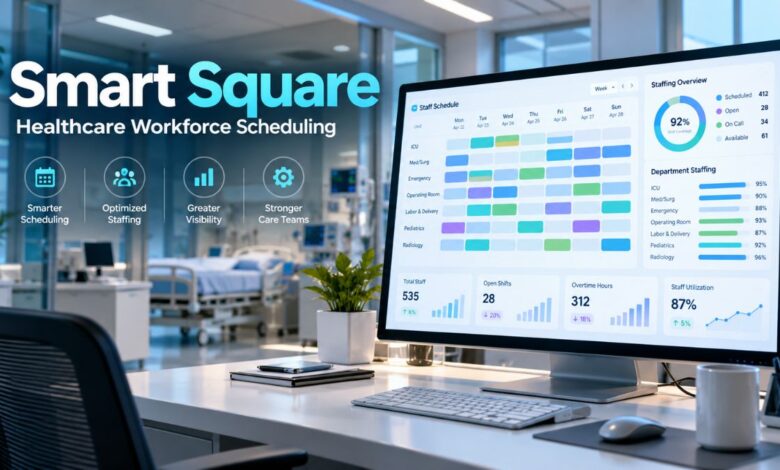
Smart Square is a healthcare workforce scheduling platform that helps hospitals manage employee shifts, predict staffing needs, and respond to shifting patient demand. Originally associated with Avantas and AMN Healthcare, the software became part of symplr following a $75 million acquisition announced in July 2025. Its significance lies not simply in replacing paper schedules but in addressing a difficult operational question: how can hospitals maintain appropriate staffing without exhausting employees or overspending on labor?
Recognized in the 2025 and 2026 Best in KLAS awards for nurse and staff scheduling, Smart Square has established a significant position in healthcare workforce technology. Yet its performance must be judged against real hospital conditions, not just predictive algorithms or promotional savings figures.
What Is Smart Square?
Smart Square is an enterprise scheduling and workforce management system built primarily for healthcare organizations. It brings staffing forecasts, employee schedules, open-shift management, and workforce analytics into a connected environment.
Unlike a basic calendar application, which records when someone is expected to work, Smart Square is designed to help determine how many employees an organization will need before a shift begins.
That distinction matters in hospitals, where staffing needs can change considerably from one department to another. An emergency department may see unpredictable admissions, while a surgical unit can anticipate demand based on planned procedures. Seasonal illness, employee absences, changing patient acuity, and unexpected vacancies introduce additional uncertainty.
Smart Square addresses these issues by combining predictive analytics with scheduling workflows. Managers can review anticipated staffing needs, identify shortages, and share available shifts with eligible employees.
For clinicians, the system offers tools for viewing schedules, submitting requests, and participating in available-shift arrangements where those features have been enabled by their employer.
Its main purpose is therefore broader than convenience. Smart Square attempts to connect workforce planning with the actual demands of patient care.
The History of Smart Square: From Avantas to symplr
Understanding the platform’s development requires examining its corporate background.
Smart Square was associated with Avantas, a healthcare workforce management company that AMN Healthcare acquired. By 2015, AMN publicly identified Smart Square as an Avantas enterprise scheduling product, showing its history extends well beyond the recent growth of generative artificial intelligence.
Its earlier positioning centered on forecasting, labor management, and operational efficiency. These capabilities reflected a long-standing challenge for hospital administrators: staffing too few employees can create clinical and operational risks, while staffing considerably beyond demand can impose unnecessary costs.
Under AMN Healthcare, Smart Square formed part of a wider portfolio of healthcare workforce technologies.
A major corporate development followed in July 2025, when AMN Healthcare announced that it had sold Smart Square to symplr.
The announced transaction valued the software business at $75 million, comprising $65 million paid at closing and a $10 million note.
The transaction also established a commercial partnership between the two organizations. AMN continued concentrating on workforce planning, advisory services, staffing, and analytics, while symplr expanded its healthcare operations software capabilities through the acquisition.
For existing customers, this represented more than a change of ownership. It placed Smart Square within a broader product environment involving scheduling, timekeeping, and workforce administration.
The acquisition also demonstrated the commercial value of specialized healthcare scheduling technology. Hospitals increasingly need systems that can interpret workforce information, not just record employee attendance.
How Smart Square Uses Predictive Scheduling
Predictive scheduling is the platform’s defining capability.
Traditional hospital scheduling often relies on historical staffing patterns, managerial experience, and adjustments as vacancies arise. Experienced supervisors remain essential, but heavy reliance on manual processes can make it hard to identify shortages early enough.
Smart Square approaches the problem through demand forecasting.
According to symplr’s published product information, the system can forecast staffing needs up to 120 days in advance. The company advertises forecasting accuracy of up to 96%, although this figure should be understood as a vendor-reported performance claim rather than a guaranteed result for every hospital.
The forecasting process uses historical information and demand-related patterns to estimate future staffing requirements. Those estimates can then be compared with planned workforce availability.
Consider a hospital unit expecting increased patient activity over a particular weekend. If projected requirements exceed the employees already scheduled, managers may identify the potential shortage weeks ahead rather than discovering it shortly before the shift.
They can then consider available internal staff, permitted overtime, float pools, or other appropriate workforce options.
The practical value comes from the additional time available to make decisions.
However, forecasting cannot eliminate uncertainty. Unexpected emergencies, regional outbreaks, severe weather, or sudden changes in patient acuity can significantly alter staffing requirements.
Predictions are best treated as decision-support information, not instructions that replace clinical judgment.
Why Open-Shift Management Matters
One of the most consequential parts of healthcare scheduling is filling uncovered shifts.
Hospitals often address vacancies through overtime, internal staffing pools, agency workers, or last-minute requests to existing employees. Each option carries different financial and operational consequences.
Smart Square provides automated open-shift management intended to identify staffing gaps and make opportunities available to suitable employees.
Its advertised capabilities include an automated variable incentive model that helps organizations manage the financial incentives associated with hard-to-fill shifts.
For example, a hospital may need additional coverage during a holiday period. Instead of immediately relying on a more expensive staffing option, its scheduling team may offer available shifts to eligible internal employees under established organizational rules.
When successful, this approach can reduce administrative work and provide employees with earlier notice of opportunities.
Nevertheless, the system does not eliminate the underlying shortage of trained healthcare professionals. A platform may help distribute available labor more effectively, but it cannot create qualified nurses where none are available.
This distinction matters when evaluating claims about efficiency.
Better allocation of existing staff is not necessarily the same as increased workforce capacity.
Smart Square Go and the Employee Experience
Although sophisticated forecasting may attract hospital executives, many frontline employees care most about day-to-day usability.
Smart Square Go is the platform’s mobile application, designed to extend scheduling functions to clinicians using supported devices.
The application description identifies several employee-facing features:
- Viewing work schedules and available shifts.
- Requesting time off or shift trades.
- Expressing interest in additional working hours.
- Synchronizing schedules with personal calendars.
- Receiving scheduling notifications.
- Accessing organizational accounts through supported authentication arrangements.
These functions can reduce reliance on telephone calls, emails, and informal messages between employees and scheduling teams.
For example, a nurse who wants an additional shift may be able to review available opportunities without contacting multiple supervisors. Similarly, an employee requesting leave may submit the request through the scheduling environment rather than depending entirely on a manual process.
Actual access depends on organizational configuration, staff eligibility, and internal approval policies.
Importantly, Smart Square Go requires an active Smart Square account. Downloading the application alone does not provide access to a hospital’s scheduling information.
The usefulness of mobile scheduling also depends on reliability.
In October 2026, the application’s Google Play listing showed a rating of about 2.7 out of five stars, with some user reviews reporting login and performance problems. Such reviews are subjective and cannot establish how the overall enterprise platform performs, but they highlight practical concerns that shouldn’t be dismissed.
A forecasting system may be sophisticated, yet its employee experience can still be undermined by authentication problems, slow loading, or difficult navigation.
What Smart Square Offers Hospital Managers
Hospital managers face competing responsibilities: maintaining appropriate coverage, following employment rules, controlling labor spending, and responding to staff concerns.
Smart Square is intended to bring information relevant to those responsibilities into a more centralized environment.
Its enterprise staffing view can help administrators compare workforce needs across departments and facilities. This is particularly relevant for healthcare systems operating multiple hospitals, where resources may need to be coordinated across locations.
The platform also supports workforce reporting and analysis.
Managers can use these capabilities to review scheduling patterns, overtime exposure, open shifts, and labor utilization.
Another important feature is integration. Symplr states that Smart Square can connect with various human resources, payroll, timekeeping, and electronic medical record systems.
These connections matter because scheduling information rarely exists in isolation.
An employee’s scheduled hours may affect payroll, workforce reporting, and operational planning. When organizations rely on disconnected software, administrators may need to reconcile information manually.
A connected system can reduce duplication, although integration quality depends on technical implementation and the accuracy of information moving between applications.
The software also supports approaches involving resource pools and flexible deployment. Such arrangements require careful governance because moving staff between departments must account for professional qualifications, competency, orientation, and patient safety requirements.
The presence of an available employee does not automatically mean that employee is appropriate for every clinical assignment.
What Independent Research Says About Smart Square
Vendor descriptions explain what software is intended to accomplish. Independent industry evaluations provide another perspective.
KLAS Research, which assesses healthcare technology using feedback from healthcare organizations, recognized Smart Square as the 2025 Best in KLAS winner for Scheduling: Nurse & Staff.
The product received an overall performance score of 89.0 out of 100 in that year’s evaluation.
In February 2026, KLAS again named Smart Square the winner in the same category, this time under symplr ownership, with a published score of 88.7 out of 100.
These consecutive awards show comparatively strong customer assessments in the evaluated market.
KLAS also published a 2025 research report examining nurse and staff scheduling technology. The report highlighted Smart Square for partnership and support, reflecting the importance of vendor relationships alongside technical functionality.
There are limitations to these findings.
KLAS scores reflect participating customer organizations and a defined evaluation methodology. They are not universal satisfaction measurements covering every nurse, manager, or hospital using the software.
Moreover, the difference between scores of 89.0 and 88.7 should not automatically be interpreted as a meaningful decline in performance. Samples and assessment conditions can change.
The stronger conclusion is that Smart Square has achieved sustained recognition in an established healthcare technology evaluation program.
That evidence is more informative than relying solely on promotional descriptions, but it does not mean every implementation will succeed.
Can Smart Square Reduce Hospital Labor Costs?
Labor expenses represent a major financial consideration for healthcare organizations. Overtime, temporary staffing arrangements, shift incentives, and administrative inefficiencies can contribute to substantial operating costs.
Smart Square’s commercial proposition is that earlier staffing decisions can reduce avoidable spending.
symplr publishes examples of hospitals achieving significant savings through its workforce management technology, including a reported $31 million in nursing labor savings across a multi-hospital system.
These figures are notable, but they should be interpreted carefully.
These are company-reported customer outcomes, not independently verified savings every hospital can expect. Organizations differ in size, existing staffing practices, labor agreements, patient demand, and technology maturity.
A hospital that previously relied heavily on emergency staffing arrangements might have more opportunities to reduce spending than one with mature workforce processes.
Software costs, implementation, integration, employee training, and ongoing administrative support must also be considered.
A meaningful financial assessment therefore needs to examine the complete cost of ownership rather than simply comparing staffing expenses before and after installation.
The most useful performance measures are likely to include avoidable overtime, time spent preparing schedules, unfilled shifts, reliance on temporary labor, employee satisfaction, and appropriate clinical coverage.
Savings achieved at the expense of safe staffing would not represent a successful outcome.
The Relationship Between Scheduling and Patient Safety
Workforce scheduling matters beyond hospital finances.
Research discussed by the U.S. Agency for Healthcare Research and Quality has established important relationships between nurse staffing, workload, fatigue, and patient safety.
Inadequate staffing increases pressure on available employees, while extended or repeated long shifts can contribute to fatigue and reduced concentration.
These issues make scheduling an operational concern with potential clinical consequences.
A system that can identify anticipated shortages could help administrators respond earlier, especially when reliable forecasts are paired with sound staffing policies.
Yet the relationship between scheduling technology and patient outcomes is not automatic.
Smart Square does not provide clinical care, independently assess every patient, or guarantee safe staffing ratios. Hospitals remain responsible for staffing decisions, employee competency, applicable regulations, and professional supervision.
The distinction is essential.
An organization might report lower overtime expenses after introducing new scheduling technology without showing improved patient outcomes. Conversely, better staffing predictability may deliver real operational benefits that are hard to separate from other hospital improvements.
Claims concerning clinical outcomes should therefore be supported by appropriate evidence rather than inferred from scheduling efficiency alone.
Smart Square Login, Access, and Account Security
Employees searching for Smart Square online are often trying to access their work schedules rather than research the product’s enterprise capabilities.
Access is generally connected to the healthcare organization that provides the software.
Employees should use the login information, authorized access point, and authentication instructions provided by their employer or IT department.
There is no reason to assume that an unfamiliar website advertising a universal Smart Square login is an official entry point for every hospital.
Smart Square Go supports authentication arrangements including single sign-on and Active Directory, according to its application documentation.
Organizations may also impose additional security controls.
Employees experiencing login problems should verify that they are using their organization’s approved application or portal, confirm the required authentication method, and contact internal technical support when necessary.
They should avoid entering employee credentials into unverified websites.
Because workforce software can process sensitive employment and operational information, organizations should also examine access permissions, data retention practices, vendor security documentation, and integration arrangements before deployment.
Evaluate security claims against contractual requirements and technical evidence, rather than assuming they’re supported by a login screen or mobile app.
The Bigger Question: Can Technology Improve Healthcare Working Conditions?
Smart Square represents a broader shift in hospital administration toward predictive workforce management.
The underlying idea is straightforward: organizations should base staffing decisions on reliable information about future demand, not just respond after problems arise.
That approach has clear potential advantages.
Earlier notice may allow employees to plan personal responsibilities. Better workforce visibility may reduce unnecessary administrative effort. More informed scheduling decisions may help hospitals use available resources appropriately.
However, employee satisfaction depends on more than whether a shift calendar is digital.
Scheduling rules must be transparent, requests must be handled fairly, and managers must account for individual circumstances.
There is also a potential tension between operational efficiency and employee autonomy.
A system optimized exclusively for labor cost could encourage decisions that workers regard as inflexible or unfair. A system designed with appropriate safeguards may instead provide greater choice and predictability.
The technology itself does not resolve that conflict.
Hospital leadership determines how much scheduling freedom employees receive, how incentives operate, and how competing objectives are balanced.
Smart Square can provide information and automate processes, but organizational culture determines how those capabilities affect day-to-day work.
What Comes Next for Smart Square?
After its acquisition by symplr, Smart Square operates within a company that offers multiple healthcare operations technologies.
That positioning creates opportunities to coordinate more closely across predictive scheduling, timekeeping, workforce analytics, and related administrative processes.
The platform’s recognition in the 2026 KLAS awards indicates that it remains relevant in a competitive market.
Its next challenge is not simply to produce more sophisticated predictions.
It must translate those predictions into dependable workflows that frontline employees and hospital administrators can use consistently.
Key considerations include mobile reliability, manageable implementation costs, system interoperability, and transparent scheduling practices.
Artificial intelligence may speed up and improve the sophistication of workforce forecasting, but hospitals still need accurate data, qualified personnel, effective management, and appropriate clinical safeguards.
Technology will be most valuable when it strengthens those foundations rather than trying to replace them.
Conclusion
Smart Square has developed from an established healthcare scheduling product into a component of symplr’s broader workforce management portfolio. Its history under Avantas and AMN Healthcare, the 2025 acquisition, and consecutive Best in KLAS awards illustrate its growing importance in hospital operations.
The platform combines predictive staffing, open-shift management, employee scheduling tools, and workforce analytics to address problems that traditional scheduling methods may struggle to resolve.
Its strengths are supported by industry recognition, while its financial benefits, mobile experience, and organizational impact require more careful evaluation.
Ultimately, judge Smart Square by whether it helps hospitals maintain appropriate staffing, improve scheduling transparency, reduce avoidable administrative pressure, and support employees without compromising patient care.
That is a more meaningful measure of success than any forecasting percentage or software award alone.