

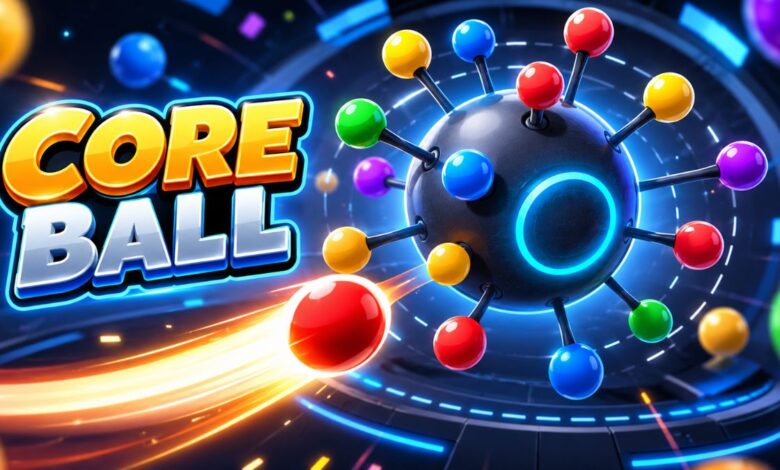
Core Ball, also known as Coreball, is an online arcade game built around a deceptively simple challenge: launch small balls toward a rotating central sphere without allowing them to collide. Originally published by ARealMe in 2015, the game developed from a straightforward browser activity into a larger test of timing, precision, and patience. Its appeal lies in its simple controls and lack of elaborate graphics. Players need only time their moves, yet even a minor mistake can end an otherwise successful attempt. Over time, additional levels and competitive features have expanded the experience without fundamentally changing its original concept.
This article explores Core Ball’s origins, gameplay mechanics, development history, challenges, and practical strategies while separating documented information from unsupported claims.
What Is Core Ball?
Core Ball is a single-player timing game where players must attach a set number of small balls to a rotating circular target. Each successful attachment adds space around the central sphere, making each subsequent shot harder.
A level ends successfully when every required ball has been attached without a collision. In the traditional version, a failed shot forces the player to restart the level.
Unlike complex action games, Core Ball doesn’t require players to learn keyboard combinations, manage fictional characters, or navigate detailed environments. Its central interaction is deliberately limited. Players observe the rotating target, identify an opening, and choose when to shoot.
That simplicity is also the source of its difficulty. An opening that appears safe when the player clicks may have moved by the time the next ball reaches the target. Success therefore depends not merely on recognizing space but on anticipating where that space will be when the shot arrives.
The distinction turns an elementary clicking exercise into a problem of visual prediction and controlled timing.
The Origins and Early Development of Core Ball
The original browser version of Coreball appeared on ARealMe in 2015. According to the publisher’s historical account, the game began with 60 levels and received another 30 within weeks of its initial release.
It appeared during a period when lightweight browser games offered an alternative to increasingly elaborate downloadable titles. Coreball’s design fit this environment: players could start almost immediately, and each attempt required little preparation.
ARealMe, the platform associated with the original browser release, was founded in 2012 and became known for online quizzes, interactive tests, and casual games. The company identifies John Kevin as its founder and chief editor. However, Coreball’s publicly available history does not clearly identify the individual programmer responsible for creating the game.
The identity of Coreball’s original individual developer has not been independently verified. The documented publisher is ARealMe, and that distinction matters when discussing the game’s history.
The game’s broader design also fits into a recognizable tradition of minimalist pin-placement and rotating-target games, including titles commonly compared with AA. The resemblance lies in the shared interaction of placing objects around a moving circular center. However, this should not be taken as proof that every game using this mechanic comes from the same developer.
How Core Ball Developed Over Time
Core Ball’s history is unusually visible because ARealMe maintains a public update record. Although some published descriptions list outdated level totals, the game’s main page provides a useful chronology of major changes.
- 2015: Coreball launched with 60 levels, according to ARealMe, before expanding to 90.
- 2022: The published update record announced 91 levels, introduced level-reaching statistics, and subsequently recorded an expansion to 100 levels.
- 2023: Personal-best tracking became part of the game’s documented development.
- 2024: The publisher announced 110 levels and introduced a daily rewards feature involving power-ups.
- 2025: ARealMe’s main game page recorded an expansion to 500 levels.
- 2026: Official mobile versions brought additional levels, leaderboards, account linking, and competitive features.
These developments reflect a shift in the game’s structure. Initially, Coreball relied primarily on finishing increasingly difficult stages. Later additions gave players further reasons to return, including performance comparisons, rewards, and new challenges.
The level count also requires careful interpretation. Different websites list different stage counts. Some pages maintained by the original publisher even display older figures.
ARealMe’s browser-game page lists 500 levels, while its official mobile app advertises 165 handcrafted levels. These figures describe separate editions and don’t necessarily contradict one another.
Why Core Ball Is More Difficult Than It Looks
Core Ball provides little visual distraction. Its central object rotates, previously placed balls remain visible, and the player must choose an appropriate moment to launch the next one.
The difficulty comes from several interacting variables. First, the number of available spaces decreases with every successful shot. A large opening may be easy to spot early in a level, but a nearly complete circle leaves far less room for error.
Second, the target’s movement changes the relationship between observation and action. Players must account for the time between initiating a shot and the ball reaching its destination.
Third, different levels can alter the rotation speed and direction. A strategy that works when the target moves slowly in one direction may become ineffective after a reversal.
Finally, the player must manage repetition. A failed attempt can immediately tempt you to repeat the same shot without considering why it failed.
The most useful adjustment is often observational rather than mechanical: watching the target complete a rotation before making the next move.
Timing Versus Reaction Speed
Although Coreball is often described as a reflex game, reaction speed alone doesn’t fully explain success.
A player with fast reactions may still fail by shooting directly at a gap that is already moving away from the launch position. A more deliberate player may succeed by predicting when the opening will align with the incoming ball.
This creates a distinction between reacting to an opportunity and anticipating one.
In many levels, the optimal action is not the fastest possible click. It is the click made at the correct point in the target’s rotation.
The game’s restricted controls make that difference particularly visible. Players cannot compensate for poor timing by moving their character, selecting a different weapon, or changing the environment. They must improve their decision-making.
The Psychology Behind Core Ball’s Repeated Challenges
Coreball illustrates a familiar arcade design principle: players are more likely to understand failure when the rules are transparent.
If two balls collide, the reason for losing is usually immediately apparent. The player can see the obstruction and recognize that the attempted placement was unsuccessful.
That clarity supports experimentation. An unsuccessful attempt may lead the player to wait longer, shoot earlier, or change the sequence in which openings are used. Each retry provides another opportunity to test an adjustment.
The difficulty can also feel personally meaningful because progress is achieved through small, measurable improvements. Completing a level that previously seemed impossible creates a clear comparison between earlier and current performance.
This interpretation has an important limitation. The game’s design aligns with established concepts such as feedback, repetition, and skill acquisition, but that does not prove specific psychological benefits for every player.
Claims that Coreball improves intelligence, prevents cognitive decline, or produces measurable long-term concentration gains would require controlled research. The publicly available material does not establish those outcomes.
Its demonstrated purpose remains entertainment through a precision-based challenge.
From Browser Game to Mobile Competition
Expanding Core Ball into dedicated mobile applications represents a significant shift in its development.
The official iOS application, published by AREALME LIMITED, retains the familiar rotating-core mechanic but adds systems beyond the original browser experience.
Its App Store listing has described 165 handcrafted levels, personal-best timing records, unlockable visual designs, and verified leaderboards.
The application also introduces competitive elements, including weekly tournament challenges. These provide additional objectives for players already familiar with the traditional level structure.
The distinction between the browser and mobile editions matters. The web version offers a direct entry point into the classic challenge, while the mobile application incorporates more extensive progression and competitive features.
The publisher also explains that some account-linked rewards can be shared between versions, although other progress remains separate.
The App Store lists the mobile game as free to download, with ads and optional in-app purchases. It would therefore be inaccurate to describe every version of Coreball as entirely free of monetization.
By October 2026, the game’s identity had expanded beyond its initial format, but its primary action remained recognizable.
Why Different Core Ball Websites Show Different Levels
Searching for Core Ball can produce confusing results.
Some websites describe 91 levels. Others report 100, 125, 500, or considerably more. Different publishers may also offer games under similar names.
These figures don’t necessarily show a single game constantly changing its total number of stages. In many cases, they refer to different versions, independently operated websites, or descriptions that have not been updated.
Three distinctions are especially important.
The original publisher: ARealMe documents a browser release dating to 2015 and maintains a public update history.
Third-party editions: Other gaming websites host related versions, but their game mechanics, progression systems, and development histories may not be identical.
The official mobile application: ARealMe’s mobile product has its own level structure, release history, and additional features.
A reliable account should therefore identify which version is being discussed before presenting an exact level total.
Similarly, claims about a universally recognized world champion, an official overall completion rate, or the game’s total lifetime player population should not be accepted without sufficient evidence.
ARealMe publishes selected player statistics and performance information, but some of its historical figures are based on player comments and estimates. They should not be presented as independently audited measures of global participation.
What Makes Core Ball Different From Other Arcade Games?
Coreball’s longevity is particularly interesting because its core mechanic needs little explanation.
The visual environment communicates almost everything a new player needs to understand. A rotating circle establishes the target. Attached balls show the occupied positions. Another ball waiting to be launched indicates the next action.
In design terms, the interface makes the objective clear without a lengthy tutorial.
The game’s difficulty then emerges from modifying a limited number of variables rather than constantly introducing unrelated mechanics.
This approach has practical advantages. Each new level can produce a different challenge by changing the arrangement of existing obstacles, the rotation pattern, or the number of required shots.
It also creates a design constraint: additional difficulty must remain understandable. If a level becomes unpredictable or visually confusing, failure may begin to feel arbitrary rather than connected to player skill.
The strongest aspect of Coreball’s original concept is the direct relationship between a player’s decision and the resulting outcome.
Its later progression systems, leaderboards, and power-ups demonstrate how a simple foundational game can be expanded without completely replacing the activity that defines it.
That continuity is arguably more significant than the raw number of levels.
Best Strategies to Win Difficult Core Ball Levels
Players encountering more challenging stages can benefit from several practical habits.
Observe before shooting: Watch the central target rotate to identify its direction and speed.
Track open spaces: Pay attention to where an opening will be when the launched ball reaches the rotating target.
Avoid unnecessary rushing: When the level has no strict time limit, waiting can improve decision quality.
Adapt after a collision: Change the timing rather than automatically repeating an unsuccessful shot.
Recognize direction changes: A reversal requires players to reconsider the pattern they were following.
Use power-ups selectively: In versions that offer them, slowing the core or protecting against a collision can help with demanding stages.
These suggestions do not guarantee success, because level arrangements vary. They address the observable mechanics rather than promising a shortcut through every challenge.
Conclusion
Core Ball began as a minimalist browser game and developed into a larger arcade property through continuing updates and mobile expansion. Its documented history stretches from ARealMe’s 2015 release to competitive features introduced in 2026.
What distinguishes the game is not elaborate storytelling or visual spectacle, but the precision of its central challenge. Players grasp the objective almost immediately, yet increasingly demanding levels require observation, anticipation, and patience.
The most revealing part of Coreball’s history is the continuity between its earliest version and its newer editions. Additional levels, performance records, and competitive systems have broadened the experience, while the essential interaction remains largely unchanged.
For a game built around a rotating circle and a single well-timed action, that sustained design identity is its most meaningful achievement.
Slug: core-ball
Tags: Core Ball, Coreball Game, Online Arcade Games, Core Ball Levels, Timing Games
(FAQs)
1. What is Core Ball?
Core Ball is an online arcade game in which players launch small balls toward a rotating central sphere. The objective is to attach all required balls without allowing them to collide with those already placed.
2. Who created Core Ball?
The original browser version of Core Ball was published by ARealMe in 2015. The individual programmer responsible for its initial development has not been independently verified through the available official records.
3. How many levels are in Core Ball?
The number of levels depends on the version. ARealMe’s browser game advertises 500 levels, while its official mobile application lists 165 handcrafted levels. Other independently hosted versions may have different totals.
4. Is Core Ball free to play?
The original browser game is free to play. The official mobile app is also free to download, though its listing indicates it includes advertising and optional in-app purchases.
5. What is the best strategy to win Core Ball?
The best strategy is to watch the rotating target before shooting, anticipate where an opening will move, and avoid rushing consecutive shots. Adjusting your timing after each failed attempt can improve your chances of completing difficult levels.