Daily Tens Review: How the Popular Daily Trivia Game Works, Its Features, and Whether It Is Worth Playing

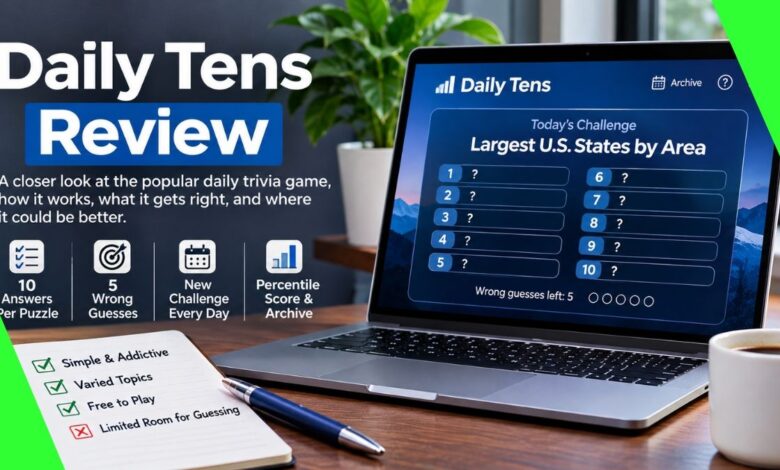
Daily Tens is a free, browser-based trivia game that challenges players to identify ten answers belonging to a ranked list. Each day introduces a new question, and players must complete the list before making five incorrect guesses. The concept is straightforward, but success depends on more than knowing a few facts. Players must understand how rankings are measured, recall relevant information, and decide which answers are worth risking.
Unlike a celebrity or online personality, Daily Tens is a gaming platform, not an individual with a personal biography. The original game operates at dailytens.com, with Daily Tens LLC identified in its privacy documentation.
This Daily Tens Review examines the game’s verified rules, accessibility, ranking system, strengths, weaknesses, and privacy considerations. It also explains how to distinguish the original platform from similarly named websites.
What Is Daily Tens?
Daily Tens is an online general-knowledge game built around a single daily challenge. Instead of answering a sequence of unrelated multiple-choice questions, players attempt to complete one list containing ten ranked entries.
A puzzle might ask for the largest American states, leading box-office performers, or other subjects with measurable rankings. The objective is not simply to name things associated with the category. Every successful answer must belong to the specific top-ten ranking established for that challenge.
The game combines factual recall with strategic decision-making. A player who knows several likely answers can fill the corresponding positions immediately. However, the remaining spaces often require closer attention to the ranking criteria.
Its defining characteristics include:
- Ten correct answers in every daily puzzle.
- Five incorrect guesses allowed before the round ends.
- A new ranked-list challenge each day.
- A percentile-based result comparing players’ performances.
- An archive containing previously published puzzles.
- Free access through a desktop or mobile browser.
- Optional Google sign-in for synchronizing progress and streaks.
The official game doesn’t require an account for casual play, making it accessible to occasional visitors who want a quick trivia challenge.
How Daily Tens Works
The core gameplay is based on a ranked list of ten hidden entries. Players see the topic and attempt to identify the answers using their existing knowledge.
For instance, consider a hypothetical challenge involving the ten largest countries by total area. A player might confidently enter Russia, Canada, or China. If an answer belongs to the specified ranking, the game places it in its appropriate numbered position.
This distinction matters: answers do not have to be submitted in ranking order.
Someone could correctly identify the tenth-ranked entry before discovering the first-ranked one. The game automatically places each accepted answer where it belongs.
Incorrect guesses carry a penalty. After five wrong submissions, the round ends, even if several positions remain unfilled.
The result rewards both knowledge and restraint. Random guessing can quickly exhaust your attempts, while careful consideration can improve your chances of completing the board.
Why the Ranking Criteria Matter
One of the most important features is the information icon explaining how a list is ranked.
A question about the largest cities could have substantially different answers depending on whether it measures city-proper population, metropolitan population, or urban-area population.
Similarly, a ranking of successful films might consider worldwide box-office revenue, domestic earnings, or another financial measure.
Daily Tens encourages players to examine the relevant measurement before guessing.
This makes the challenge more interesting than an ordinary memory exercise. Players must understand the question’s definition, not merely recognize the general subject.
The Five-Wrong-Guess Rule: The Game’s Defining Feature
The most consequential gameplay decision is the limit on incorrect answers.
Daily Tens does not restrict players to only five total guesses. Instead, it allows correct guesses to continue while penalizing mistakes.
A knowledgeable player could identify all ten entries without losing a life. Another player might discover only a few answers before reaching the fifth incorrect guess.
This system creates a clear trade-off between confidence and experimentation.
The early stages can feel relatively approachable because obvious answers are usually easier to remember. The difficulty rises when the board contains only unfamiliar or borderline entries.
Suppose a player has found seven answers and has two incorrect guesses remaining before losing. Three positions remain empty. At that point, entering an uncertain answer becomes a meaningful decision rather than a harmless attempt.
The challenge is therefore not just recalling facts. It is deciding when the available evidence justifies a guess.
That small element of risk gives Daily Tens much of its identity.
Daily Tens Scoring and Player Percentiles
After a round, Daily Tens provides a percentile result based on other people who played that day’s challenge.
A percentile is a comparative measure, not simply the percentage of answers a player identified.
For example, finding seven out of ten answers means completing 70% of the list. It does not automatically mean the player belongs to the 70th percentile.
The latter depends on the distribution of results among participants.
This distinction is important because puzzle difficulty changes from day to day. Completing six answers on a particularly difficult subject could represent a stronger comparative performance than completing eight answers on an easier question.
Daily Tens also lets players share their results, adding a social element without requiring direct multiplayer competition.
However, percentile rankings should not be confused with standardized measures of intelligence or knowledge. They reflect performance within a particular group of participants on a particular puzzle.
What Makes Daily Tens Different From Other Trivia Games?
Daily Tens belongs to the broader family of daily browser games that encourage users to return for a new challenge.
Its structure resembles the daily-release model popularized by Wordle, but the underlying mental task is different.
Wordle focuses on identifying a hidden word through letter-based feedback. Daily Tens asks players to retrieve factual information and associate it with an established ranking.
That changes the type of knowledge involved.
Someone with strong vocabulary and language-pattern skills might do well at Wordle but struggle with a Daily Tens question involving sports statistics. A dedicated sports fan might see the opposite.
Daily Tens is also distinct from conventional multiple-choice trivia. Players generally need to produce answers rather than select from four visibly presented alternatives.
This increases the emphasis on active recall, the process of retrieving information without being shown the answer directly.
The ranking structure adds another layer. Players can use already revealed positions to think about what might fit between them, although the usefulness of that information varies considerably by topic.
Daily Tens Archive and Replay Options
A common weakness of daily puzzle games is that completing the current challenge leaves little else to do.
Daily Tens partly addresses that limitation through an archive of previous lists.
The original game’s official documentation confirms that earlier puzzles can be accessed through its archive. Independent game directories also report that archived play is subject to daily limits.
This lets players revisit earlier topics without turning the main experience into an unrestricted stream of puzzles.
Importantly, an archive is not the same as an unlimited mode.
As of November 2026, the original dailytens.com is described by independent game directories as offering archived challenges but not a separate unlimited-play mode.
Some other websites using the Daily Tens name advertise unlimited games, additional hint systems, or alternative difficulty settings. Those features should not automatically be attributed to the original platform.
For readers seeking accurate gameplay information, identifying the correct website matters.
Is Daily Tens Free, and Does It Require an Account?
Daily Tens is free to play through its official website.
The basic daily challenge doesn’t require a purchase, an app download, or account registration. Players can access it through a compatible browser on a computer or mobile device.
This removes several common barriers associated with casual online games.
An occasional visitor can attempt a puzzle without committing to a subscription or creating another password.
Players who want to retain their progress across devices have an additional option. According to the official website, Google sign-in can synchronize scores, progress, and streaks.
That feature is optional, not required for participation.
Free access, however, should not be interpreted as an assurance that a website collects no user information.
The platform’s privacy policy provides a more detailed explanation of how gameplay information is handled.
Daily Tens Privacy: What Players Should Know
Daily Tens LLC identifies itself as the organization responsible for its privacy policy, which was updated on October 26, 2026.
The document explains that anonymous players receive a random browser-associated player identifier. Gameplay results, including scores, identified answers, completion time, and certain sharing activity, may be stored against that identifier.
When players choose Google sign-in, the platform receives an associated email address and unique account identifier to support account functionality. Its policy states that it does not receive the user’s Google password.
The website also says it automatically collects technical and usage information, potentially including device characteristics, IP addresses, and browsing activity.
Its privacy notice discusses analytics, advertising-related technologies, and certain third-party service providers.
These disclosures do not establish that the game is unsafe. They do show why the absence of mandatory registration should not be interpreted as complete anonymity.
The policy additionally describes account-deletion options and explains that removing an account’s identity does not necessarily erase all previously recorded, anonymized game results.
Privacy-conscious players should review the current notice and available choices before signing in.
Strengths of Daily Tens
Daily Tens has several advantages that make its design appealing.
The first is simplicity. The rules are easy to understand without extensive instructions, and the objective stays consistent from one challenge to the next.
Its second strength is variety. Ranked lists can cover significantly different areas of general knowledge, reducing reliance on a single specialist subject.
The third is the combination of recall and strategy. Players must balance what they know against the consequences of uncertain guesses.
Other strengths include:
- Low entry barrier: No payment or registration is required for basic gameplay.
- Brief format: One daily challenge suits casual play.
- Clear objective: Finding all ten entries provides an unambiguous goal.
- Comparative results: Percentiles offer context beyond a raw score.
- Historical access: The archive gives players additional opportunities to explore older topics.
- Ranking explanations: Information about the underlying measurement helps clarify why answers belong on a list.
The ranking explanations are particularly valuable. A well-defined trivia question can teach players something about measurement and classification, rather than simply testing isolated facts.
Where Daily Tens Falls Short
The same rules that make Daily Tens engaging can also create frustration.
Its five-mistake limit leaves little room for experimentation when a player encounters an unfamiliar topic. A difficult question about specialist statistics might end a session quickly, regardless of that player’s wider general knowledge.
Ranking questions can also expose ambiguities.
Terms such as largest, most successful, and most popular depend heavily on the dataset and measurement method. Even an apparently simple list can produce disagreement when figures come from different years or institutions.
Another limitation is answer recognition. The game uses an answer-entry system, and players may need to select recognized names or spellings. Someone who understands the correct answer but enters an unsupported variation could encounter difficulty.
Finally, players seeking unlimited practice may find the original game’s controlled daily format restrictive.
These drawbacks do not undermine the basic concept. They reflect the compromises required to turn a broad general-knowledge quiz into a concise competitive challenge.
How to Improve Your Results in Daily Tens
A good strategy begins before the first answer is submitted.
Read the full category and identify its ranking measure. Do not assume that a familiar subject uses the most familiar definition.
Next, enter answers supported by strong knowledge rather than beginning with speculative possibilities. Early correct entries help establish the list’s pattern without using up your limited mistake allowance.
When the remaining entries become difficult, consider the ranking systematically.
A geography question might benefit from thinking region by region. A historical list may become easier when considered chronologically. A sports ranking might require distinguishing career totals from results within a particular season.
Pay attention to the positions already revealed. They may help narrow the possibilities, especially when the ranking follows a recognizable numerical or chronological sequence.
Most importantly, distinguish between an answer that seems plausible and one that is likely to fall within the exact top ten.
Daily Tens rewards confident knowledge more consistently than random experimentation.
Daily Tens vs Other Daily Puzzle Games
The popularity of daily web puzzles reflects several familiar features: a predictable release schedule, a manageable task, and a result you can compare or share.
Daily Tens uses those conventions while placing ranked factual knowledge at the center of the experience.
Other games approach rankings differently. Rank It, for example, asks players to arrange supplied items in the correct order, while GuessTen involves identifying entries in a top-ten list under a different guessing allowance.
In Daily Tens, players have to discover the entries themselves while managing a fixed number of mistakes.
This makes it particularly suitable for people who enjoy general-knowledge quizzes, sports records, cultural rankings, and geographical facts.
It may appeal less to players who prefer visual puzzles, narrative games, or tasks based primarily on deduction rather than remembered information.
Who Operates Daily Tens?
The official privacy documentation identifies Daily Tens LLC as the organization behind the service.
However, the publicly available official pages reviewed for this article do not establish a verified personal biography of an individual founder or developer.
Specific claims about an owner’s age, education, relationships, personal income, or net worth would therefore be inappropriate without stronger evidence.
Verified financial data has not been publicly disclosed.
The relevant facts for evaluating Daily Tens concern its actual service, operating rules, published policies, and accessibility—not an invented personal history.
This distinction is especially important when similarly named websites or third-party profiles describe the platform inconsistently.
Conclusion: Is Daily Tens Worth Playing?
Daily Tens offers a focused alternative to conventional online trivia. Its central idea—finding ten ranked answers before making five mistakes—is easy to understand, yet it creates decisions that grow harder as the puzzle progresses.
The strongest feature is the relationship between factual recall and risk. Knowing the subject helps, but understanding the precise ranking and choosing when to guess can be equally important.
Its limitations are also clear. Some questions may be inaccessible to players unfamiliar with the topic, strict answer recognition can cause frustration, and the original game’s daily-play structure may not satisfy those wanting unlimited challenges.
For people who enjoy general knowledge, ranked lists, and short browser-based puzzles, Daily Tens is worth trying. Its free access makes that decision uncomplicated.
Its broader appeal isn’t that the game measures intelligence or delivers a guaranteed educational benefit. It offers a structured way to test what you know, spot gaps in your understanding, and return the next day for a different challenge.
(FAQs)
Is Daily Tens a legitimate online game?
Daily Tens operates as an accessible browser-based trivia game with published rules and privacy documentation. You can play the basic gameplay without purchasing software or creating an account. That does not constitute an independent security audit.
How many wrong guesses are allowed in Daily Tens?
Players may make five incorrect guesses. The game ends when the fifth mistake is recorded or when all ten answers have been identified.
Can I play Daily Tens on my phone?
Yes. The official website supports browser-based access on mobile devices, meaning a separate mobile application is not required for the main daily puzzle.
Does Daily Tens provide a new puzzle every day?
Yes. The platform publishes one new top-ten trivia challenge each day. Previous challenges are also accessible through its archive.
Does Daily Tens have an unlimited mode?
The original dailytens.com is not documented as offering a separate unlimited mode as of November 2026. Another independently operated website using a similar name advertises unlimited play, but its features should not be confused with those of the original game.