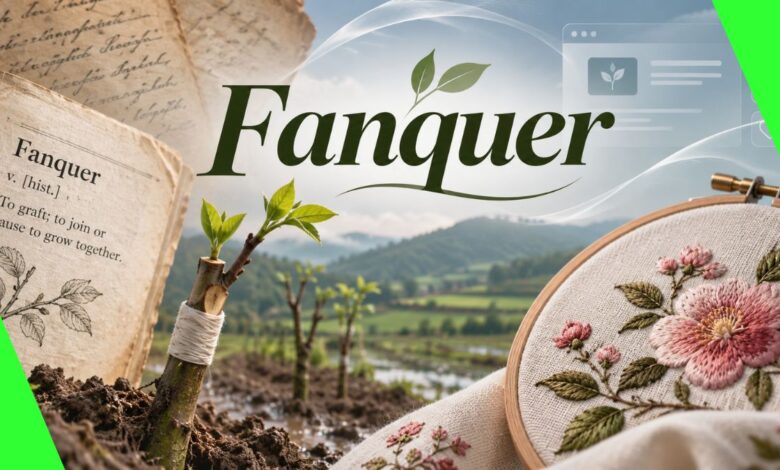
Fanquer is not an independently verified celebrity or public figure. Its clearest documented identity is linguistic: the Diccionari català-valencià-balear records Fanquer as a regional Catalan word associated with mud and traditional agricultural work in Mallorca. The same spelling appears on embroidery products, while recent online articles have assigned it interpretations involving dedicated fans and digital communities.
Those different uses have created an unusual situation. Someone researching Fanquer might expect to discover a personality, an entertainment platform, or a newly invented internet expression. Yet the strongest available evidence points to a much older word.
Understanding Fanquer requires separating documented history from commercial naming and modern speculation.
The Documented Origins of Fanquer
The most authoritative evidence for Fanquer comes from the Diccionari català-valencià-balear (DCVB), a historical dictionary of Catalan vocabulary.
Its entry records two meanings associated with Mallorca.
The first describes a substantial quantity of mud or a particularly muddy place. The second refers to a worker who followed someone grafting plants and applied mud to the grafts.
The dictionary also traces the word to fang, the Catalan noun meaning mud.
This etymology matters because it provides a documented explanation of the word, independent of contemporary internet interpretations.
A Word Connected to Traditional Agricultural Labor
The occupational meaning is particularly revealing.
Plant grafting involves joining plant tissues so they can develop together. Traditional methods may have involved applying protective materials around the graft union. The historical dictionary identifies the fanquer as the person who applies mud during this process.
Rather than describing a prominent individual, the term identified a specific responsibility within agricultural work.
That definition offers a glimpse into how rural vocabulary developed around practical occupations. Particular tasks could acquire their own names, preserving distinctions that modern readers might otherwise overlook.
The DCVB also records a Mallorcan pronunciation, represented phonetically as fəŋké.
These details establish Fanquer as more than a recently invented collection of letters. They do not, however, prove that every modern use of the spelling developed from the Catalan word.
Is Fanquer a Celebrity or Public Figure?
Despite Fanquer’s appearance in online search results, the reliable evidence reviewed does not establish a recognizable celebrity, actor, musician, or public personality using that name.
No authoritative biographical record was identified that would support a conventional celebrity profile.
Important personal details consequently remain unverified:
- Full legal name: Not established for an identifiable public figure.
- Date of birth and age: No reliable biographical information confirmed.
- Nationality and family background: Not independently documented.
- Education and professional career: No verified personal history established.
- Relationships and marital status: No reliable public information available.
- Net worth: No verified financial data has been publicly disclosed for an identifiable celebrity under this name.
These gaps do not prove that no one has ever used Fanquer as a nickname, username, or professional identity. They demonstrate that the available material cannot reliably connect the term with one specific person.
An unfamiliar name should not become a fictional biography simply because it attracts searches.
Without credible interviews, official profiles, or independently verified professional records, assigning someone an age, career history, or family background would be misleading.
How Fanquer Became Associated With Online Fan Culture
A separate explanation has emerged in contemporary online writing.
Some articles describe Fanquer as a label for a particularly knowledgeable or actively involved fan. Under this interpretation, the word refers to someone whose participation extends beyond ordinary appreciation.
Such a person might organize discussions, preserve information, produce creative work, or help other members understand a shared interest.
The behavior itself is familiar across entertainment, gaming, sports, and online communities.
What remains uncertain is whether Fanquer has actually become an established expression for that behavior.
The Proposed Fan and Connoisseur Connection
One suggested explanation combines the English word fan with connoisseur.
A connoisseur possesses developed knowledge or judgment concerning a particular subject. Together, they suggest a dedicated enthusiast with considerable expertise.
Another proposed interpretation connects fan with conquer, emphasizing participation, influence, or achievement within a community.
Neither proposed combination has a verified origin story.
No authoritative linguistic record identifies who first introduced either interpretation or establishes when it entered regular use.
The distinction between an attractive explanation and a documented etymology is essential. A word can sound like a combination of two familiar expressions without actually deriving from them.
In the case of Fanquer, the documented Catalan derivation from fang is stronger historical evidence than either speculative English-language explanation.
The Claims About a Fanquer Digital Platform
Another complication comes from websites describing Fanquer as a digital environment for creators and their audiences.
These descriptions sometimes mention exclusive content, fan participation, rewards, community memberships, and tools for audience engagement.
Such features are plausible because comparable functions already exist across established online services.
Nevertheless, the material reviewed does not independently establish a functioning Fanquer platform with a clearly identified operator, verifiable development history, and officially documented features.
Detailed descriptions on multiple websites are not sufficient confirmation.
For a claimed digital service, stronger evidence would include an identifiable company, official product documentation, independently attributable announcements, and a functioning service that can be inspected.
Until such evidence is available, descriptions of a dedicated Fanquer platform should be treated as unverified claims rather than facts.
Fanquer as an Embroidery Product Name
The commercial use of Fanquer offers a more concrete modern example.
Retail listings identify Fanquer as the brand name associated with beginner embroidery kits.
One listing describes a floral embroidery package containing patterned fabric, colored embroidery threads, needles, instructions, and an adjustable embroidery hoop. Its product identifier is B09YNS3V4T.
This establishes that the spelling has appeared as a commercial product label.
It does not establish a complete company history, identify a verified founder, or demonstrate that the seller intended any connection with traditional Catalan vocabulary.
Commercial product names can develop independently from existing words.
A retailer may use a distinctive spelling for identification and marketing without adopting its historical meaning.
The appropriate conclusion is therefore limited but meaningful: Fanquer has a documented use in craft-product listings, separate from its linguistic history.
Fanquer and Fanquare: Two Names That Should Not Be Confused
A particularly practical source of confusion involves Fanquare, a similar-looking name associated with porcelain tableware.
The distinction is only one letter, but the products are different.
Fanquare appears on decorative tea sets, porcelain cups, saucers, teapots, and related household items. The brand also maintains a website presenting its tableware collections.
Someone who remembers seeing a floral product could easily confuse an embroidery kit with decorative porcelain, especially when searching from memory rather than checking the original packaging.
The similarity does not establish that Fanquer and Fanquare belong to the same company.
No reliable evidence reviewed demonstrates common ownership or a shared corporate history.
For buyers, checking the spelling, product category, and model identifier is more useful than relying on a broad search result.
What the Different Uses of Fanquer Reveal
The most interesting aspect of Fanquer is not that it has several possible meanings. It is that those meanings come from different kinds of evidence.
A historical dictionary documents regional vocabulary and etymology.
A retailer’s listing establishes how a product is labeled.
An online article can show how a writer interprets or promotes an expression, but cannot automatically establish widespread linguistic acceptance.
These sources answer fundamentally different questions.
The DCVB entry supports the existence of the Catalan word. The embroidery listings demonstrate commercial use. Articles about internet fandom show a proposed contemporary interpretation.
None of those facts automatically establishes a celebrity, a social networking business, or a universally accepted English slang term.
This separation is especially important when unfamiliar search terms begin appearing across multiple websites.
Repeated explanations may create an impression of consensus even when they ultimately depend on the same unsupported assumption.
Independent evidence matters more than repetition.
How to Identify the Correct Meaning
The most reliable interpretation depends on where the word appears.
A reader encountering Fanquer in a traditional Mallorcan text should first consider its documented regional meaning.
Someone seeing it on craft packaging should investigate the associated product and manufacturer details.
When the word appears in an online discussion about enthusiastic fans, it may reflect a creative or informal usage, but that interpretation should not be assumed to be standardized.
Claims involving an application, membership service, or creator platform require additional verification.
These distinctions prevent a single spelling from being mistaken for one unified identity.
Conclusion
Fanquer has a genuine, documented linguistic history, but its modern appearances cannot all be traced to a single origin.
The strongest historical evidence identifies it as a Mallorcan Catalan word connected with mud and agricultural grafting. Commercial listings also use the name for embroidery products, while online writers have proposed interpretations involving fan enthusiasm and digital participation.
No reliable evidence reviewed identifies Fanquer as a specific celebrity or confirms a dedicated digital platform under that name.
The more compelling story is therefore linguistic and cultural rather than biographical.
Fanquer illustrates how a regional word can coexist with modern commercial labels and speculative digital meanings without those uses necessarily sharing a history.
(FAQs)
What is the real meaning of Fanquer?
The Diccionari català-valencià-balear records Fanquer as a Mallorcan Catalan word describing a substantial quantity of mud or a worker who applied mud during traditional plant grafting.
Is Fanquer a famous person?
No identifiable celebrity or public figure named Fanquer could be independently established from the reliable sources reviewed. A verified personal biography is not available.
Where does the word Fanquer come from?
Its documented Catalan origin is the word fang, meaning mud. Suggested combinations involving English words such as fan, connoisseur, and conquer have not been established as its historical origin.
Is Fanquer an online platform?
Some online articles describe a digital fan-engagement concept under this name. However, independently verified ownership, operations, and official platform features have not been established.
Is Fanquer the same as Fanquare?
No confirmed connection has been established. Fanquer appears on embroidery product listings, while Fanquare is associated with porcelain tea sets and tableware.
Why does Fanquer appear with different meanings online?
The same spelling occurs in different contexts, including historical language, commercial product naming, and contemporary internet commentary. Each use needs to be assessed independently rather than treated as evidence of one shared meaning.