
APGFCU: The Complete Story Behind Aberdeen Proving Ground Federal Credit Union

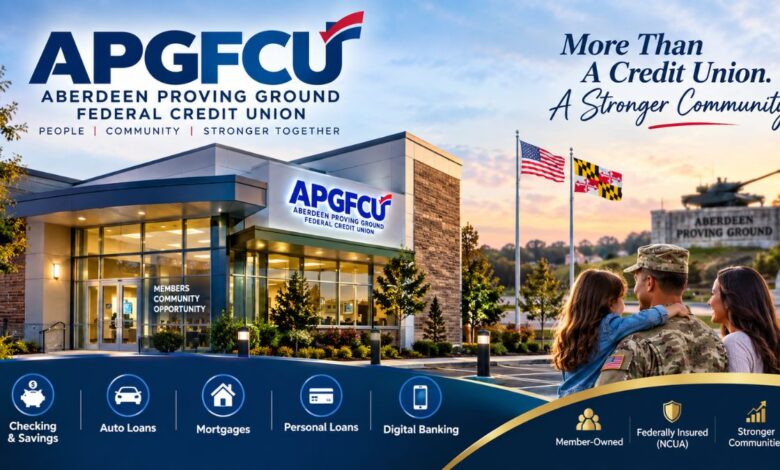
APGFCU, officially known as Aberdeen Proving Ground Federal Credit Union, is a member-owned financial institution headquartered in Harford County, Maryland. Founded in 1938, it grew from a small cooperative serving employees associated with Aberdeen Proving Ground into a regional credit union that provides banking and lending services to thousands of members.
Unlike traditional shareholder-owned banks, APGFCU operates through a cooperative ownership model. Its members collectively own the institution, and its financial services are designed around their needs.
Today, APGFCU provides checking accounts, savings products, personal loans, vehicle financing, mortgages, and digital banking facilities.
The institution’s development reflects the wider history of American credit unions, which began as community-focused financial cooperatives and gradually expanded into sophisticated banking organizations.
The History and Foundation of APGFCU
APGFCU was founded on January 13, 1938, when nine employees associated with Aberdeen Proving Ground established a financial cooperative.
Each founding member subscribed to a $5 share, for a total of $45 in subscribed member shares.
The purpose was straightforward: provide accessible savings and borrowing opportunities through an institution collectively owned by its members.
Aberdeen Proving Ground, a major United States Army installation in Maryland, played an important role in shaping the credit union’s identity.
Military installations often support substantial civilian workforces alongside military personnel. Financial services tailored to these communities can help families manage savings, household expenses, and borrowing requirements.
During its early decades, APGFCU operated on a comparatively small scale.
Volunteers managed its operations until 1960, when Nancy Stubbs became its first full-time employee. She later served as chief executive and remained an influential figure in the institution’s development until retiring in 1994.
By that time, APGFCU had expanded to four branches.
This progression shows how a workplace-based cooperative grew into a more substantial regional financial institution.
How APGFCU Became a Community Credit Union
An important milestone occurred in 2003 when APGFCU became a community-chartered credit union.
Before this transition, membership was more closely connected to particular employment and organizational relationships.
The community charter expanded eligibility to qualifying individuals with connections to designated geographic areas.
This change allowed the institution to serve a broader population while maintaining its cooperative ownership model.
Its later expansion into Baltimore County and Baltimore City further increased the communities eligible to access its services.
Although APGFCU retains the name of its original military-associated community, its modern membership is not limited to military personnel.
Understanding APGFCU’s Member-Owned Structure
What Makes a Credit Union Different?
APGFCU operates as a not-for-profit financial cooperative.
Unlike a conventional commercial bank owned by private investors or shareholders, a credit union is owned collectively by its eligible members.
This distinction influences how the institution is governed and how its financial resources are managed.
Rather than distributing profits to outside shareholders, a credit union can use its earnings to strengthen reserves, improve services, invest in technology, and support competitive financial products.
However, cooperative ownership does not automatically guarantee that every loan or savings product offers better rates than competing banks.
Actual rates and fees depend on market conditions, account requirements, institutional policies, and the financial circumstances of individual members.
Governance and Accountability
Federal credit unions generally operate under boards elected by members.
These boards oversee strategic planning, institutional policies, and organizational accountability.
Professional managers and employees handle daily operations.
This governance structure lets members participate in the institution’s direction, although individual members do not control lending decisions or routine financial operations.
The structure’s effectiveness depends on responsible leadership, regulatory compliance, and transparent reporting.
APGFCU Financial Growth and Performance
APGFCU’s published financial information provides insight into its development.
According to its 2025 annual report, the institution recorded approximately $2.6 billion in total assets and served 182,247 members at the end of the reporting year.
Its loan portfolio totaled about $2.2 billion, and reported net income was about $25.5 million.
The annual report also reported about 10.6% asset growth, 12% loan growth, and 8.4% membership growth.
These figures demonstrate expansion in both financial activity and member participation.
Nevertheless, institutional size is only one measure of financial performance.
Long-term financial stability also depends on capital adequacy, asset quality, liquidity, lending standards, and risk management.
Consumers should therefore avoid interpreting growth statistics alone as proof that any particular financial product is superior.
APGFCU’s Expansion Through Members First of Maryland
In August 2025, APGFCU expanded through an NCUA-facilitated transaction involving Members First of Maryland Federal Credit Union.
The transaction included assuming liabilities and acquiring assets associated with Members First.
Approximately 2,400 members joined APGFCU through the arrangement.
The expansion also added branches in Dundalk and Perry Hall, strengthening the institution’s presence in Baltimore County.
This development represented more than a simple increase in branch locations.
Integrating another credit union’s members requires coordination across account management, digital banking systems, customer support, loan servicing, and regulatory requirements.
For members, continuity and reliable access to financial services are essential throughout such transitions.
Who Can Become an APGFCU Member?
Although APGFCU originated within a military-associated community, its membership eligibility has expanded considerably.
Qualifying individuals may include people who live, work, attend school, worship, or volunteer in designated Maryland communities.
These include Harford County, Cecil County, Baltimore County, and Baltimore City.
Certain immediate family and household relationships may also provide eligibility.
According to its published membership information, establishing a Share Savings account with a $5 deposit is part of becoming a member.
Applicants should review the institution’s current eligibility requirements before applying.
Banking and Financial Services Offered by APGFCU
Checking Accounts
APGFCU provides checking products intended to support everyday financial activities.
Members can use these accounts to receive income, pay bills, make purchases, and manage household transactions.
Before opening an account, prospective members should compare fees, balance requirements, overdraft policies, and digital banking features.
Savings Accounts
Savings products are designed to help members manage money for future needs.
These needs may include emergency savings, planned purchases, or longer-term financial objectives.
When evaluating a savings account, the annual percentage yield is important, but it should not be considered in isolation.
Minimum balances, withdrawal limits, account restrictions, and potential fees may affect a product’s overall value.
Personal and Vehicle Loans
Consumer lending is an important part of APGFCU’s services.
Eligible members may apply for personal financing or vehicle loans, subject to approval and applicable lending standards.
Borrowers should compare the annual percentage rate, repayment period, fees, and total cost of borrowing.
A lower monthly payment does not always mean a less expensive loan.
Longer repayment periods can reduce monthly obligations but increase total interest paid.
Mortgages and Home Equity Financing
APGFCU also provides home financing products.
Mortgage applicants should examine available interest rates, closing costs, repayment terms, and eligibility requirements.
Home equity financing requires additional consideration because the property may secure the loan.
Consumers should carefully evaluate repayment obligations before committing to any secured loan.
Digital Banking and Technology
Modern financial services increasingly depend on accessible digital platforms.
APGFCU offers online and mobile banking features that let members manage accounts without visiting a physical branch for every transaction.
Available functions include checking account balances, making transfers, paying bills, and depositing checks on mobile.
Its 2025 annual report also described more than 15 digital enhancements, including loan payments, transaction limits, and credit score information.
Digital banking can improve convenience, particularly for people managing work and family responsibilities.
However, security remains essential.
Members should use strong passwords, enable available authentication protections, monitor account activity, and promptly report suspicious transactions.
Is APGFCU a Legitimate and Safe Financial Institution?
APGFCU is an established, federally chartered credit union operating within the U.S. financial regulatory system.
The National Credit Union Administration regulates federally chartered credit unions and administers federal share insurance.
Eligible deposits at federally insured credit unions are generally protected up to $250,000 per depositor, per insured credit union, for each applicable ownership category.
Actual coverage depends on account ownership arrangements and NCUA insurance rules.
Federal deposit insurance does not mean that every financial product is protected against losses.
Investment products and certain other financial arrangements may fall outside federal share insurance coverage.
Members should confirm the insurance status and conditions applicable to the specific accounts they use.
Understanding APGFCU fees
A member-owned institution can still charge fees for financial services.
APGFCU’s published consumer service price list, effective March 2, 2026, identifies charges associated with certain account activities.
These include some stop-payment requests, account maintenance conditions, and other services.
For example, its published schedule includes a $29 charge for certain stop-payment requests.
It also charges a $10 monthly fee when a qualifying money market share account falls below its stated $2,500 minimum.
Fee schedules can change.
Members should therefore consult the latest official disclosures before opening an account or requesting a service.
APGFCU Leadership and Management
APGFCU’s 2025 annual report identified Becky Smith as president and chief executive officer and Donald J. Burnett as chairman of the board.
The leadership’s reported priorities included membership expansion, improved digital services, and community engagement.
Such priorities reflect the operational demands of a regional financial cooperative.
As an institution grows, leadership must balance innovation with financial stability, customer expectations, and regulatory responsibilities.
Effective management becomes particularly important when a credit union expands geographically or integrates members from another institution.
Community Involvement and Financial Education
Community engagement is an established part of the credit union model.
APGFCU has emphasized community participation and financial education as components of its institutional identity.
Its 2025 annual report described a dedicated community impact function and an employee volunteerism program.
Financial education can help consumers understand budgeting, responsible borrowing, credit management, and saving.
These subjects matter most when households face changing interest rates or uncertain economic conditions.
However, the effectiveness of community programs should be evaluated through participation, measurable outcomes, and transparent institutional reporting rather than promotional statements alone.
APGFCU vs Traditional Banks
Although APGFCU provides many services commonly associated with commercial banks, its ownership and governance model are different.
Feature APGFCU Traditional Bank
Ownership Credit Union Members Shareholders or Private Owners
Structure Not-for-Profit Cooperative Commercial Banking Institution
Eligibility Membership Rules Apply Generally Open to Qualifying Customers
Deposit Insurance NCUA Usually FDIC
Governance Member-Elected Board Corporate Governance Structure
Financial Products Savings, Loans, Checking, Mortgages Savings, Loans, Checking, Mortgages
Neither structure guarantees a better financial outcome for every customer.
The appropriate choice depends on account terms, borrowing costs, digital services, geographic accessibility, and individual financial priorities.
Why APGFCU Matters in Maryland
APGFCU shows how a locally established financial cooperative can expand while maintaining a regional identity.
Its historical connection with Aberdeen Proving Ground remains central to its name, but its operations now reach a much broader community.
The expansion from nine original members to more than 182,000 members by the end of 2025 illustrates its transformation.
Its continued relevance depends on more than membership numbers or institutional assets.
Members also need reliable banking systems, responsible lending, fair account terms, accessible support, and transparent management.
Those factors ultimately determine whether a financial cooperative fulfills its stated purpose.
Conclusion
APGFCU has developed from a small employee-based credit union founded in 1938 into a substantial regional financial institution serving communities across Maryland.
Its history is rooted in cooperative ownership, while its present operations include consumer banking, lending, digital financial services, and community participation.
The institution’s published financial results show significant growth, but consumers should still assess individual account terms and borrowing conditions before making financial decisions.
For eligible residents and other qualifying applicants, APGFCU represents an established alternative to conventional commercial banking.
Its long-term success will depend on maintaining financial strength, effective governance, and dependable service as its membership and operations continue to develop.
(FAQs)
1. What is APGFCU, and what does it stand for?
APGFCU stands for Aberdeen Proving Ground Federal Credit Union. It is a federally chartered, member-owned financial cooperative based in Maryland that offers savings accounts, checking services, loans, mortgages, and digital banking.
2. Is APGFCU only available to military personnel?
No. Although APGFCU originated within the Aberdeen Proving Ground community, eligible individuals who live, work, attend school, worship, or volunteer in designated Maryland areas may also qualify for membership.
3. When was APGFCU established?
Nine employees associated with Aberdeen Proving Ground founded APGFCU on January 13, 1938. Each founding member subscribed to a $5 share, bringing in $45 in initial subscribed shares.
4. Is APGFCU federally insured and safe for deposits?
APGFCU is federally insured by the National Credit Union Administration. Eligible deposits generally receive insurance protection up to $250,000 per depositor, per insured credit union, for each applicable ownership category, subject to NCUA rules.
5. How can someone become an APGFCU member?
An individual must meet APGFCU’s eligibility requirements, complete the membership application, and establish a qualifying Share Savings account. The institution’s published requirements identify a $5 share deposit as part of establishing membership.