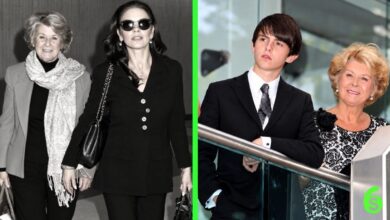
Cicely Johnston: The Untold Story of Demond Wilson’s Wife, Their Marriage and Family Life


Cicely Loise Johnston, also known as Cicely Wilson, is an American former model and actress best known as Demond Wilson, who played Lamont Sanford in the television comedy Sanford and Son. They remained married until Wilson’s death on January 30, 2026, at age 79. The couple raised six children and experienced a striking change in circumstances when Wilson exchanged Hollywood success for Christian ministry. Although Johnston has often been described simply as a celebrity wife, contemporary reporting shows she had her own professional background and that their marriage endured serious difficulties. Much of her personal history, however, remains outside the public record.
Wilson’s death revived interest in the family he had spent decades protecting from the pressures of entertainment fame. For Johnston, it also brought renewed attention to a life that has rarely been documented in her own words.
Quick Bio
| Detail | Information |
|---|---|
| Full name | Cicely Loise Johnston |
| Also known as | Cicely Johnston, Cicely Wilson |
| Nationality | American |
| Known for | Former model, film appearance and marriage to Demond Wilson |
| Previous occupation | Model; also reported to have worked as an airline stewardess |
| Film appearance | Caged Heat (1974) |
| Husband | Demond Wilson (1946–2026) |
| Reported wedding date | May 3, 1974, according to IMDb |
| Children | Six |
| Publicly reported children | Christopher, Nicole, Melissa, Sarah, Demond Jr. and Tabitha/Tabatha |
| Marital status | Widowed in January 2026 |
| Date of birth | Not independently established |
| Personal net worth | Not publicly verified |
Who Is Cicely Johnston?
Johnston became publicly known through her marriage to Wilson, a familiar face of 1970s network comedy. Unlike her husband, whose professional achievements and personal struggles were widely documented, she kept a comparatively low public profile.
Her background in modeling is supported by contemporary reporting. In an October 1986 interview with the Los Angeles Times, journalist Doug Brown identified Johnston as a former model and reported that she was 41 at the time.
That historical detail is especially useful because reliable accounts of her early life are scarce. Publicly accessible, authoritative records do not firmly establish her exact birth date, parents, childhood residence, or educational qualifications. Claims about these subjects should therefore not be treated as verified biography.
Some secondary profiles also describe Johnston as a former airline stewardess. The description has circulated widely, but independent contemporary documentation of that employment is limited. Her modeling background is considerably better supported.
Johnston’s distinction from the conventional Hollywood-spouse narrative lies partly in this uneven historical record. She was connected to the entertainment industry through her own work, but the surviving coverage concentrates overwhelmingly on Wilson.
That imbalance makes it important to separate what can be established from what later writers have assumed.
Her Modeling Career and Appearance in Caged Heat
One of the clearest professional records connected to Johnston is her appearance in the 1974 film Caged Heat.
Directed by Jonathan Demme, the film was an early entry in his career, long before his later mainstream successes. It was a women-in-prison production associated with producer Roger Corman’s low-budget filmmaking world.
The film’s cast records, including those published by Metacritic and IMDb, list Cicely Johnston as Cicely.
This is stronger evidence than the unsourced suggestions sometimes made about her entertainment career. It establishes a specific production, release year, and character credit.
The appearance should nevertheless be understood in proportion. Johnston was not one of the film’s principal performers, and available records do not establish a substantial subsequent acting career.
Documentation is also insufficient to explain why she did not continue working regularly in films. Attributing that decision entirely to marriage, motherhood, or a desire for privacy would turn an assumption into a personal history she has not publicly confirmed.
Her screen credit remains a small but verifiable part of her biography.
Marriage to Demond Wilson and the Question of Their Wedding Date
Johnston and Demond Wilson married when Sanford and Son had established Wilson as a recognizable television performer.
The commonly reported wedding date is May 3, 1974. IMDb records that date, and the New York Times obituary published after Wilson’s death identifies 1974 as the marriage year.
However, historical reporting contains a discrepancy.
The Los Angeles Times profile published on October 13, 1986, described their relationship as a 14-year marriage. Taken literally, that account suggests a wedding around 1972 rather than 1974.
The difference does not undermine the fact that Johnston and Wilson were married for more than five decades. It does mean that the exact chronology is not entirely consistent across published sources.
Without an independently examined marriage certificate or another definitive primary record, May 3, 1974, is best presented as the widely reported wedding date rather than a detail beyond all possible dispute.
Their relationship continued until Wilson’s death in January 2026. Regardless of which early date is accepted, it was an exceptionally long marriage by the standards of a profession in which personal relationships frequently attract public scrutiny.
Yet longevity alone does not describe what happened during those decades.
The Difficult Years Behind Wilson’s Hollywood Success
Demond Wilson‘s career brought considerable financial success, public recognition and access to a privileged lifestyle. His private life, by his own subsequent account, was substantially more troubled.
The most revealing contemporary evidence comes from his 1986 interview with the Los Angeles Times.
During that conversation, Wilson spoke openly about his dissatisfaction with acting, his past substance abuse and the damage his behavior had caused within his marriage.
The report also addressed his extramarital affairs. Wilson acknowledged serious relationship difficulties and told the journalist that Johnston had left him during an earlier period of marital strain.
His account complicates the simplified image of an uninterrupted, harmonious celebrity marriage.
It also demands careful attribution.
The interview documented Wilson’s recollections, not an independently recorded account from Johnston. His statements show how he understood the relationship and his own conduct. They do not establish every detail of Johnston’s experience, thoughts, or decisions.
By 1986, Wilson said that he had repaired the damage to the marriage. The couple lived together with their children, and his public emphasis shifted toward family life and religious work.
That progression is supported by the reporting, but Johnston’s own testimony has not established the precise private circumstances of their reconciliation.
A responsible account recognizes both the acknowledged difficulties and the marriage’s long continuation without romanticizing either.
Why the Family Left Hollywood
By the early 1980s, Wilson had become increasingly dissatisfied with the entertainment business.
He had achieved enormous visibility through Sanford and Son, subsequently starring in Baby… I’m Back! and The New Odd Couple. Despite that professional momentum, he began moving away from acting and toward Christian ministry.
The Los Angeles Times reported that Wilson had given up an affluent lifestyle that included a large Bel-Air residence and expensive automobiles.
Around 1984, according to its 1986 reporting, the family relocated to Mission Viejo, California, in Orange County.
In Wilson’s account, the move had a specific purpose: he wanted his children to grow up away from the social pressures and artificial expectations he associated with Hollywood.
He described a family routine involving outdoor recreation, sports, and ordinary activities rather than the constant pursuit of entertainment-industry status.
Johnston was part of the household during this transition. However, assigning her a particular philosophy or motivation for the relocation would be speculative without a direct statement from her.
What can be established is that their shared domestic circumstances changed substantially as Wilson’s professional identity changed.
The family moved away from the image of television celebrity and toward a lifestyle centered, at least in Wilson’s public descriptions, on parenting and faith.
Demond Wilson’s Religious Transformation
Wilson’s decision to become a minister was a defining development in his later life.
Having grown up with Roman Catholic influences and exposure to Pentecostal worship through his grandmother, he described religion as a longstanding personal concern rather than a completely new interest.
During the 1980s, he became involved in evangelical Christian ministry and was ordained in the Church of God in Christ.
His work later included preaching, religious writing, and outreach to people rebuilding their lives after imprisonment.
The transition placed the family in a different social environment from the one that had surrounded Wilson’s television career.
Although Johnston’s religious views are not well documented in direct interviews, she remained married to Wilson throughout his decades of ministry.
That continuity matters, but it should not be mistaken for evidence that she participated in every aspect of his religious work. Public documentation of her independent involvement remains limited.
Cicely Johnston and Demond Wilson’s Six Children
Johnston and Wilson were the parents of six children, a detail consistently supported by major reporting following Wilson’s death.
The Los Angeles Times obituary published in January 2026 identified them as:
- Christopher Wilson
- Nicole Wilson
- Melissa Wilson
- Sarah Wilson
- Demond Wilson Jr.
- Tabitha Wilson
There is a small variation in published spellings. The New York Times obituary, reproduced under license by GV Wire, uses Tabatha, while the Los Angeles Times uses Tabitha.
Some secondary online profiles instead list a child named Louise and spell Melissa as Mellisa. The family listings in the major 2026 obituaries provide a stronger basis for identification, although the spelling variation should be acknowledged.
A particularly useful historical detail comes from the 1986 interview, when Wilson and Johnston were described as raising five children. By the time of his death, contemporary reports identified six.
The difference is consistent with the family growing after the earlier interview, though the available sources do not establish the children’s individual birth dates.
The 2026 Los Angeles Times obituary also identified two grandchildren, Madison and Isabella.
Most family members have not maintained the same public visibility as their father. Their private lives should not be reconstructed from unsupported claims about occupations, relationships, or current residences.
What Demond Wilson’s Death Changed
On January 30, 2026, Demond Wilson died at age 79 at his home in the Palm Springs area of California.
The death was confirmed publicly by his representatives and family.
The Associated Press reported that Wilson had died following complications from cancer. Subsequent reporting, including the New York Times, identified prostate cancer as an illness he had been experiencing.
His death marked the end of a career that had moved through several distinct phases: military service, Broadway and television performance, comedy stardom, religious ministry and writing.
For many viewers, Wilson remained permanently associated with Lamont Sanford, the frequently exasperated son of Fred Sanford, played by Redd Foxx.
For his family, the event was a personal loss rather than merely the disappearance of a familiar television personality.
Johnston was specifically named as his surviving wife in obituaries published by the Associated Press, the Los Angeles Times, and other established news organizations.
Wilson’s family also requested privacy during the period following his death.
That request matters when considering Johnston’s subsequent life. Her status as a surviving spouse is established; any detailed account of her private grieving process, current domestic arrangements or future intentions would require information she or an authorized representative had chosen to make public.
No such account should be invented to complete a biographical narrative.
How Old Is Cicely Johnston?
Authoritative sources reviewed for this profile have not firmly established Johnston’s precise birth date.
However, a useful historical reference exists. The Los Angeles Times described her as 41 years old in October 1986.
That report suggests a birth year around 1944 or 1945, depending on whether her birthday had occurred by the publication date.
It remains an inference rather than a verified birth record.
Consequently, websites that give an exact birthday or age without citing authoritative documentation should be treated cautiously.
The 1986 newspaper reference is more informative than a modern age estimate presented without an identifiable source.
Cicely Johnston’s Net Worth and Financial Background
Johnston’s personal finances are not documented well enough to support a reliable net-worth figure.
No verified financial data has been publicly disclosed.
Wilson’s substantial earnings during his television career do not establish Johnston’s independent assets, lifetime income, or financial position after his death.
Historic news reports described the family’s expensive residence, automobiles, and later changes in lifestyle. Those details illuminate the economic circumstances surrounding Wilson’s career, but they cannot be converted responsibly into a personal fortune attributed to his wife.
Neither a specific inheritance nor an estimated estate distribution should be presented as fact without supporting financial or legal documentation.
The Public Record and the Woman Behind It
Cicely Johnston occupies an unusual place in the story of Sanford and Son.
She was connected to a major television performer during the height of his career. She had an identifiable professional background, appeared in a feature film, and shared a marriage that continued through his retirement from regular television acting, his public religious transformation, and his final decades.
Yet the strongest documentary material about that marriage comes largely from Wilson’s own statements.
This creates an important distinction between her actual life and the historical record available to describe it.
A 1986 journalist could interview Wilson, record his description of their family and document his account of their difficulties. That reporting provides valuable evidence, but it does not make Johnston a fully documented public narrator of those events.
Her absence from extensive celebrity coverage should not automatically be interpreted as a deliberate rejection of fame. It establishes only that comparatively little direct reporting about her has entered the public record.
The difference matters.
Celebrity biographies frequently fill such gaps with imagined personalities, undocumented childhood details, or assumptions about a spouse’s sacrifices. Johnston’s story does not require those inventions.
The documented facts are already substantial: a modeling career, a film credit, a marriage spanning more than five decades, six children, a major family relocation, and the experience of living alongside a husband whose public identity changed profoundly.
Conclusion
Cicely Johnston’s biography is inseparable from Demond Wilson’s public life, but it should not be reduced entirely to his achievements.
She had a professional identity before becoming widely known through their marriage, and her 1974 film credit provides independent evidence of her connection to the entertainment industry. Contemporary reporting also reveals that the couple’s long relationship included difficulties that Wilson acknowledged publicly rather than an uncomplicated Hollywood romance.
His death in January 2026 brought their family history back into public view. Editorially, the key distinction is between the substantial history that can be documented and the personal experiences Johnston has not publicly described.
Her place in television history is established through a long family association with one of the defining performers of 1970s American comedy. The details of her life beyond that association deserve the same factual care and respect for privacy.
Read this too:Diane Addonizio: The Untold Story of Howie Long’s Wife, Her Legal Career and Life Beyond the NFL
(FAQs)
1. Who is Cicely Johnston?
Cicely Johnston is a former American model and actress best known as Demond Wilson’s wife, the actor who portrayed Lamont Sanford in Sanford and Son. She also appeared in the 1974 film Caged Heat.
2. When did Cicely Johnston marry Demond Wilson?
IMDb reports the widely cited wedding date as May 3, 1974. A 1986 Los Angeles Times report gives an inconsistent marriage duration, so the wedding timeline isn’t uniform across sources.
3. How many children does Cicely Johnston have?
Johnston and Wilson had six children. Major 2026 obituaries identify Christopher, Nicole, Melissa, Sarah, Demond Jr., and Tabitha or Tabatha.
4. Was Cicely Johnston an actress?
Yes. Film credits identify her as a cast member of Jonathan Demme’s 1974 film Caged Heat, playing a character named Cicely. Her later acting career is not reliably documented.
5. Is Cicely Johnston still alive?
Johnston was identified as surviving her husband when he died on January 30, 2026. Major public reporting reviewed for this article does not establish a later death.
6. What is Cicely Johnston’s net worth?
Her personal net worth has not been verified through reliable financial disclosures. Figures published by celebrity-estimate websites should not be treated as facts.
7. What happened to Demond Wilson?
Demond Wilson died on January 30, 2026, in California, at age 79. His death was attributed to complications from cancer, and reporting identified prostate cancer as an illness he had been experiencing.