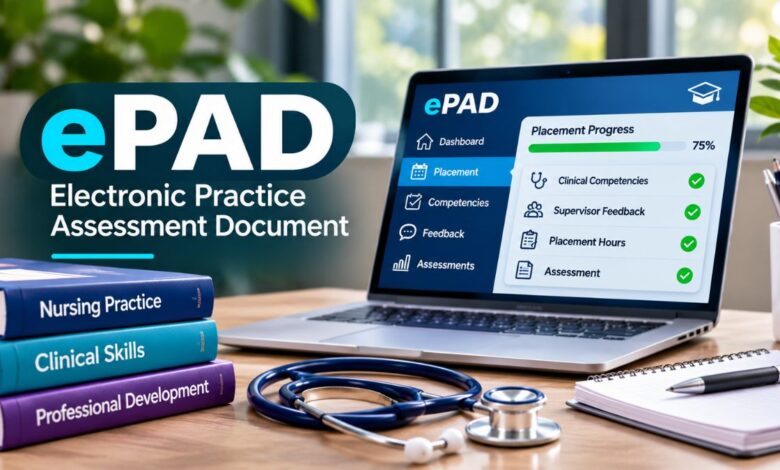
ePAD, short for Electronic Practice Assessment Document, is a digital system universities and healthcare training providers use to record, monitor, and assess students’ practical learning. It is particularly important in nursing education, where students must demonstrate clinical competence, professional behavior, and progress throughout supervised placements. Rather than relying exclusively on paper-based assessment books, students and authorized assessors can use electronic records to document achievements, provide feedback, and review performance.
The significance of ePAD extends beyond replacing paperwork. It supports a structured assessment process that connects students, healthcare professionals, and academic institutions, making evidence of practical learning more accessible to those who evaluate it.
What Is ePAD and How Does It Work?
The electronic Practice Assessment Document is an online assessment record that supports students undertaking practical training in professional healthcare environments.
Its primary function is to document learning experiences and provide evidence that students are developing the knowledge, skills, and professional conduct required by their educational programs.
In nursing education, practical experience is essential to professional preparation. Students spend substantial periods working in healthcare environments, where their progress must be supervised and evaluated. The ePAD supports this process through digital documentation.
Depending on the university and the platform it uses, students may access records through a browser, mobile application, or electronic portfolio service. Authorized staff can review submitted material, record observations, and contribute to assessments.
However, ePAD is not a single universal software product. Universities may use different platforms, including MyProgress and PebblePad, to deliver electronic practice assessment documentation.
This distinction matters because login procedures, available functions, and documentation requirements can vary between institutions.
Why Universities Introduced Electronic Practice Assessment
Healthcare education has traditionally relied on printed assessment documents that include placement objectives, competency records, attendance information, and supervisor evaluations.
Although paper documentation can provide an effective record, it creates practical difficulties when several professionals need access to the same information.
A nursing student may complete a placement under the supervision of multiple healthcare professionals while also receiving academic support from university staff. When assessment records exist only on paper, reviewing progress across different locations can require additional coordination.
Electronic systems were introduced to make this documentation easier to access and manage.
Anglia Ruskin University reports using MyProgress for electronic practice assessment documentation since 2015, initially in nursing and subsequently across additional healthcare programs. Leeds Beckett University also began using electronic placement assessment workbooks in 2017.
These examples show that ePAD developed through institutional adoption rather than a single national rollout.
The underlying objective has remained consistent: to support effective assessment without making students and assessors unnecessarily dependent on physical documents.
The Essential Features of ePAD
An ePAD typically brings together several components of practice assessment within one structured digital environment.
Clinical competency records allow students and assessors to document progress towards specific practical skills and professional outcomes. The exact requirements depend on the course, stage of training, and relevant professional standards.
Placement documentation provides an organized record of learning activities, scheduled reviews, and assessment decisions.
Another important function involves recording feedback. Practice supervisors may contribute observations about a student’s clinical performance, communication, professional conduct, and development.
Assessment records can also include reflective learning activities, helping students reflect on their experiences and identify areas for further improvement.
Many implementations support digital recording of placement hours. This allows attendance information to be reviewed and verified as part of the student’s required practical experience.
Some platforms also provide mobile access and offline documentation. These capabilities should not be assumed to exist in every university’s version.
How ePAD Supports Nursing Students
For nursing students, the transition from academic learning to supervised clinical practice involves more than demonstrating isolated technical skills.
Students must learn to communicate appropriately, recognize their professional responsibilities, apply theoretical knowledge, and respond safely to clinical situations.
An electronic assessment record provides a structured way to capture evidence of that development.
At the beginning of a placement, students may need to review learning objectives and complete initial documentation with their assigned practice supervisor or assessor.
As the placement progresses, they record relevant experiences and complete the forms required by their program.
Feedback from practice staff helps identify strengths, emerging capabilities, and areas that need further attention.
The result should be more than an administrative checklist.
A properly maintained ePAD provides a developing picture of the student’s practical learning, although the quality of that picture depends on accurate documentation and meaningful assessment.
The technology does not establish clinical competence on its own. Professional judgment remains essential.
The Responsibilities of Practice Supervisors and Assessors
The distinction between supervision and assessment is fundamental to understanding how ePAD operates.
Under the Nursing and Midwifery Council’s standards for student supervision and assessment, different professionals support, evaluate, and confirm a student’s development.
Practice Supervisors
Practice supervisors support students during practical learning activities.
Their responsibilities include providing appropriate guidance, facilitating learning opportunities, observing performance, and contributing feedback.
They may document relevant observations in the student’s electronic assessment record.
Their involvement helps ensure that clinical experiences are connected to the learning outcomes expected by the educational program.
Practice Assessors
Practice assessors evaluate students’ progress using relevant evidence and professional judgment.
They consider whether the student has demonstrated the required standards at the appropriate stage of training.
Their work can involve reviewing feedback, examining assessment records, discussing progress with the student, and completing designated assessment requirements.
Academic Assessors
Academic assessors contribute the university’s educational perspective.
They work with practice assessors to evaluate student progression and ensure that assessment decisions reflect the program’s requirements.
Electronic documentation can support communication among these participants, but it does not remove their individual professional responsibilities.
How Students Access and Use ePAD
Access procedures depend on the institution providing the system.
For example, the University of Essex explains that its students and staff can access ePAD through university single sign-on. In contrast, external practice staff may receive account activation instructions after being allocated to a student’s assessment record.
Other universities use different access arrangements.
A typical student workflow involves:
- Accessing the university’s designated ePAD platform.
- Reviewing the allocated placement and assessment documents.
- Completing initial placement information and required learning agreements.
- Recording relevant clinical experiences and placement hours.
- Requesting feedback and assessment from authorized staff.
- Reviewing completed documentation before the relevant submission or progression deadlines.
Students should follow the instructions issued by their own institution rather than assuming that guidance for another university applies to their account.
This is particularly important when completing assessment forms or obtaining electronic approval.
The Importance of Accurate Clinical Documentation
An electronic assessment system is only as reliable as the information recorded within it.
Incomplete placement hours, missing supervisor feedback, incorrect assessment details, or delayed submissions can create difficulties when a student’s progress is reviewed.
Universities therefore emphasize regular documentation rather than leaving all assessment tasks until the end of a placement.
Aston University’s guidance, for example, explains that students must record their placement hours and that practice supervisors or assessors should verify them regularly.
Accurate records also support continuity between different placement experiences.
When a student moves to another clinical environment, existing documentation may provide useful evidence of earlier achievements and development needs, subject to the institution’s access arrangements.
However, digital documentation should not contain unnecessary confidential patient information.
Students must follow their placement provider’s confidentiality requirements, university policies, and applicable data protection obligations.
Clinical learning can be recorded without exposing identifiable patient details.
The Relationship Between ePAD and Professional Standards
In the United Kingdom, nursing education operates within a framework of professional standards established by the Nursing and Midwifery Council (NMC).
These standards define expectations for student supervision and assessment, including the roles of practice supervisors, practice assessors, and academic assessors.
The electronic assessment document helps institutions record evidence relevant to those expectations.
However, the NMC’s regulatory standards and the university’s software system serve different purposes.
The professional standards establish educational and assessment requirements. The electronic platform provides a way to document the evidence and decisions connected to those requirements.
This distinction prevents a common misunderstanding: using ePAD does not automatically demonstrate that a student has achieved professional competence.
Competence must still be assessed through appropriate learning experiences, evidence, and professional judgment.
The Advantages of Digital Practice Assessment
One of the main advantages of ePAD is its ability to keep assessment information in a more accessible format.
When authorized users can access records remotely, they can review progress without needing the student’s physical assessment booklet.
Digital forms can also make it easier to identify outstanding documentation and organize feedback across a placement.
Another potential benefit is continuity. Students undertaking different placements may have their assessment evidence organized within a consistent electronic structure.
For academic staff, access to current documentation can help identify when students need additional support or when communication with placement providers is required.
These advantages are practical, not automatic.
A digital system improves assessment administration only when users receive adequate training, permissions function correctly, and staff have sufficient time to provide meaningful feedback.
Common Challenges and Limitations
Despite its potential benefits, ePAD also introduces operational challenges.
Students may experience login problems, incorrect placement allocations, unavailable assessment forms, or uncertainty about how electronic signatures work.
External practice staff sometimes require separate accounts or activation procedures, which can delay registration if it is not completed.
Connectivity presents another consideration.
Clinical environments do not always offer convenient access to computers or reliable wireless networks. Although some systems support offline functions, their availability varies.
Digital confidence also differs among users. A student familiar with online applications may still need guidance on the specific rules governing assessment submissions.
Universities address these issues through user guides, training resources, helpdesks, and platform-specific instructions.
The University of Essex, for instance, publishes guidance covering form completion, placement records, account access, and assessment procedures.
The most important lesson is that electronic systems need ongoing administrative and educational support. Software alone cannot resolve weaknesses in supervision or assessment practice.
The Wider Use of ePAD Beyond Nursing
Although electronic practice assessment documentation is strongly associated with nursing, its application is not limited to one profession.
Universities increasingly use related digital assessment methods across healthcare and professional education.
The University of Essex provides ePAD guidance for areas including nursing, occupational therapy, social work, and speech and language therapy. It also introduced electronic practice assessment documentation for physiotherapy students and apprentices in October 2023.
Anglia Ruskin University similarly describes extending electronic practice assessment provision across its healthcare courses, with eMORA used for student midwives.
These examples illustrate how a common assessment principle can support several disciplines while retaining profession-specific requirements.
The documentation required for a physiotherapy student will not necessarily be identical to that required for a nursing student.
Each program must assess the capabilities relevant to its professional framework.
What ePAD Means for the Future of Healthcare Training
Adopting electronic assessment documents reflects a broader shift toward digitally supported professional education.
Universities must maintain reliable evidence of student development while coordinating learning across hospitals, community services, and other practical environments.
Electronic assessment systems can support that coordination, particularly when students and educators work in different locations.
Nevertheless, future progress should not be measured simply by the number of forms transferred online.
The more meaningful question is whether digital assessment helps educators identify development needs earlier, provide better feedback, and make well-supported decisions about competence.
Evidence of those benefits requires careful evaluation. Software adoption alone cannot be assumed to deliver them.
The strongest implementation is one in which the technology supports human expertise rather than attempting to replace it.
Conclusion
ePAD has become an important part of practice-based healthcare education, providing a digital framework for documenting student learning, clinical performance, professional development, and assessment decisions.
Its value lies in connecting information that might otherwise remain scattered across paper records, different placements, and multiple assessors.
Yet effective use depends on more than having an electronic platform. Accurate documentation, professional feedback, appropriate supervision, and consistent institutional support remain essential.
For students, understanding ePAD means learning how to maintain a reliable record of practical progress. For educators, it means using that record to support fair and informed assessment.
The central principle remains unchanged: technology should make professional learning more transparent and manageable without weakening the human judgment on which competent healthcare practice depends.
(FAQs)
1. What does ePAD stand for?
In healthcare education, ePAD usually stands for electronic Practice Assessment Document. It is used to record and assess students’ practical learning experiences, clinical skills, and professional development.
2. Is ePAD only used by nursing students?
No. Although ePAD is widely associated with nursing education, electronic practice assessment systems are also used in other healthcare and professional programs. Availability depends on the university and course.
3. How can students log in to ePAD?
Students normally access ePAD through a university-approved website or application. Login instructions vary: some institutions use single sign-on, while others use dedicated platform accounts.
4. Can ePAD be accessed on a mobile phone?
Some ePAD systems support mobile browsers or dedicated applications. Certain platforms also provide offline functionality, but students should check their university’s specific guidance.
5. Who is responsible for completing ePAD assessments?
Students maintain their assigned documentation, while authorized practice supervisors, practice assessors, and academic assessors contribute feedback and assessment decisions according to their respective responsibilities. The exact process depends on the educational program.