

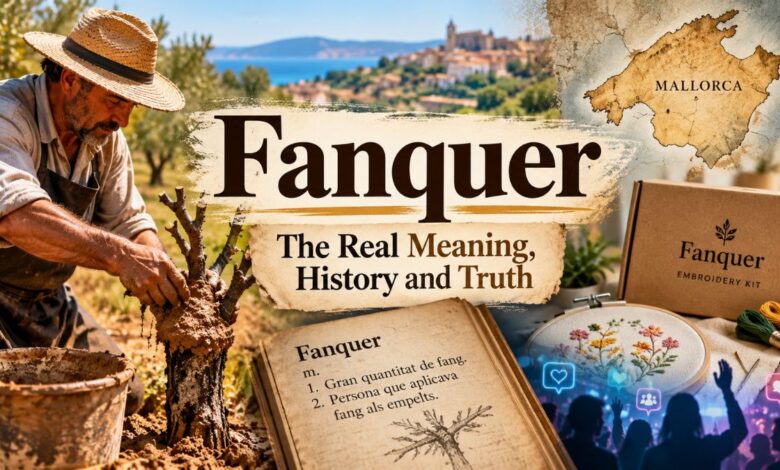
Fanquer is not an independently verified celebrity or public figure. Research instead identifies it as a documented word in Mallorcan Catalan, with meanings connected to mud and traditional agricultural work. The Diccionari català-valencià-balear, a major historical dictionary of Catalan, records two distinct uses of the term. One describes a substantial quantity of mud; the other refers to a worker who applied mud during grafting.
That documented history contrasts with newer online interpretations linking the name to digital communities, personal branding, and fan engagement. No reliable biographical record identifies Fanquer as a specific entertainer, influencer, or public figure. Its most credible story is therefore linguistic and cultural, not biographical.
The Documented Origins of Fanquer
The strongest evidence for the word comes from the Catalan linguistic tradition, not contemporary entertainment reporting.
In the Diccionari català-valencià-balear, Fanquer appears as a masculine noun associated with Mallorca. Its recorded etymology connects it directly to fang, the Catalan word for mud. The dictionary preserves two meanings that reveal how regional vocabulary can describe both a physical condition and a specific form of human labor.
The first meaning concerns an unusually large amount of mud. It evokes conditions familiar in agricultural landscapes, particularly where rainwater turns exposed soil into difficult ground. Unlike a modern invented definition, this meaning is supported by historical lexicographical documentation.
The second meaning is more occupational. It describes a person who follows a worker performing grafting and applies mud to the grafts. The distinction matters because it shows that Fanquer could historically refer to someone performing a specific task without functioning as a personal name.
This is the closest reliable connection between the word and a human identity. It is a traditional occupational description, not evidence of a particular celebrity’s biography.
Fanquer and Its Connection to Traditional Agricultural Work
The occupational meaning offers a glimpse into an agricultural practice that depended on coordinated manual labor.
Grafting involves joining plant material so that two plant parts can grow together. People have long used it in fruit cultivation and horticulture to reproduce desirable varieties, improve plant characteristics, and manage productive trees.
The historical dictionary entry identifies a worker called an empeltador—a person performing grafting—and describes the Fanquer as someone who followed that worker and applied mud to the grafts.
This detail is significant because it distinguishes two responsibilities within the same activity. One person performed the grafting operation, while another handled a material used in the process.
The dictionary preserves an older agricultural quotation referring to preparing the mud and removing unwanted material. Such documentation provides evidence of terminology associated with practical work rather than merely offering an abstract definition.
However, the entry does not establish exactly when the occupation originated, how widespread it was, or when the designation fell out of regular use. Those questions would require additional historical agricultural records.
What can be established is that Fanquer once described a recognizable agricultural function in Mallorcan vocabulary.
Why the Linguistic History Matters
Regional language preserves details that formal historical narratives sometimes overlook. Terms associated with manual occupations can reveal how communities classified everyday responsibilities, identified specialized work, and communicated practical knowledge.
The two documented meanings of Fanquer illustrate this relationship particularly well.
The first meaning refers to the physical environment: mud created by soil and water. The second belongs to human activity: an individual responsible for applying that material during agricultural work.
Both senses arise from the same linguistic foundation.
That connection helps explain how a word rooted in a familiar substance can develop a meaning associated with a person or occupation.
The broader word fang itself has an extensive history in Catalan. Historical dictionaries record literal, figurative, and specialized meanings, along with expressions that use mud as an image of difficulty or trouble.
This does not mean every meaning of fang automatically applies to Fanquer. Instead, it places the regional term within a documented family of related vocabulary.
Fanquer as a Modern Brand or Digital Identity
Outside its documented linguistic context, Fanquer has also appeared as a commercial name.
An online retail listing identifies Fanquer as the brand associated with a beginner’s embroidery kit. The advertised product includes materials such as an embroidery hoop, patterned fabric, coloured threads and needles. Its listing identifies a product availability date of April 23, 2022.
This provides evidence of commercial use of the name. It does not, by itself, establish a company founder’s identity, a business’s history, or any relationship between the product name and the older Catalan word.
Those distinctions are important.
A product listing can confirm that a name has been used commercially, but it cannot independently verify a company’s ownership, legal status or broader commercial success.
Likewise, an unusual word in a username or website address does not prove it represents a recognized organization.
A name may develop several unrelated identities over time. Without documentation connecting them, these identities should be examined separately.
The Confusion Surrounding Fanquer’s Online Meaning
The internet can make an unfamiliar word appear more established than the evidence justifies.
When readers search for an unusual expression, they may encounter multiple explanations presented with similar confidence. Repeated claims can then make a particular definition seem widely accepted.
In Fanquer’s case, newer interpretations have associated the term with enthusiastic fans, audience participation, online identity and community engagement.
The problem is not that such meanings are impossible. Language continually changes, and communities regularly introduce new expressions.
The problem is the absence of sufficiently authoritative evidence identifying a widely accepted modern definition, its original author, or a clearly documented history of its adoption.
For example, the suggestion that Fanquer combines the English words fan and conquer should not be presented as established etymology. The recorded Catalan derivation from fang is much more firmly supported.
An existing word can also be independently adopted for a new purpose. That would not invalidate its earlier meaning.
The responsible distinction is between documented historical usage and proposed contemporary interpretation.
Is Fanquer a Celebrity or Public Figure?
Although Fanquer could be an artistic name, reliable evidence is insufficient to identify a particular celebrity by that name.
No authoritative biographical information was established through the research conducted for this article.
Consequently, the following personal details remain unverified:
- Birth and family background: No reliable information established.
- Education and professional training: Not independently documented.
- Entertainment career: No verified filmography, discography, or professional credits connected to an identifiable individual.
- Marriage or relationships: No reliable public information established.
- Net worth: Verified financial data has not been publicly disclosed for any identifiable celebrity using this name.
These gaps do not prove that no one has ever used Fanquer as a personal or professional name. They mean that a specific individual cannot responsibly be identified from the available evidence.
Attaching invented personal details to such an ambiguous name would mislead readers.
How Fanquer Differs From Similar Words
Some confusion may arise because Fanquer resembles terms used in other languages.
The English word flanker, for instance, refers to someone positioned on a flank in contexts including sport and military organization. The French verb flanquer has different established uses.
A resemblance in spelling or pronunciation, however, does not prove a shared origin.
The Catalan dictionary also records fangar, a related word that can describe muddy ground. Although it shares the root fang, it does not match Fanquer in meaning or grammatical use.
Distinguishing these terms prevents readers from confusing a documented regional word with unrelated expressions.
It also demonstrates why dictionary evidence is more useful than interpreting a name purely from how it sounds.
What the Available Evidence Actually Establishes
The research supports three separate conclusions.
First, Fanquer is an authentic historical Catalan word, with meanings recorded in a recognized dictionary. Its regional association with Mallorca and its derivation from fang are documented.
Second, the same spelling has appeared in a modern commercial product listing. That establishes another use of the name but does not demonstrate any historical connection between the two.
Third, descriptions of Fanquer as a contemporary digital movement, specific online platform, or entertainment personality lack the primary-source verification needed for confident reporting.
No documented basis supports an exact celebrity birth date, career timeline, personal relationship history, or financial estimate.
The available record is narrower than some online explanations suggest, but it is also more interesting than the claim that Fanquer is simply a meaningless invented word.
Its documented connection to agricultural labor gives the term a tangible history.
Conclusion
Fanquer is best understood as a name with an established regional linguistic history and more ambiguous modern uses. In the sources examined, its earliest reliably documented identity is neither a celebrity nor an internet platform, but a Mallorcan Catalan noun associated with mud and traditional grafting work.
That distinction changes the way the subject should be reported.
Historical evidence reveals a link between language, agriculture, and specialized labor. Commercial listings show that the spelling has also been adopted as a product name. Claims about a specific public personality or a universally recognized digital concept require further verification.
For readers looking for the real story behind Fanquer, the strongest conclusion is straightforward: its historical meaning can be documented, but a celebrity biography cannot currently be established.
(FAQs)
1. What is Fanquer?
Fanquer is a documented word in Mallorcan Catalan. Historically, it refers to either a large quantity of mud or an agricultural worker who applied mud during grafting.
2. Is Fanquer the name of a famous person?
No identifiable celebrity or public figure named Fanquer could be independently verified through the reliable sources examined. A documented entertainment career or personal biography has not been established.
3. Where does the word Fanquer originate?
The Diccionari català-valencià-balear associates the word with Mallorca and derives it from the Catalan noun fang, meaning mud.
4. Is Fanquer a business or online platform?
The name appears in commercial listings for embroidery products. However, there is insufficient authoritative evidence to identify it as a specific digital platform or to establish the product brand’s corporate history.
5. Why does Fanquer have different meanings online?
The spelling appears in different contexts, including historical vocabulary and modern commercial naming. Some websites also propose new digital meanings, but these interpretations should not be confused with its documented linguistic origins.