
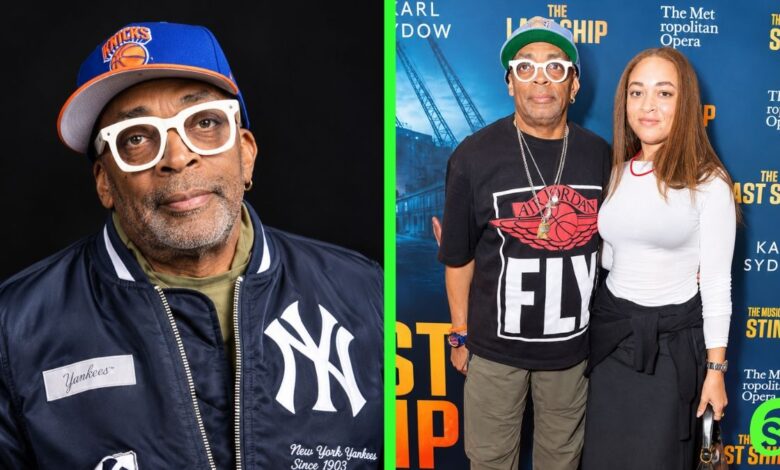
Satchel Lee is an American photographer, filmmaker, and visual artist whose career extends beyond her famous family. The daughter of Oscar-winning director Spike Lee and producer Tonya Lewis Lee, she has developed a distinctive body of work spanning editorial photography, independent publishing, film, and contemporary art. Her first solo exhibition, Where We Find Ourselves, opened in Houston in September 2025, marking a key moment in her artistic career. By 2026, her work had become increasingly concerned with Black American history, cultural memory, identity, and the social expectations that shape everyday life.
Her public identity is often introduced through her father’s achievements. Her professional record, however, offers a more substantial story: that of an artist developing her own methods, subjects, and creative priorities.
Quick Bio
| Field | Details |
|---|---|
| Full Name | Satchel Lee |
| Profession | Photographer, Filmmaker, Visual Artist |
| Nationality | American |
| Birthplace | New York City, USA |
| Age | Approximately 31 (2026) |
| Father | Spike Lee |
| Mother | Tonya Lewis Lee |
| Sibling | Jackson Lee (Brother) |
| Education | NYU Tisch School of the Arts |
| Graduation Year | 2017 |
| Known For | Photography, DRØME, Golden Globe Ambassador |
| Notable Film | Words Matter (2019) |
| Notable Exhibition | Where We Find Ourselves (2025) |
| Golden Globe Ambassador | 2021 |
| Marital Status | Not publicly confirmed |
| Net Worth | Not publicly disclosed |
Growing Up in a Family of Filmmakers and Storytellers
Born and raised in Manhattan, New York, Satchel grew up in a household closely connected to American filmmaking, literature, and cultural activism. Her father, Spike Lee, became internationally recognized for films including Do the Right Thing, Malcolm X, and BlacKkKlansman. Her mother, Tonya Lewis Lee, established her own career as a producer, writer, and advocate.
Satchel also has a younger brother, Jackson Lee, who has pursued his own creative work.
The family’s prominence gave Satchel early exposure to the entertainment industry, although public accounts do not establish precisely how individual childhood experiences shaped her eventual artistic decisions. What is documented is that she pursued formal film education and began producing creative projects before attracting widespread attention through her family’s public appearances.
The distinction matters. Her father’s filmmaking often examines race, political conflict, American history, and social institutions. Satchel’s later photography and artistic installations address some related subjects, but through different forms and perspectives.
Rather than treating their shared interests as evidence that her work reproduces his approach, it is more accurate to recognize a family connection alongside a developing independent artistic practice.
Education at New York University
Satchel attended New York University’s Tisch School of the Arts and graduated from its film program in 2017.
Her education involved filmmaking and visual storytelling, disciplines that would remain central to her subsequent career. In a 2019 Vogue profile, the publication reported that photographer Tyler Mitchell shot her thesis film.
During her university years, she also established an artist collective called Chromatic, according to her account in a 2018 interview with Office Magazine.
That experience offers an early indication of an interest that extends beyond conventional film production. Creative collectives bring together people working across artistic disciplines, and Satchel’s later professional activities similarly resisted confinement to a single medium.
Her studies gave her experience in film’s technical and narrative aspects. Photography, writing, publishing, and creative direction subsequently became interconnected parts of her professional life.
Building a Career Through DRØME Magazine
One of Satchel’s significant early projects was her involvement with DRØME, an independent fashion and arts publication emphasizing queer creativity, visual experimentation, and underrepresented voices.
She worked alongside Caroline D’Arcy Gorman, her business partner and fellow creative director.
The publication operated at the intersection of contemporary fashion, photography, art, and cultural commentary. Its editorial approach emphasized the importance of allowing artists and communities to represent themselves rather than relying exclusively on established media institutions.
In an interview published by Office Magazine in December 2018, Satchel discussed her responsibilities as creative director and her continuing interest in photography, film, and writing.
The magazine’s third print volume featured cultural figures including actor Ashton Sanders, musician Billie Eilish, and fashion designer Christian Siriano.
DRØME was particularly important because it demonstrated Satchel’s participation in the organizational side of creative production. Developing an independent publication involves editorial planning, collaboration, visual direction, and the practical challenges of sustaining a relatively small media operation.
Her work with the magazine also connected directly to her interest in queer representation.
Rather than treating representation solely as a subject to be discussed, DRØME created an editorial platform where artists could present their work and identities on their own terms.
Working With Spike Lee on Words Matter
Satchel’s professional relationship with her father became especially visible through Words Matter, a short promotional film associated with the fashion brand Coach in 2019.
The project featured actor Michael B. Jordan and used a visual concept involving stones marked with hateful language.
Satchel co-wrote the short film with Spike Lee, while her brother Jackson also participated in the collaboration.
The project’s central idea was to reject hateful expression and choose a more constructive approach to human relationships.
Its significance to Satchel’s biography is not simply that she worked with an internationally recognized filmmaker. It is that the collaboration provided a documented example of her writing work within a professional visual production.
The project also reveals a point of continuity between her interests and those commonly associated with her father: the relationship between language, public responsibility, and social identity.
Nevertheless, their individual contributions should not be confused. Spike Lee’s established filmmaking career and Satchel’s developing work remain distinct, even when they collaborate on the same production.
Photography, Fashion, and Visual Storytelling
As Satchel’s career developed, photography became an increasingly prominent part of her professional identity.
In a June 2022 interview with Rose Inc., she was described as having photographed campaigns for Tory Burch and Official Rebrand, as well as digital covers for Numéro magazine. The profile also discussed her on-camera work for Rodarte and her direction of music videos for musician Sofía Valdés.
These projects demonstrated her ability to move between commercial photography, editorial imagery, and filmmaking.
Fashion photography frequently requires artists to communicate a recognizable visual identity while satisfying the expectations of a publication or client. Independent art projects provide different opportunities, including greater freedom to explore personal subjects.
Satchel’s work across both environments became an important part of her artistic development.
Her interest in people and storytelling appeared consistently in her interviews. Photography was not merely a way to create attractive images; it offered a way to communicate experiences, relationships, and perspectives.
That interest would become especially visible in her later exhibition work.
The Historic Golden Globes Milestone in 2021
Satchel gained broader public recognition when she and Jackson were selected as Golden Globe Ambassadors for 2021.
The Hollywood Foreign Press Association announced their appointment on January 12, 2021.
Their selection was historically significant for several reasons:
- Satchel and Jackson became the first two siblings of color to hold the Golden Globe Ambassador positions together.
- Jackson became the first Black male Golden Globe Ambassador.
- Satchel became the first openly queer person to serve as an ambassador.
The siblings participated in the 78th Golden Globe Awards, held on February 28, 2021.
The ambassador role traditionally involves ceremonial duties and promoting philanthropic causes. It is not an award recognizing an individual’s filmmaking or acting achievements.
For Satchel, the appointment created an opportunity to support a cause connected to her publicly expressed priorities.
She selected Callen-Lorde, a New York-based organization providing healthcare and related services to LGBTQ+ communities.
The organization received a $25,000 grant from the Hollywood Foreign Press Association on her behalf.
Jackson selected Big Brothers Big Sisters of America, which received an equivalent grant.
Their selections connected the public visibility of the Golden Globes to charitable organizations serving different communities.
The event also highlighted Satchel’s identity as an openly queer creative professional. In interviews surrounding the ceremony, she spoke about the importance of giving underrepresented people meaningful opportunities to influence entertainment and cultural representation.
From Editorial Photography to Contemporary Art
Satchel’s professional direction broadened further as she began working with historical research, architectural forms, and installation-based art.
A defining example emerged in 2025, when she presented her first solo exhibition, Where We Find Ourselves, at the Freedmen’s Town Visitors Center in Houston, Texas.
The exhibition opened on September 5, 2025.
It focused on Freedmen’s Town, a historically Black Houston neighborhood established by formerly enslaved African Americans after emancipation.
The community developed into an important center of Black social, religious, and economic life. Over time, infrastructure development, displacement, and other urban changes substantially altered its physical landscape.
Satchel first became acquainted with the area in 2024 while visiting Houston for the Black Artists Retreat associated with artists Theaster Gates and Eliza Myrie.
The experience led to an artistic project examining the relationship between physical places and the communities whose histories they contain.
Where We Find Ourselves: Preserving a Community’s Memory
The exhibition combined photography, architectural models, installation, and documentary filmmaking.
Rather than focusing exclusively on traditional portraits or straightforward documentary photographs, Satchel produced small-scale representations of historically important locations in Freedmen’s Town.
The models included sites associated with the community’s early development and surviving structures affected by deterioration.
One work referred to the house of Isabel Simms, an early female property owner in the neighborhood. Another examined the empty site associated with the home of Jack Yates, an influential religious and community leader.
These miniature structures were photographed against dark backgrounds, separating them visually from their present-day surroundings.
The technique created a striking effect.
Buildings and vacant sites that might be overlooked within an urban landscape became isolated subjects demanding attention. By enlarging the resulting photographs, Satchel transformed physically diminished places into images with greater visual presence.
The approach also introduced a tension between what remained and what had disappeared.
A photograph can document a surviving building, but an architectural model can also suggest the history of a site whose original structure no longer exists.
In this sense, the exhibition used visual reconstruction to examine historical loss.
Giving the Community a Voice
An important component of the project was its documentary element, A Dream Held Close: Life and Legacy in Freedmen’s Town.
For the film, Satchel interviewed people connected to the community, including preservation advocates, religious figures, historians, and residents.
Featured among them were Charonda Johnson, Pastor Samuel Smith, Dr. Sally Withers, and Bobby Johnson.
Their participation added perspectives that architectural images alone could not provide.
Satchel acknowledged in her 2025 interview with W Magazine that she was approaching the neighborhood as someone from outside Houston. Including people who lived in or worked to preserve Freedmen’s Town allowed the project to incorporate local knowledge rather than depending exclusively on her interpretation.
That editorial decision is significant.
Historical preservation is not simply about recording buildings. It also involves understanding who remembers those places, why they matter, and what communities stand to lose when their physical surroundings change.
By combining personal testimony with photographic reconstruction, the exhibition addressed both the visible and less visible dimensions of cultural memory.
How Her Artistic Perspective Developed by 2026
In an interview published by PAPER Magazine on October 29, 2026, Satchel discussed a growing interest in performance—not merely theatrical performance, but the ways people present themselves within everyday social life.
She examined how expectations surrounding education, class, respectability, and public behavior can influence how Black Americans understand and present their identities.
The interview offered a particularly useful perspective on her artistic development.
Her earlier publishing and commercial photography had frequently emphasized visibility and representation. Her more recent work also considers what happens when social pressure shapes representation.
These questions involve subtle distinctions.
Being visible does not necessarily mean being fully understood. A socially acceptable public image may conceal experiences that do not conform to conventional expectations.
Satchel’s comments indicate an interest in exploring these contradictions without requiring viewers to accept a single interpretation.
She also discussed possible future interests in historic New York locations, including Seneca Village, the former Black community displaced during the creation of Central Park.
Those comments show artistic curiosity, not a confirmed announcement of a new exhibition.
As of November 2026, her documented work shows a growing interest in connecting photography with historical research, cultural identity, and image interpretation.
The Relationship Between Satchel Lee and Spike Lee
Satchel’s relationship with Spike Lee remains an unavoidable part of her public biography, but it should not be treated as the complete explanation for her career.
The two share an interest in stories concerning Black American experiences and cultural history. Their methods, however, differ.
Spike Lee is principally associated with feature filmmaking, using narrative cinema to examine political, historical, and social conflicts.
Satchel has developed a practice involving photography, editorial publishing, short films, and contemporary art installations.
Their collaboration on Words Matter established a direct professional connection. Her later independent work, particularly Where We Find Ourselves, demonstrates that she has also pursued projects with her own subject matter and artistic framework.
Family recognition may influence how audiences first encounter her work, but it does not replace an examination of what she has actually produced.
The strongest evidence for her artistic identity comes from her documented creative decisions, not assumptions about inherited talent or personal ambition.
Personal Life, Identity, and Public Boundaries
Satchel has discussed her identity as a queer Black woman in published interviews and has connected those experiences to her interest in storytelling and representation.
She has also spoken about the significance of Juneteenth, cultural heritage, and community gatherings.
In her 2022 Rose Inc. interview, she described the holiday as an opportunity to recognize African American history and celebrate the people and traditions that contribute to her sense of identity.
Those statements are relevant because she has voluntarily connected these subjects to her professional perspective.
Other aspects of her personal life are less publicly documented.
Reliable, independently verified information about a current spouse or romantic partner is not established by the major interviews reviewed for this profile. Her relationship status should therefore not be presented as fact.
Similarly, a verified personal net worth has not been publicly disclosed. Online estimates should not be confused with documented financial information.
Her exact date of birth is also not consistently established in the authoritative material used for this article. W Magazine described her as 30 years old in September 2025, but that does not provide a sufficiently precise basis for stating an exact birthday.
These distinctions help maintain a clear separation between public professional information and private details.
Significant Career Milestones
Satchel’s career can be traced through several documented events:
- 2017: Graduated from the film program at NYU’s Tisch School of the Arts.
- 2018: Discussed her creative-director role at DRØME and her work across filmmaking, photography, and writing.
- 2019: Co-wrote Words Matter, a Coach short film involving Spike Lee and Michael B. Jordan.
- 2021: Served alongside Jackson Lee as a Golden Globe Ambassador and supported Callen-Lorde.
- 2022: Discussed commercial photography, music-video direction, and African American cultural identity in an interview with Rose Inc.
- 2025: Opened her debut solo exhibition, Where We Find Ourselves, in Houston.
- 2026: Discussed her fine-art practice, Black American life, and social performance in an interview with PAPER Magazine.
The chronology illustrates a career developing across multiple creative fields rather than through a single conventional entertainment-industry path.
What Makes Satchel Lee’s Work Distinctive?
The most revealing feature of Satchel’s artistic career is the relationship between her chosen subjects and her methods.
Her independent publishing work created space for queer artists and cultural figures. Her photography explored how individuals and identities are visually presented. Her Houston exhibition expanded those interests toward the historical environments in which communities develop and disappear.
These projects are different in medium and scale, but they share an underlying concern with whose experiences are made visible.
The progression is not necessarily a deliberate career plan. Public interviews do not establish that Satchel mapped out these stages in advance.
What is clear is that her later work has become more explicitly research-driven, incorporating historical places and community testimony alongside her established visual techniques.
Her treatment of Freedmen’s Town is a particularly useful example because it gives architectural history an intimate visual form without reducing the neighborhood to a decorative subject.
It also raises questions extending beyond Houston: how communities preserve their histories, how cities decide what survives, and how artists can represent places with which they have personal or cultural connections but not necessarily lifelong familiarity.
Conclusion
Satchel Lee is an established creative professional whose identity extends well beyond being Spike Lee’s daughter. Her work encompasses independent publishing, photography, filmmaking, and contemporary art, supported by a documented record of collaborations, public presentations, and interviews.
Her 2025 exhibition Where We Find Ourselves marked a substantial development in her practice, bringing historical research and community perspectives into a form that combined photography, documentary film, and architectural reconstruction.
By late 2026, her public comments indicated a continued interest in Black American cultural memory, social expectations, and photography’s interpretive possibilities.
Her family background remains an important part of her biography. Yet her professional achievements provide a clearer basis for understanding her place in the arts: an artist using visual storytelling to examine identity, representation, and the histories that shape contemporary life.
Read this too:Ernestine Charles: The Powerful Story of RuPaul’s Mother, Her Life, Family, and Lasting Influence
(FAQs)
1. Who is Satchel Lee?
Satchel Lee is an American photographer, filmmaker, and visual artist. She is the daughter of acclaimed filmmaker Spike Lee and producer Tonya Lewis Lee. She is known for her photography, independent creative projects, and contemporary art exhibitions.
2. Who are Satchel Lee’s parents?
Satchel Lee’s parents are Spike Lee and Tonya Lewis Lee. Her father is an Oscar-winning filmmaker known for Do the Right Thing and BlacKkKlansman, while her mother is a producer, author, and advocate.
3. How old is Satchel Lee?
Satchel Lee was reported to be 30 years old in September 2025. However, her exact date of birth has not been consistently confirmed through authoritative public sources.
4. What does Satchel Lee do for a living?
Satchel Lee works as a photographer, filmmaker, and visual artist. She has been involved with DRØME magazine, commercial photography, short films, and art exhibitions. Her solo exhibition Where We Find Ourselves explored the history and cultural memory of Houston’s Freedmen’s Town.
5. What is Satchel Lee’s net worth?
Satchel Lee’s net worth has not been publicly verified. Although she has worked on photography, filmmaking, and creative projects, reliable financial records establishing her personal wealth are not publicly available.