

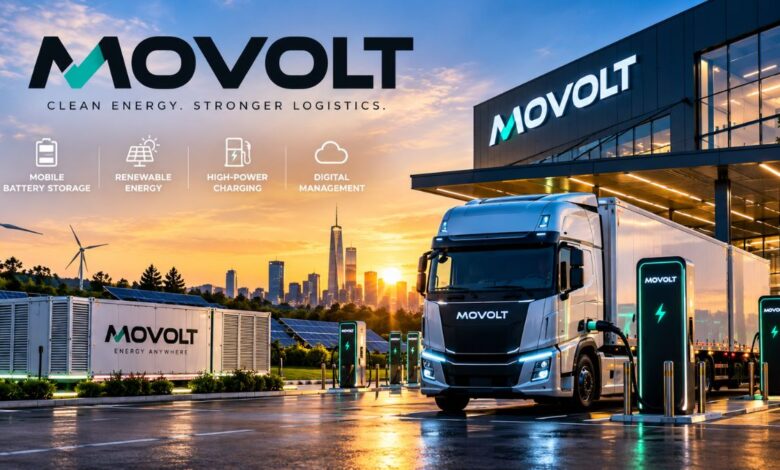
Movolt, officially presented as MOVOLT Group, is a Frankfurt-based German company specializing in electric-truck charging infrastructure, renewable energy solutions, and battery-storage technology. Unlike a celebrity or entertainment personality, Movolt is an emerging business tackling one of the major obstacles facing Europe’s transition to electric commercial transport: the limited availability of high-capacity charging infrastructure.
The company’s approach combines mobile battery storage, renewable electricity, charging equipment, and digital energy management. Its business model is designed to help logistics operators introduce electric trucks without necessarily waiting for extensive electricity-grid upgrades. Although its corporate identity and proposed services are documented, independently verified evidence of large-scale commercial deployments and financial performance remains limited
The Origins and Development of Movolt
Movolt’s documented corporate history began in November 2025, when MOVOLT Solutions GmbH was registered in Frankfurt am Main. German commercial-register information records its registration on November 21, 2025, with an initial registered share capital of €50,000.
The company’s business purpose included engineering and commercial services connected with electric-vehicle charging, electricity generation, energy storage, and supply infrastructure. This indicates that its proposed activities extended beyond installing conventional charging stations.
Additional companies were subsequently registered under the MOVOLT name, including MOVOLT Truck GmbH, MOVOLT Energy GmbH, and MOVOLT Infra GmbH. Their establishment suggests an organizational approach that separates different operational functions within the wider business.
MOVOLT Truck GmbH was registered in December 2025, while the Energy and Infra entities were registered in March 2026. These records provide a useful timeline of the company’s legal development, although registration dates do not necessarily indicate when the original business concept was created.
This distinction matters because newly established infrastructure businesses may spend considerable time developing technology, obtaining approvals, securing commercial relationships, and organizing financing before operating at scale.
Movolt’s corporate structure aligns with its ambition to combine charging technology, electricity procurement, energy storage, and infrastructure operations into a coordinated service.
Who Owns and Manages Movolt?
Ullrich Appel is identified as managing director of MOVOLT Solutions GmbH in the company’s published legal information and German registration records. His name is also associated with other entities operating under the MOVOLT name.
The managing director plays an important legal and operational role within a German limited liability company, but that position should not automatically be interpreted as proof of sole ownership.
A fully verified breakdown of MOVOLT Group’s beneficial ownership, founding shareholders, and external investors has not been established from the available public information.
Likewise, reliable details concerning Appel’s education, personal background, and private finances are limited. Assigning unverified biographical information to him would create a misleading impression of certainty.
From an editorial perspective, the most relevant facts concern his documented management responsibilities and the company’s stated activities.
Why Electric-Truck Charging Is Becoming Increasingly Important
The growing adoption of electric commercial vehicles creates infrastructure challenges that differ considerably from those of passenger cars.
An electric passenger car may remain parked overnight and recharge gradually through a comparatively modest connection. Heavy commercial vehicles often operate on demanding delivery schedules, carry substantial loads, and consume far more electricity.
A logistics depot accommodating numerous electric trucks may require several vehicles to charge during the same evening or overnight period.
This concentration of demand can exceed the electrical capacity available at existing commercial premises.
Improving the connection may require new transformers, additional distribution infrastructure, technical approvals, and substantial construction work. Such projects can also involve complicated coordination with electricity-network operators.
For fleet managers, these challenges create uncertainty about when electric vehicles can be introduced without disrupting business operations.
The International Energy Agency has identified charging infrastructure as a key factor in expanding electric heavy-duty transport. Its Global EV Outlook 2026 reported strong growth in worldwide electric-truck sales during 2025.
These developments help explain why companies such as Movolt are developing alternative approaches to delivering electricity where commercial vehicles need it.
How Movolt’s Battery-Storage Technology Works
A defining feature of Movolt’s proposed technology is integrating mobile battery energy storage systems, often shortened to mobile BESS.
Instead of relying exclusively on electricity delivered through a fixed grid connection, the concept allows energy to be stored in batteries and made available when charging demand arises.
Movolt describes a system that collects, stores, and transports renewable electricity to locations that need additional charging capacity.
For example, an energy-storage unit could theoretically be charged at a renewable generation site before being moved to a commercial vehicle depot.
Once connected to suitable equipment, the stored electricity could supplement the depot’s existing power supply.
This approach is intended to address situations where installing additional conventional grid capacity would take considerable time.
However, transporting stored electricity also introduces operational challenges. Battery capacity, transportation costs, energy-conversion losses, equipment maintenance, and charging frequency all affect the system’s practical value.
Consequently, the commercial success of mobile energy storage depends on its ability to deliver reliable electricity at a competitive overall cost.
Movolt’s publicly described technology clearly explains its proposed approach, but independently verified performance results would be needed to establish its efficiency under routine operating conditions.
Movolt’s Zero-CAPEX Charging Business Model
One of Movolt’s most prominent commercial proposals is its Zero-CAPEX Depot service.
CAPEX stands for capital expenditure, referring to money invested in long-term assets such as buildings, machinery, and infrastructure.
Traditional electric-truck charging installations may require fleet operators to invest substantial amounts in charging equipment, electrical connections, and construction.
Movolt proposes an alternative arrangement under which it plans, finances, builds, and operates the charging infrastructure.
Under the advertised business model, customers pay for electricity consumed rather than purchasing the infrastructure directly.
The arrangement resembles a charging-as-a-service agreement, potentially reducing the financial burden associated with establishing an electric-truck depot.
This approach could be particularly relevant for transport companies that want to focus investment on new vehicles rather than energy infrastructure.
Nevertheless, zero upfront expenditure does not mean the service is free or without financial commitments.
Contract duration, electricity pricing, maintenance responsibilities, service guarantees, minimum consumption requirements, and termination conditions are all relevant considerations.
A transport operator would need to evaluate the agreement’s total cost before comparing it with a conventional infrastructure purchase.
Movolt has also advertised an approximately 12-week implementation timeframe for its turnkey depot concept. This represents a company-stated proposition rather than an independently established delivery period applicable to every project.
The Role of Movolt Cloud and Movolt OS
Movolt’s proposed operating model includes digital technology alongside batteries and charging equipment.
The company’s published portfolio identifies MOVOLT Cloud and MOVOLT OS as components of its software infrastructure.
MOVOLT Cloud is described as a platform for connecting charging systems, energy resources, fleet operations, and external services.
MOVOLT OS is presented as an energy and logistics management solution intended to coordinate charging requirements, battery availability, energy procurement, and mobile storage operations.
This coordination matters because commercial vehicles rarely need the same amount of electricity at the same time.
A delivery depot may operate several vehicles with different routes, battery capacities, and departure schedules.
Effective energy management could help determine which vehicles should charge first, when additional stored electricity is needed, and how available power should be distributed.
Digital coordination may also become more valuable when a logistics business operates multiple depots across different locations.
However, a product description alone does not establish the software’s practical performance.
Publicly documented implementations, technical assessments, and verified customer experiences would provide stronger evidence of its capabilities.
Movolt’s Plans for High-Power Charging Hubs
Beyond individual commercial depots, Movolt has outlined concepts for larger charging facilities serving heavy-duty electric vehicles.
These proposed hubs combine powerful charging equipment with battery storage and renewable-electricity generation.
The company has also described facilities that support drivers with practical amenities such as secure parking, sanitary services, and food-related facilities.
This wider approach reflects the requirements of long-distance freight operations.
Truck charging is not simply about connecting a vehicle to electricity. Charging locations must also suit large vehicles, accommodate driving schedules, and allow drivers to take required breaks.
Movolt’s published plans refer to infrastructure designed with future megawatt-scale charging requirements in mind.
Higher charging capacities could become increasingly relevant as battery-electric heavy commercial vehicles develop.
Nevertheless, the distinction between planned technical capabilities and completed operational infrastructure remains essential.
Do not present a proposed charging hub as an operational facility unless its completion and availability have been independently confirmed.
Renewable Energy and Movolt’s Sustainability Approach
Environmental sustainability forms an important part of Movolt’s stated commercial proposition.
The company’s concept combines renewable electricity from sources such as solar and wind with stationary and transportable battery storage.
One potential advantage of energy storage is that electricity generated during periods of strong renewable production can be used later.
Movolt also proposes transporting stored electricity to where it is needed, potentially helping connect renewable generation with charging demand that is otherwise difficult to supply.
The wider environmental value of this arrangement depends on several factors.
These include the sources of electricity used to charge the batteries, the environmental impact of battery manufacturing, transportation emissions, storage losses, and equipment lifespan.
Although electric trucks produce no exhaust emissions during driving, their overall environmental impact depends partly on electricity generation and vehicle production.
Consequently, the company’s proposed system should not automatically be described as entirely emission-free.
An independently conducted lifecycle assessment would be needed to quantify the emissions associated with Movolt’s specific energy-delivery model.
What Is Known About Movolt’s Financial Position?
Financial transparency matters especially when assessing an emerging infrastructure company.
Movolt’s commercial registration records provide information about its legal entities and their registered share capital.
However, registered capital should not be confused with annual revenue, company valuation, investment raised, or profitability.
The reviewed information does not publicly establish verified financial data on Movolt’s commercial performance.
Likewise, a dependable figure for its total operating charging capacity, number of paying customers, or completed commercial projects has not been independently confirmed.
The company has described pilot projects as being in development, but that statement should not be treated as evidence of widespread commercial deployment.
For investors, commercial partners, and potential customers, independently verified operational results would provide a more complete picture of the company’s progress.
Such evidence might include completed installations, electricity delivered, customer agreements, equipment reliability, and documented operating costs.
Challenges and Opportunities Facing Movolt
Movolt operates within a market where infrastructure demand is developing alongside electric commercial vehicle adoption.
This presents opportunities, but also exposes the company to technical and commercial risks.
A major challenge involves ensuring that mobile storage can supply enough electricity to support demanding logistics schedules.
Heavy-duty charging requires substantial power, especially when several vehicles charge simultaneously.
Another challenge concerns pricing.
A transportable storage solution must remain economically competitive after accounting for battery financing, transportation, equipment depreciation, electricity procurement, maintenance, and energy losses.
Operational reliability is equally significant. Logistics businesses depend on predictable vehicle availability, and charging disruptions can affect delivery schedules and contractual obligations.
Competition is another consideration.
As electricity networks expand and dedicated truck-charging infrastructure becomes more widespread, transport operators may gain access to additional charging options.
Movolt’s long-term position will therefore depend on its ability to demonstrate measurable advantages in cost, deployment speed, reliability, or operational flexibility.
The company’s integrated approach is an identifiable commercial proposition. Whether it becomes a sustainable competitive advantage will depend on verified results.
The Future of Movolt in Electric Commercial Transport
The expansion of battery-electric commercial vehicles creates a growing need for dependable charging infrastructure.
Businesses seeking to electrify their fleets must consider vehicle availability, route planning, energy costs, and the practical limitations of existing depots.
Movolt’s strategy attempts to combine several parts of that challenge within one service.
Rather than focusing exclusively on charging hardware, the company proposes managing electricity supply, energy storage, infrastructure investment, and digital coordination.
The approach could appeal to fleet operators facing delays or financial obstacles when upgrading existing facilities.
Nevertheless, long-term growth cannot rest solely on market opportunity or stated ambition.
For Movolt, meaningful progress would be demonstrated through completed commercial projects, repeat customers, proven technical performance, and transparent financial or operational reporting.
Its next phase will be important in determining whether the proposed system becomes an established commercial service.
Conclusion
Movolt is a developing German energy and electric-truck charging infrastructure company whose business concept addresses the practical challenges of commercial fleet electrification.
Through mobile battery storage, renewable energy, high-power charging equipment, and digital management systems, the company proposes an alternative to conventional charging infrastructure development.
Its Zero-CAPEX charging model is intended to reduce initial infrastructure expenditure for logistics operators, while its wider technology plans focus on reliable energy availability across commercial transport networks.
The company’s legal existence, management structure, and proposed services are documented. However, independently verified information about its revenue, commercial scale, and operating performance remains limited.
Movolt’s significance therefore lies in the infrastructure problem it is attempting to solve and the particular combination of services it has proposed. Its ultimate influence on electric commercial transport will depend on how successfully those plans are implemented.
(FAQs)
1. What is Movolt, and what does the company do?
Movolt is a Frankfurt-based German company focused on electric-truck charging infrastructure and energy solutions. Its proposed services combine battery storage, renewable electricity, high-power charging equipment, and digital energy management to support logistics companies introducing electric commercial vehicles.
2. Who is the owner or CEO of Movolt?
Ullrich Appel is identified as managing director of MOVOLT Solutions GmbH in German corporate records. However, a complete, independently verified breakdown of the ownership of the wider MOVOLT Group has not been established from the available public information.
3. When was Movolt founded, and where is it located?
MOVOLT Solutions GmbH was registered on November 21, 2025, in Frankfurt am Main, Germany. Additional related companies were registered in late 2025 and early 2026. The original date on which the business idea was developed has not been independently established.
4. What makes Movolt different from traditional electric-vehicle charging companies?
Movolt proposes combining conventional charging infrastructure with mobile battery storage, renewable-energy procurement, and a charging-as-a-service model. Its approach is intended to support commercial depots where available grid capacity may be insufficient, although its operational advantages still require independent verification.
5. What is Movolt’s net worth, and is the company successful?
A verified valuation, revenue figure, or profitability record for Movolt has not been established from the reviewed public information. Its registered share capital does not indicate its market value. Assessing the company’s commercial success would require reliable financial reporting, customer information, and evidence of completed operational projects.