
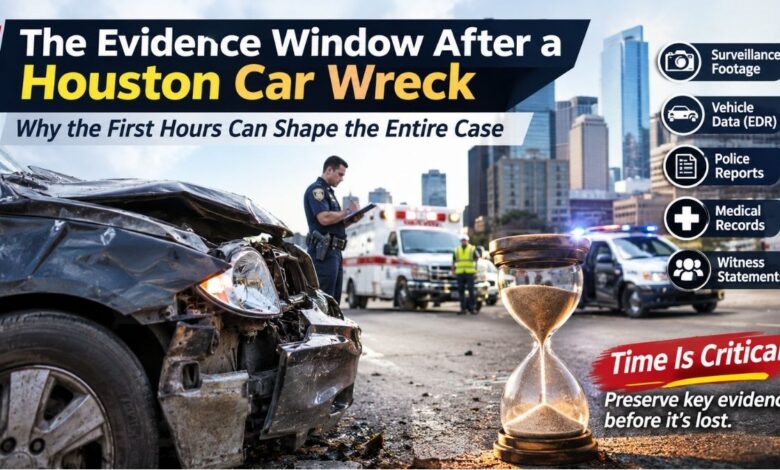
A Houston car wreck can last only seconds, but establishing what happened may take months. The most important evidence isn’t always in a police report. It may exist on a dashboard camera, inside a damaged vehicle’s electronic systems, in a nearby business’s surveillance archive, or in photographs taken before the wreckage is removed. Each source has its own limitations, and some records can disappear long before an insurance dispute or lawsuit begins.
The evidence window after a Houston car wreck is the practical period during which investigators, drivers, and their representatives can identify, secure, and verify information about the collision. It is not a fixed legal deadline. Understanding that distinction is essential to separating an accurate reconstruction from an account built on incomplete evidence.
Why the First Hours After a Houston Collision Matter
The immediate aftermath of a traffic collision is often chaotic. Emergency responders attend to injuries, police officers assess the scene, damaged vehicles are moved, and traffic resumes. Those activities are necessary, particularly when a collision occurs on a busy highway or major intersection, but they also change the physical environment that investigators may later need to examine.
Tire marks can become less visible. Broken vehicle components may be cleared away. Temporary road conditions may change. Witnesses leave, sometimes without providing contact information, while vehicles are transported to storage facilities or repair shops.
Not every collision produces the same evidentiary challenges. A minor rear-end crash with clear photographs and consistent witness accounts may be relatively straightforward. A multivehicle collision involving disputed traffic signals, commercial vehicles, or serious injuries can require a much more detailed investigation.
The central problem is not simply whether evidence exists. It is whether that evidence can still be located, preserved, authenticated, and interpreted when a dispute arises.
The Three Clocks That Determine Whether Evidence Survives
The evidence window is best understood through three different timelines: the lifespan of physical evidence, the retention period of electronic records, and the legal deadlines governing potential claims.
These timelines do not necessarily overlap.
Physical evidence can change almost immediately. Debris is removed, vehicles are repaired, and road surfaces are reopened to ordinary traffic. Electronic records may remain available longer, but their retention depends on the equipment, operator, and applicable policies. Legal deadlines often extend for months or years, even though the evidence needed to support a claim may have disappeared much earlier.
That mismatch is fundamental.
A person can remain legally entitled to bring a lawsuit while having already lost access to potentially decisive evidence.
The practical response is to identify different categories of evidence separately rather than assume that filing a police report or notifying an insurer automatically preserves everything.
Surveillance Cameras: Available Footage Is Not Guaranteed Evidence
Houston’s extensive road network creates numerous potential sources of video evidence. Businesses, apartment complexes, residences, parking facilities, and individual motorists may operate cameras capable of recording nearby traffic.
However, the presence of cameras does not establish that a collision was recorded.
A device might face the wrong direction. Its view could be obstructed. The equipment may not have been operating, or a recording may have been overwritten before anyone requested it.
One particularly important distinction concerns Houston TranStar, the regional transportation and emergency management system.
Its official frequently asked questions state:
Houston TranStar does not record video or save images from these cameras.
The statement refers to TranStar’s roadway monitoring cameras and directly challenges the assumption that every publicly visible traffic camera produces an accessible archive.
Independent recording services or other camera operators may retain footage separately, but their existence does not establish that video of a particular collision is available.
Why Original Video Files Matter
A recording is most useful when investigators can establish its origin, timing, and integrity.
An original video export may contain technical information that is absent from a screenshot or a recording captured from another screen. The surrounding footage can also provide context that a short clip cannot.
For example, a few seconds might appear to show a driver entering an intersection against a signal. A longer recording could reveal the preceding signal sequence, the movement of nearby vehicles, or an obstruction affecting visibility.
Investigators therefore need to distinguish between what video directly shows and what viewers infer from it.
Useful preservation information includes the camera’s location, the original file format, the recording date, the timestamp’s accuracy, and the circumstances under which the file was obtained.
Preserving an unaltered original alongside a separate working copy can help maintain the record’s reliability.
Vehicle Data: The Evidence That Cannot Be Seen
Modern vehicles may contain an event data recorder (EDR) that captures technical information associated with certain collision events.
According to the National Highway Traffic Safety Administration, these systems can record information such as vehicle dynamics, driver inputs, restraint use, and crash-related changes in motion. The data generally concern a short interval around a triggering event rather than an extended driving history.
This information can provide an additional perspective when witness accounts and physical evidence appear inconsistent.
An EDR may help investigators examine whether the brakes were applied before an impact or how vehicle speed changed during the recorded interval. Yet investigators must interpret the information within the system’s technical limitations.
Not every vehicle records identical data. Not every collision triggers the same recording behavior, and a stored value does not explain why a driver acted a certain way.
Federal recording standards have also evolved. A National Highway Traffic Safety Administration rule published in December 2024 extended the required pre-crash recording period for covered EDRs from five seconds to twenty seconds, with a general compliance date of September 1, 2027. That future compliance date means the newer standard should not be assumed to apply to every vehicle involved in a 2026 collision.
Who Can Retrieve the Data?
Texas Transportation Code Section 547.615 places restrictions on access to information recorded by qualifying vehicle recording devices.
Retrieval by someone other than the owner generally requires a recognized legal basis, such as owner consent or a court order, subject to specified statutory exceptions. Certain location-data requests face additional restrictions.
Consequently, recovering vehicle data is not necessarily as simple as connecting diagnostic equipment.
Vehicle ownership, consent, technical accessibility, and the circumstances of the investigation all matter. In a serious or disputed collision, preserving the relevant vehicle or electronic module before substantial repairs or disposal may become important.
Police Reports: An Official Record, Not a Complete Reconstruction
Police collision reports are among the most familiar documents associated with road accidents. They provide structured information about the incident, the vehicles involved, and observations gathered during the investigation.
Under Texas Transportation Code Section 550.062, an investigating officer must electronically submit a qualifying collision report to the Texas Department of Transportation within 10 days when the collision involves injury, death, or apparent property damage of at least $1,000 to one person’s property.
The Houston Police Department states that its accident reports generally take five to eight days to process before becoming available.
A completed report can help establish the recorded circumstances of a collision, but it should not be confused with every possible source of supporting evidence.
TxDOT specifically explains that its crash-report records do not include investigative materials such as officer photographs, field notes, or dashcam videos. Requests for those materials must be directed to the investigating agency.
That distinction creates an important investigative challenge: obtaining the crash report is only one part of obtaining the relevant record.
An officer’s written account does not automatically resolve every question of legal responsibility. A report may document observations or conclusions, while additional evidence can support, qualify, or challenge a particular reconstruction.
The Importance of Medical Documentation
Evidence after a collision is not limited to the roadway.
When injuries occur, medical records can help establish what symptoms were reported, what examinations were performed, which injuries were diagnosed, and what treatment followed.
The Texas Department of Insurance advises people who receive medical treatment after a wreck to retain their medical records and bills for insurance purposes.
These records can become particularly significant when there is a dispute over whether a reported condition resulted from the collision.
An early medical record does not automatically prove causation. Similarly, the absence of an immediate diagnosis does not necessarily establish that no injury occurred.
Medical causation may require consideration of examination findings, preexisting conditions, diagnostic tests, treatment history, and expert medical assessment.
The quality of the record matters more than the volume of paperwork.
Witness Testimony and the Problem of Reconstructing Memory
A witness may be able to describe details that no camera captured: a driver’s movements before impact, an unexpected lane change, a vehicle’s apparent direction of travel, or conditions at the scene.
But firsthand testimony also has limitations.
Someone who observed only the final moments before impact may not know what happened earlier. Someone watching from a distant pavement might have seen the collision without having a clear view of a traffic signal.
Different accounts should therefore be compared carefully rather than treated as mutually exclusive simply because they vary.
The most valuable witness information often concerns the person’s position, visibility, proximity, and opportunity to observe specific events.
Identifying witnesses promptly is especially useful because contact information may become difficult to obtain after people leave the scene.
Texas transportation guidance recommends collecting witness names and contact details after a collision, alongside information identifying the vehicles and drivers.
For investigators, contemporaneous photographs and witness accounts complement each other. Neither should automatically take precedence without examining what each can reliably establish.
When Insurance Investigations Begin
Once a collision is reported to an insurance company, an adjuster may examine photographs, repair estimates, statements, police records, and other available material.
The insurer’s investigation serves a different purpose from a comprehensive forensic reconstruction.
An insurance company may focus on policy coverage, liability, the extent of damage, and the reasonable cost of repairs. A more complex case may require additional engineering, medical, or accident-reconstruction analysis.
This difference explains why early preservation remains valuable even when an insurance claim appears routine.
A vehicle may be repaired before responsibility is fully disputed. Photographs may document visible damage but not reveal the condition of components before they were replaced.
Likewise, a business’s surveillance recording might become relevant only after a witness challenges the original account.
The Texas Department of Insurance encourages motorists to report accidents promptly, document damage, and retain relevant information. It also explains that motorists generally may choose their own repair shop rather than being restricted to an insurer’s suggested list.
Preservation and disclosure are separate decisions. Keeping a complete original record does not require publicly distributing sensitive footage, medical information, or private correspondence.
Legal Deadlines Are Different From Evidence Deadlines
Texas generally provides a two-year limitations period for many personal-injury claims under Civil Practice and Remedies Code Section 16.003, although exceptions and different rules can apply.
That period does not guarantee evidence will remain available for two years.
A significant distinction also applies when a potential claim involves a governmental entity.
Under the Texas Tort Claims Act, governmental units generally must receive notice of qualifying claims within six months, subject to statutory provisions and exceptions.
Houston’s city charter requires 90 days’ notice for certain claims against the city. Whether it applies, and whether an exception is available, depends on the circumstances.
These shorter notice provisions can be consequential in crashes potentially involving government-owned vehicles or alleged governmental responsibility.
A person should therefore avoid treating the ordinary two-year limitations period as the only deadline that matters.
An important investigative distinction emerges: preserving evidence, notifying insurance, providing governmental notice, and filing a lawsuit are separate procedural matters. Completing one does not automatically satisfy the others.
What a Reliable Evidence Timeline Looks Like
No universal number of hours determines how long Houston crash evidence remains recoverable. Nevertheless, a practical sequence can reduce the risk that important records will be overlooked.
- Immediately after the collision: Prioritize medical assistance and roadway safety. When safe, record vehicle positions, damage, surrounding conditions, identifying information, and witnesses.
- During the earliest practical preservation period: Identify potential dashcam and surveillance sources, request preservation where appropriate, and retain original recordings rather than relying only on edited copies.
- Before major vehicle repairs or disposal: Consider whether electronic data or physical components may require examination, particularly in a disputed or serious collision.
- As records become available: Obtain the appropriate police report and identify whether additional investigative records must be requested separately.
- Throughout an insurance or legal investigation: Preserve medical documentation, repair records, correspondence, and a clear record of when you obtained or transferred evidence.
The sequence is not a statutory timetable. It reflects the different ways evidence can change, become unavailable, or require formal procedures to obtain.
The Difference Between Preserving Evidence and Proving Fault
Even a comprehensive collection of evidence does not guarantee that responsibility can be established with certainty.
A damaged vehicle can show the location and extent of contact without revealing every movement that preceded it. A surveillance camera may establish timing without capturing the relevant traffic signal. Electronic information can document recorded vehicle inputs without establishing a driver’s intentions.
Reliable accident reconstruction therefore depends on examining how different sources support—or contradict—one another.
Physical damage, vehicle data, witness testimony, video recordings, roadway geometry, and medical documentation may all contribute to the broader account.
Where inconsistencies remain, the appropriate conclusion is not always a definitive assignment of fault. Sometimes the evidence supports only a narrower finding.
That restraint matters especially in cases that receive public attention, where early speculation can spread before official investigations conclude.
The Larger Lesson: Evidence Has a Life Cycle
The aftermath of a Houston collision demonstrates a broader reality about modern investigations.
Much of the relevant information exists outside a single official institution. A police department may retain certain investigative records. TxDOT maintains the formal crash-report system. Private businesses control their own surveillance archives. Manufacturers design vehicle recording systems, while motorists, medical providers, insurers, and repair facilities hold other pieces of the record.
No single source necessarily possesses the complete history of an incident.
The investigative challenge is therefore partly logistical: determining what information exists, who controls it, how long it may remain available, and what lawful process is required to preserve or obtain it.
This is where the evidence window acquires its real significance.
A photograph captured shortly after a crash may document a condition that cannot be recreated. An original recording can preserve context missing from a circulated excerpt. A vehicle examined before extensive repairs may reveal information unavailable afterward.
Each is potentially valuable because it protects the ability to test competing explanations against evidence that has not been unnecessarily altered or lost.
Conclusion
The evidence window after a Houston car wreck is not measured by one legal deadline or a universally applicable number of days. It is shaped by changing crash-scene conditions, record-keeper retention practices, vehicle technology, investigative procedures, and Texas law.
The most consequential distinction is between evidence that once existed and evidence that can still be reliably examined.
Police reports, surveillance footage, electronic vehicle records, witness accounts, and medical documentation each answer different questions. Their combined value depends on authenticity, context, and careful interpretation.
A responsible investigation does not assume that every missing record proves misconduct or that every available recording provides a complete explanation.
It establishes what can be verified, identifies what remains uncertain, and preserves the strongest available factual foundation before crucial information disappears.
That is the purpose of the evidence window: not to guarantee a particular outcome, but to protect the possibility of reaching an accurate one.

