Complio Explained: The Essential Guide to Clinical Compliance, Features, Costs, and Student Requirements

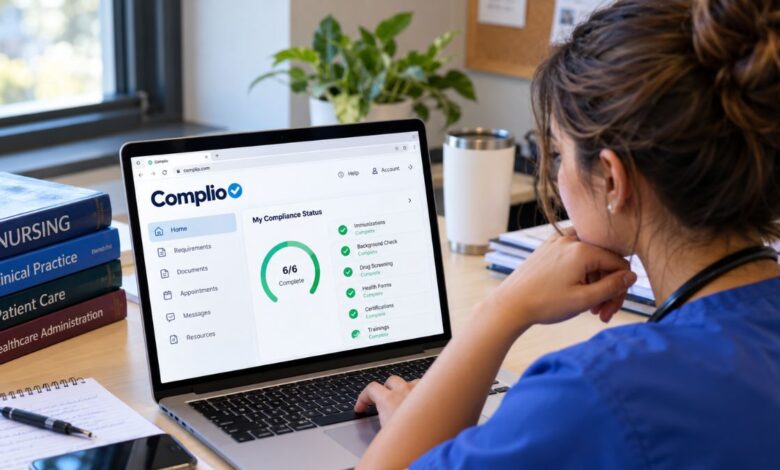
Complio is a web-based clinical compliance management platform designed to help healthcare students, universities, and clinical training programs manage essential documentation and screening requirements. Originally developed by American DataBank and now part of DISA Healthcare, Complio simplifies the process of tracking immunization records, background checks, drug screenings, certifications, and other clinical requirements. By providing a centralized system for uploading documents, monitoring compliance status, and receiving expiration notifications, the platform helps students prepare for clinical placements while supporting institutional compliance
What Is Complio?
Complio is a web-based clinical compliance management platform used by universities, healthcare education programs, and clinical training organizations to collect, review, and monitor student compliance documentation. Originally developed by American DataBank, the platform operates within DISA Healthcare after DISA Global Solutions acquired American DataBank in February 2025.
For nursing students and other healthcare trainees, Complio is more than a document-upload portal. It provides a centralized system to show that required immunizations, medical screenings, background checks, certifications, and other prerequisites are completed before participating in clinical placements.
Its significance comes from a practical challenge: a student may have completed every required health screening yet still be ineligible for clinical placement because the supporting documentation has not been properly submitted, reviewed, and approved.
Complio helps institutions distinguish between completing a requirement and proving compliance.
This article examines Complio’s background, functionality, ownership, student onboarding process, pricing, security considerations, and role in healthcare education.
The Background and Development of Complio
Complio’s history is closely connected to American DataBank, a company established in 1998 that developed services for background screening, immunization tracking, and compliance management.
Healthcare education presents an unusually demanding administrative environment. Students move between classrooms, laboratories, universities, hospitals, and other clinical facilities. Each location may impose requirements that must be completed before the student can participate.
Those requirements are not necessarily identical.
A university may require a particular immunization record or certification, while an affiliated hospital may impose additional screening or onboarding conditions. Maintaining accurate documentation across these organizations can involve significant administrative work.
American DataBank developed Complio to support collecting, reviewing, and managing those requirements through a centralized online system.
The platform eventually became part of compliance procedures at numerous educational institutions, including programs associated with the University of Connecticut, the University of Michigan, and other universities.
Although American DataBank’s founding year is publicly documented, a definitive independent launch date for the Complio software itself has not been established from the available official corporate history. The company’s 1998 founding date should therefore not be confused with the software’s release date.
The 2025 Acquisition That Changed Complio’s Corporate Position
A major development occurred on February 4, 2025, when DISA Global Solutions announced its acquisition of American DataBank.
The transaction followed DISA’s 2024 acquisition of CastleBranch, reflecting a broader expansion into healthcare screening and compliance technology.
At the time of the American DataBank acquisition, DISA also announced the creation of a dedicated Healthcare Technology division.
David Dickson was named to lead the new division, bringing together capabilities involving student screening, immunization compliance, and clinical rotation management.
Toshi Akiyama, identified in the acquisition announcement as American DataBank’s founder and chief executive, publicly supported the combination.
The acquisition’s corporate importance extends beyond a change in ownership. Universities increasingly need systems that can coordinate student documentation with clinical placement processes, screening providers, and healthcare facilities.
Bringing different compliance services into the same corporate organization could allow closer coordination across these activities.
However, an announced integration strategy should not be mistaken for proof that every feature or software system has already been combined.
DISA has also published a notice describing an intended internal merger of American DataBank into its parent company, while stating that existing services, pricing arrangements, and established processes would continue without interruption.
How Complio Works for Healthcare Students
For most students, using Complio begins after receiving instructions from their university or clinical training program.
Institutions generally determine which requirements apply, which subscription package a student needs, and the deadlines for submitting documentation.
A typical process involves several stages.
Account creation and subscription
Students establish an account through the enrollment route designated by their institution. Depending on the program, this may involve a university-specific Complio portal or an institutional login.
Some programs require students to purchase a compliance tracking subscription before they can view and complete their assigned requirements.
Collecting documentation
The student gathers the documents required for clinical clearance. These may include vaccination records, laboratory reports, tuberculosis testing information, professional certifications, or completed institutional forms.
Submitting records
Upload documents and associate them with the appropriate requirement. Students may also need to enter additional details, including the date of an immunization, the type of screening performed, or a laboratory result.
Review and verification
Submitted information enters a review process. Compliance personnel assess whether the documentation satisfies the applicable requirement.
An uploaded document does not automatically mean the requirement has been approved.
Maintaining compliance
Students must monitor their status and update records when certifications expire, new requirements are introduced, or further documentation becomes necessary.
The process can continue throughout an academic program.
The Difference Between Uploading Documents and Becoming Compliant
One of the most important aspects of Complio is the distinction between document submission and accepted compliance.
The University of Connecticut explains that documents are reviewed according to the specific requirements to which they are attached.
Consider a student who receives one laboratory report containing results for measles, mumps, and rubella immunity.
Although the report includes all three results, attaching it only to the measles requirement may not satisfy the separate mumps and rubella requirements.
The document may need to be associated with each applicable category.
This procedural detail explains why students sometimes experience delays even after submitting documentation that appears complete.
Another issue is document quality.
Records may be rejected because they are incomplete, unreadable, missing required identification, or lacking the information the institution requires.
A laboratory report, for example, may need to show the patient’s name, the relevant testing dates, provider information, and interpretable results.
The practical lesson is that successful submission is not the same as successful verification.
A student should check the status of each requirement rather than assuming that an uploaded file has been accepted.
Key Features of the Complio Platform
Complio’s functionality depends partly on the services an institution purchases or enables.
Its established capabilities include several important areas.
Immunization tracking
Students can submit vaccination records, laboratory evidence of immunity, and related documentation. The system supports tracking requirements that may need renewal or additional verification.
Background screening
Where included in the relevant package, the platform supports ordering and tracking background screening services.
Drug screening management
Students may be directed to order required drug screening services through their institutional Complio process.
Document management
The platform provides a centralized location to store and review compliance-related submissions.
Compliance status monitoring
Users can review individual requirement statuses and determine whether additional documentation or action is necessary.
Expiration notifications
The platform can notify students when existing compliance documents approach expiration or when an update is required.
Clinical onboarding support
Institutional implementations may include functionality supporting clinical placement requirements, document sharing, and other onboarding activities.
These capabilities are particularly valuable in programs where clinical participation depends on maintaining multiple overlapping forms of clearance.
Why Universities and Healthcare Programs Use Complio
Universities do not use Complio simply because they need an online filing cabinet.
The underlying challenge involves accountability.
A student may meet a course’s academic requirements but still lack permission to enter a clinical facility. Healthcare training programs must confirm that required checks are complete before students begin working in environments involving patients, staff, and sensitive information.
An organized compliance platform can help administrators identify missing documents and monitor readiness across student groups.
It also creates a more consistent process for handling recurring requirements.
For example, a student may obtain an accepted certification during one semester, only to find that it will expire before a later clinical rotation.
A system that tracks expiration dates allows the student and institution to identify that problem before the next placement begins.
The University of Connecticut explicitly warns that students who fail to maintain required compliance may be delayed in starting placements or removed from placements when their status lapses.
This illustrates Complio’s practical importance: a compliance problem can become an academic scheduling problem, with potential consequences for clinical hours and program progression.
Complio Pricing and Subscription Costs
Complio does not have one universal student price that applies to every institution.
Costs depend on the specific package, subscription duration, screening requirements, and arrangements established by the educational program.
For example, Linfield University’s School of Nursing publishes a $129.40 Complio bundle covering a background check, drug screening, and a 30-month immunization tracking subscription.
The university breaks that figure into $92.10 for background and drug screening services and $37.30 for the tracking subscription.
That published price is an institutional example, not a standard rate for all Complio users.
Students may also face separate expenses for medical appointments, immunizations, laboratory work, and other services necessary to meet program requirements.
These costs are distinct from the fee charged for document tracking or screening administration.
Before purchasing a package, students should confirm the correct product with their institution. Buying the wrong package may create unnecessary expenses or require additional steps.
Complio Login and Account Management
Complio provides web-based account access, with DISA Healthcare maintaining an official DISA Complio login and student support resource.
New users generally need to follow the instructions issued by their educational institution.
Existing users can return to the platform to review their records, monitor outstanding requirements, and submit updates.
The exact login procedure may differ between institutions, particularly where university authentication systems are integrated.
Students should avoid assuming that the first website found through an internet search is necessarily their institution’s authorized enrollment page.
The safest approach is to use the university-provided portal or official DISA Healthcare login resources.
Account access alone also does not establish compliance. A student must still complete the applicable requirements and obtain the necessary approvals.
Data Security and Privacy Considerations
Because Complio manages potentially sensitive information, privacy and security are central concerns.
Depending on the required services, student accounts may contain medical records, immunization histories, identification information, and background-screening details.
Universities using the platform describe it as a system for managing and protecting compliance documentation.
However, institutional statements about security should not be interpreted as an unconditional guarantee that information can never be exposed or accessed improperly.
Students should understand which organizations are authorized to review their information, how records may be shared with clinical partners, and what rights they have regarding their data.
Access and disclosure arrangements can depend on the institution, the specific service being used, and applicable privacy or consumer reporting laws.
A useful precaution is to retain personal copies of important documents outside the compliance portal and review the relevant privacy terms before sharing sensitive records.
Students should also protect their account credentials and avoid sending medical documents through unofficial channels.
Complio and Other Clinical Placement Systems
Complio is sometimes used alongside separate platforms rather than replacing every administrative system involved in healthcare training.
Linfield University, for instance, describes using Complio to manage personal student compliance while using ACEMAPP for clinical-site compliance and placement-related activities.
This distinction matters.
A system that establishes whether students satisfy health and screening requirements is not necessarily the same system that assigns placements, records clinical hours, or coordinates every activity at a hospital.
Different applications may exchange information or support related workflows, but their responsibilities can remain separate.
Students who receive instructions to use more than one system should not assume that uploading a document into one automatically fulfills every requirement in another.
Limitations and Common Challenges
Complio can organize the compliance process, but it cannot eliminate the requirements imposed by educational institutions or clinical facilities.
Several challenges remain.
Document rejection: Records that fail institutional verification requirements may need correction and resubmission.
Multiple deadlines: A student’s overall compliance status can be affected by different expiration dates across several categories.
Institution-specific rules: Requirements may vary between programs and clinical sites, even when students use the same platform.
Additional expenses: Screening services and medical requirements can impose costs beyond the basic tracking subscription.
Review periods: Submission does not necessarily result in immediate approval.
Administrative dependency: Students may need assistance from their university when a question concerns an institutional requirement rather than the software’s technical operation.
These limitations do not establish that Complio is ineffective. They reflect the broader complexity of clinical compliance, where software supports a process involving students, institutions, reviewers, and healthcare facilities.
This distinction matters when evaluating the platform fairly.
Is Complio a Legitimate Platform?
Yes. DISA Complio is an established clinical compliance platform associated with American DataBank and DISA Healthcare.
Its use is documented through official university resources, institutional compliance guidance, and DISA’s corporate materials.
However, the platform’s legitimacy does not mean every website using the Complio name is connected to DISA.
Students should verify unfamiliar login pages and payment requests through their university or the official platform provider.
Complio also does not independently determine every academic admission, licensing, or clinical placement decision. Institutions and relevant authorities retain responsibility for their own decisions.
The Future of Complio Under DISA Healthcare
Complio’s position within DISA Healthcare places it in a corporate structure focused on screening, compliance management, and healthcare education technology.
The combination of American DataBank and CastleBranch reflects an effort to bring related services under a broader healthcare technology organization.
DISA has publicly identified expanded technology capabilities and closer clinical integration among its strategic objectives.
Whether these initiatives significantly improve usability, processing efficiency, or institutional coordination will depend on implementation and the experiences of participating organizations.
Publicly verified performance data is insufficient to conclude that the acquisition has already produced particular improvements in processing speed or reduced student costs.
The platform’s long-term value will ultimately be measured by its reliability, the clarity of its compliance processes, its handling of sensitive information, and its ability to support students and administrators without unnecessary complications.
Conclusion
Complio occupies an important administrative position within healthcare education by providing a structured method for collecting, reviewing, and monitoring clinical compliance documentation.
Its development through American DataBank and subsequent placement within DISA Healthcare explain its corporate background, while its adoption by educational institutions demonstrates the practical need it serves.
For students, the key point is that compliance requires more than having the correct medical records or certifications.
Documents must be submitted accurately, reviewed under the applicable institutional rules, and maintained throughout the relevant period.
Complio provides the technology to help manage that process. Responsibility for completing requirements remains shared among students, educational programs, and the organizations that review and enforce clinical standards.
(FAQs)
1. What is Complio used for?
Complio manages clinical compliance documentation, including immunization records, background checks, drug screenings, professional certifications, and other prerequisites required by healthcare education programs.
2. Is Complio owned by American DataBank or DISA Healthcare?
Complio was developed by American DataBank. DISA Global Solutions acquired American DataBank in February 2025, and the platform is now branded and supported within DISA Healthcare.
3. How much does Complio cost?
Pricing varies by university, program, subscription length, and screening package. Students should check their institution’s specific requirements and fees before purchasing a subscription.
4. Why does Complio show a non-compliant status after documents are uploaded?
A non-compliant status may indicate missing information, rejected documentation, incomplete requirements, an expired record, or a submission that has not yet received the necessary approval. Students should review the relevant category and any reviewer comments.
5. Can students attend clinical placements without completing Complio requirements?
Where an institution requires Complio for clinical clearance, students generally must satisfy the applicable compliance requirements before participating in placements. The specific consequences and deadlines are determined by the educational institution and its clinical partners.