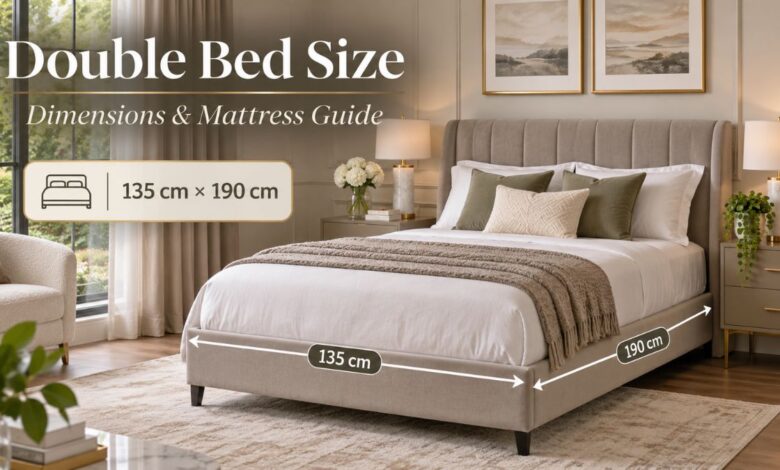
A practical guide to standard double bed measurements, mattress sizes, room requirements, and the differences between UK, US, and international bed dimensions.
In the United Kingdom, a double bed is commonly understood as a mattress measuring 135 cm wide and 190 cm long (4 feet 6 inches by approximately 6 feet 3 inches). However, dimensions aren’t universal. In the United States, a standard double bed, also called a full bed, measures 54 inches wide and 75 inches long, or approximately 137 × 191 cm. These differences may seem small, but they matter when buying mattresses, bed frames, and fitted sheets.
For anyone furnishing a bedroom, the key question isn’t simply whether a double bed will fit. It is whether the mattress provides enough sleeping space while leaving sufficient room for movement, furniture and everyday activities.
This guide explains standard double bed dimensions, regional variations, comparisons with other mattress sizes, and the practical considerations that help buyers make informed decisions.
What Is a Standard Double Bed Size?
A standard double bed is designed to accommodate two adults, although it offers considerably less personal sleeping space than a king-size mattress.
In the UK, the standard double mattress measures 135 × 190 cm, equivalent to approximately 53 × 75 inches. The traditional imperial description is 4 feet 6 inches wide by 6 feet 3 inches long.
These measurements refer to the mattress itself, not the complete bed frame. A wooden frame, upholstered surround, or storage bed can take up extra floor space depending on its construction.
A double mattress remains a popular option because it balances sleeping comfort with bedroom space. It can work particularly well for couples in moderately sized bedrooms, individual sleepers who prefer extra room, and guest bedrooms that need to accommodate different visitors.
However, the word double does not guarantee identical measurements across countries. Buyers should always confirm the actual dimensions before ordering.
Double Bed Sizes in Different Countries
One of the most overlooked details when buying a bed is that mattress sizing conventions vary internationally.
A product described as a double bed in one market may not match the measurements used elsewhere.
United Kingdom
The standard UK double mattress measures 135 × 190 cm.
It is a widely available option for adult bedrooms, guest rooms and rental properties. UK retailers generally distinguish between small double, standard double, king and super king sizes.
United States
In the United States, a double mattress is usually called a full-size mattress.
Its standard dimensions are 54 × 75 inches, approximately 137 × 191 cm.
Although this is close to the UK double size, the measurements are not identical. The difference can affect the fit of tightly tailored mattress protectors and fitted sheets.
European Countries
European mattress dimensions vary by country and manufacturer.
Common two-person mattress sizes include 140 × 200 cm, 160 × 200 cm and 180 × 200 cm.
A 140 × 200 cm mattress is sometimes marketed as a double, while 160 × 200 cm may be described as a queen or another regional size designation.
Because European naming conventions aren’t fully standardized, dimensions are more reliable than labels.
Australia
In Australia, a standard double mattress typically measures 138 × 188 cm.
This makes it slightly wider but shorter than a standard UK double mattress.
Australian queen and king mattresses use different measurements from their UK counterparts, so direct comparisons are especially important.
Double Bed Size vs Queen Size
Comparing double and queen beds can be confusing because queen size isn’t a universally standardized UK mattress category.
In the United States, a standard queen mattress measures 60 × 80 inches, approximately 152 × 203 cm.
This makes it wider and longer than a US full mattress.
In the UK, a standard king mattress measures 150 × 200 cm, which is relatively close to the American queen size.
However, buyers should not assume that UK king bedding will fit an American queen mattress perfectly.
Differences in width, length, and mattress depth can affect the fit.
The safest approach is to compare exact measurements rather than relying on names such as double, queen or king.
What Room Size Is Suitable for a Double Bed?
A double bed needs more floor space than its mattress dimensions suggest.
Room planning should account for the bed frame, access around the mattress, bedside furniture, wardrobes and doors.
For comfortable everyday movement, a clearance of approximately 60–75 cm around accessible sides of the bed is a useful planning guideline.
This is not a universal building requirement. The appropriate clearance depends on the bedroom layout, furniture arrangement and accessibility needs.
For example, a UK double mattress measuring 135 × 190 cm would require a clear rectangular area of about 255 × 250 cm if you provide 60 cm of space on both sides and at the foot.
This calculation excludes the bed frame’s extra dimensions.
A bedroom measuring approximately 3 × 3 meters can often accommodate a double bed, but the final layout depends on the location of doors, windows and wardrobes.
In smaller rooms, placing one side of the bed against a wall may free up floor space, although it reduces access for the person sleeping on that side.
Is a Double Bed Big Enough for Two Adults?
A standard double bed can accommodate two adults, but whether it provides sufficient comfort depends on individual sleeping habits.
Couples who prefer sleeping close together may find a double mattress entirely suitable.
Others may feel restricted, especially if one person changes position frequently during the night.
A standard UK double provides each sleeper with approximately 67.5 cm of width.
By comparison, a UK king offers 75 cm per person, while a super king provides 90 cm per person.
These differences matter when considering shoulder width, sleeping position, and movement.
For couples with significantly different sleep preferences, a larger mattress may offer practical advantages.
However, mattress firmness, motion isolation and edge support can also influence comfort. A well-constructed double mattress may provide a better sleeping experience than a poorly designed larger mattress.
Double Bed Size for Tall People
Mattress length matters most for taller sleepers.
A standard UK double mattress is 190 cm long, which may feel restrictive for someone approaching or exceeding that height.
Sleepers generally benefit from a mattress that provides some additional length beyond their standing height.
This allows room for pillows, natural sleeping positions and movement without the feet extending beyond the mattress.
A UK king mattress measures 200 cm long and may be a better choice for taller adults.
Some manufacturers also offer custom-length mattresses, although these can require specially sized bed frames and bedding.
Before purchasing, measure the sleeper’s height and consider their usual sleeping position.
Someone who sleeps fully stretched out may need more length than a person who naturally sleeps with bent knees.
Double Bed Frame Size vs Mattress Size
A common purchasing mistake is assuming that a bed frame has the same external dimensions as its mattress.
The mattress size describes the sleeping surface. The frame dimensions describe the complete furniture structure.
A double mattress measuring 135 × 190 cm may sit inside a frame that is noticeably wider and longer.
The difference depends on the design.
Minimalist metal frames may add relatively little width, while upholstered platform beds can have thick padded borders.
Storage beds may require additional clearance for drawers, and ottoman beds need suitable space for the mattress platform to lift.
Headboards can also increase the furniture’s overall length or height.
Always check three measurements before purchasing: mattress dimensions, frame dimensions and available bedroom space.
These figures are particularly important when fitting a bed between wardrobes, walls or other fixed furniture.
Choosing the Right Double Mattress
Mattress dimensions are only one part of the buying decision.
The internal construction determines how the mattress supports body weight, responds to movement and regulates temperature.
Memory Foam Mattresses
Memory foam responds to pressure and body heat, allowing the surface to contour around the sleeper.
Some people appreciate its pressure-relieving properties, particularly around the shoulders and hips.
However, foam composition and ventilation affect how warm the mattress feels.
Pocket-Sprung Mattresses
Pocket-sprung mattresses contain individual springs housed in fabric pockets.
Because the springs respond independently, they may help reduce movement transfer between sleeping partners.
Comfort depends on spring design, upholstery layers, and overall construction, not spring count alone.
Hybrid Mattresses
Hybrid mattresses combine spring support systems with foam, latex, or other comfort materials.
Their performance varies considerably by manufacturer.
A hybrid label does not automatically indicate superior quality, so buyers should examine the actual construction and warranty terms.
Latex Mattresses
Latex mattresses are known for their responsive feel and elastic support.
Natural and synthetic latex products differ in composition, and individual models vary in firmness and ventilation.
The best mattress provides support that suits the sleeper’s body, preferred position, and comfort needs.
Double Bed Size and Bedding Measurements
Correctly sized bedding helps protect the mattress and maintain a comfortable sleeping surface.
For a standard UK double mattress, a fitted sheet is typically designed for 135 × 190 cm.
However, fitted sheets also have a depth measurement.
A 30 cm thick mattress may require a deeper fitted sheet than a 20 cm thick mattress.
Mattress toppers can increase the total depth further.
Duvet sizes are different from mattress sizes.
A standard UK double duvet commonly measures 200 × 200 cm, allowing fabric to extend over the sides of the mattress.
Some couples prefer a larger duvet to reduce the likelihood of one person pulling the covers away from the other.
When buying bedding from international retailers, confirm the measurements in centimeters because regional labels may differ.
Advantages of a Double Bed
A double bed offers several practical benefits for households that need to balance comfort and available space.
Its relatively compact dimensions make it suitable for many bedrooms where a king-size mattress would restrict movement.
Standard double mattresses and bedding are widely available, providing buyers with a broad selection of materials, designs, and price points.
For individual sleepers, a double offers considerably more room than a single mattress.
It can also provide flexibility in guest bedrooms, accommodating either one adult or two visitors.
Another advantage is furniture compatibility. Many bedroom furniture collections include frames designed for standard double mattresses, making it easier to coordinate beds with wardrobes, bedside tables and storage units.
The main limitation is shared sleeping width.
For couples who value personal space, a double may feel restrictive compared with larger alternatives.
How to Measure Your Bedroom Before Buying a Double Bed
Accurate measurements can prevent costly mistakes.
Start by measuring the room’s width and length, including any alcoves or architectural features that affect furniture placement.
Next, identify the position of doors, windows, radiators and built-in wardrobes.
Check whether doors and drawers can open fully after the bed is installed.
The external dimensions of the proposed bed frame should then be compared with the available floor space.
It is also sensible to measure access routes, including staircases, hallways and door openings.
Some bed frames can be assembled inside the bedroom, but certain mattresses and large upholstered components may be difficult to maneuver through narrow spaces.
If you’re buying a storage bed, confirm the clearance needed to operate its drawers or lifting mechanism.
These checks are particularly important in apartments, loft conversions and older properties with restricted access.
Common Mistakes When Buying a Double Bed
The first mistake is relying solely on the mattress size name.
A double bed purchased from an international retailer may use different dimensions than the local standard.
Another common issue is measuring the mattress but ignoring the frame’s external dimensions.
This can result in furniture that technically fits the room but leaves too little space to move around.
Buyers also sometimes overlook mattress depth when purchasing fitted sheets.
A sheet with inadequate pocket depth may repeatedly slip off the mattress corners.
Finally, choosing a mattress solely because it feels comfortable during a brief showroom test can be misleading.
Support, temperature regulation and pressure relief are best evaluated over a longer period.
Where available, a reasonable home trial period and clearly explained return policy can reduce the risk of an unsuitable purchase.
How to Choose Between a Double and King Bed
The decision between a double and king mattress should begin with the people who will use it.
For one adult, a standard double can provide generous sleeping space without occupying excessive floor area.
For two adults, the extra width of a king may improve comfort, especially if both sleepers prefer more room.
Height is another consideration.
A UK king is 10 cm longer than a standard double, making it potentially more suitable for taller individuals.
Bedroom dimensions may ultimately determine the choice.
A larger mattress that leaves inadequate access to wardrobes or doors can make a room less practical.
Budget also matters because larger mattresses, frames and bedding generally cost more.
A carefully selected double bed with a suitable mattress may be a better investment than a larger bed that compromises room layout or mattress quality.
Conclusion
The standard double bed size in the UK is 135 × 190 cm, while the equivalent US full-size mattress measures approximately 137 × 191 cm. Although these dimensions are similar, international variations mean that mattress labels should never replace accurate measurements.
A double bed can be an excellent choice for individual sleepers, guest rooms, and couples comfortable sharing a relatively compact sleeping surface.
However, selecting the right bed involves more than checking width and length. Mattress construction, frame dimensions, sleeper height, bedding compatibility and available bedroom space all influence the final decision.
For buyers who need a balance between comfort, affordability and efficient use of space, a standard double remains a practical option. Those who prioritize extra sleeping space, particularly taller individuals and couples, may find a king-size mattress better meets their needs.
(FAQs)
1. What is the standard double bed size in the UK?
A standard UK double bed mattress measures 135 cm wide and 190 cm long, commonly described as 4 feet 6 inches by 6 feet 3 inches. Bed frames may be larger than these measurements.
2. What is a double bed size in feet?
A standard UK double bed is approximately 4 feet 6 inches wide and 6 feet 3 inches long. In the United States, a full or double mattress measures exactly 4 feet 6 inches wide and 6 feet 3 inches long.
3. Is a double bed suitable for two people?
Yes. A standard double mattress can accommodate two adults, although each person receives approximately 67.5 cm of sleeping width on a UK double. Couples who prefer additional personal space may find a king-size bed more comfortable.
4. What is the difference between a double bed and a king bed?
A standard UK double mattress measures 135 × 190 cm, while a UK king measures 150 × 200 cm. The king adds 15 cm of width and 10 cm of length, offering more room for couples and taller sleepers.
5. What size bedroom is best for a double bed?
A bedroom measuring approximately 3 × 3 meters can often accommodate a standard double bed, depending on the furniture layout. Ideally, allow around 60–75 cm of clearance along accessible sides for comfortable movement, and account for the full bed frame, not just the mattress.