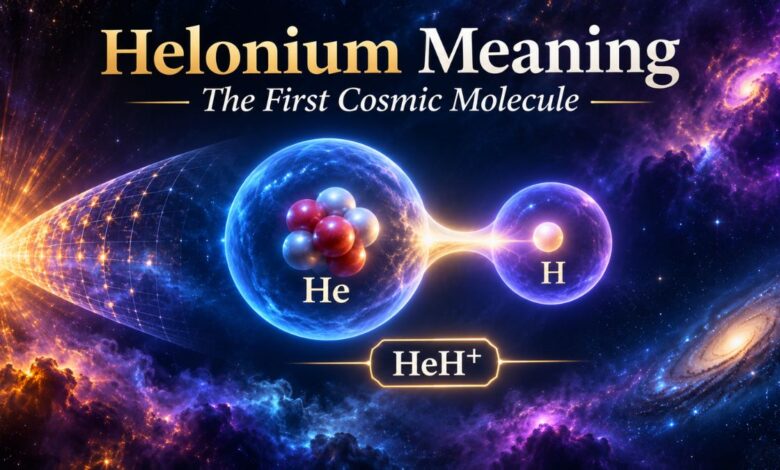
Helonium refers to the helium hydride ion, a positively charged molecular species represented by the chemical formula HeH⁺. It consists of helium and hydrogen joined by a chemical bond. Although the name resembles that of an element, helonium is not listed on the periodic table. Its scientific importance lies in its extraordinary history: researchers believe helium hydride was the first type of molecule to form after the Big Bang.
For decades, scientists understood its chemistry but struggled to identify it in space. That changed in 2019, when astronomers confirmed its presence in a distant planetary nebula. The discovery strengthened a fundamental theory about how chemistry began in the early universe.
What Is Helonium Meaning in Science?
Helonium is an alternative name for the helium hydride cation, HeH⁺. The more frequently used scientific designation is helium hydride ion.
Unlike ordinary neutral molecules, this species carries a positive electrical charge. Its structure contains one helium nucleus, one hydrogen nucleus, and two electrons.
Helium generally behaves as a chemically unreactive noble gas because its electron shell is complete. Under suitable conditions, however, helium can form molecular bonds when a proton is involved.
This unusual behavior makes HeH⁺ particularly interesting to chemists studying molecular structure, electrical charge, and reactions involving simple atoms.
The name helonium refers to protonated helium. It is not a newly discovered element, a commercial material, or another name for ordinary helium gas.
Understanding that distinction matters because helium and helonium have dramatically different chemical properties.
The Chemical Formula and Structure of Helonium
Helonium’s chemical formula is HeH⁺.
Each part of the formula communicates something important:
- He: Represents helium, a noble gas with atomic number 2.
- H: Represents hydrogen, the lightest chemical element.
- ⁺: Indicates that the molecular species has one positive electrical charge.
The ion can be understood as a helium atom bonded to a proton.
Because it consists of two different atomic nuclei, it belongs to a class of species called heteronuclear diatomic molecules or molecular ions.
Its simple structure makes helium hydride especially useful in theoretical chemistry. Scientists can examine its electronic behavior and compare experimental measurements with quantum-mechanical calculations.
Why Helonium Is Different From Ordinary Helium
The difference between helium and helonium extends far beyond their names.
Helium is exceptionally unreactive under ordinary conditions. Its electronic configuration makes it resistant to forming conventional chemical bonds.
Helonium, by contrast, is a highly reactive positive ion.
An isolated HeH⁺ ion can remain intact under appropriate conditions, but it reacts readily when it encounters many neutral atoms or molecules.
This explains why helium hydride can be studied in specialized laboratory environments and detected in space without being a substance normally stored in everyday containers.
Its scientific importance comes from its molecular behavior rather than any practical consumer application.
The Origin of Helonium: Chemistry After the Big Bang
The history of helium hydride is closely tied to the universe’s earliest stages.
Immediately following the Big Bang, conditions were too hot for ordinary neutral atoms and molecules to survive. Matter existed in an extremely energetic environment containing atomic nuclei, electrons, and radiation.
As the universe expanded, its temperature gradually decreased.
Helium nuclei could capture electrons to become neutral helium atoms while much of the hydrogen remained ionized.
This created conditions in which neutral helium could interact with positively charged hydrogen nuclei, commonly called protons.
One proposed early-universe formation reaction is:
He + H⁺ → HeH⁺ + photon
The photon carries away excess energy, allowing the molecular bond to form.
According to established cosmological chemistry models, helium hydride was among the earliest molecular species and is widely identified as the first type of molecule to form in the universe.
Its appearance represented an important transition from a universe containing separate atomic particles to one capable of supporting molecular chemistry.
How Helium Contributed to Early Molecular Evolution
Helium hydride did not remain the dominant molecular species.
As additional neutral hydrogen atoms became available, HeH⁺ could react with them and contribute to chemical pathways that produced molecular hydrogen (H₂).
Molecular hydrogen later became especially important because it could help primordial gas lose thermal energy under suitable astrophysical conditions.
Gas cooling is an important part of the physical processes that allow dense regions of matter to develop into stars.
Helium was therefore not a direct building block of planets or living organisms. Its importance is more fundamental: it participated in the earliest chemical pathways that preceded the much more complicated molecular processes of later cosmic history.
When Was Helonium First Discovered?
The scientific history of helium hydride contains two distinct discoveries.
The molecular ion was first identified in laboratory research in 1925. This established that helium and hydrogen could form the positively charged species under suitable experimental conditions.
However, demonstrating that a molecule exists in a laboratory is different from proving that it occurs naturally in space.
Scientists subsequently developed theoretical models suggesting that helium hydride should exist in certain astronomical environments.
Beginning in the late twentieth century, researchers investigated locations where conditions might support its formation.
Despite several attempts, convincing astronomical confirmation remained elusive for decades.
The breakthrough finally came in April 2019.
The Historic 2019 Discovery of Helonium in Space
On April 17, 2019, researchers published a major discovery in the scientific journal Nature.
An international research team led by astrophysicist Rolf Güsten reported the first definitive astronomical detection of the helium hydride ion.
The scientists identified HeH⁺ in NGC 7027, a planetary nebula approximately 3,000 light-years from Earth in the constellation Cygnus.
A planetary nebula is a cloud of gas associated with a star in a late stage of its evolution. Despite the name, it is not a nebula created by a planet.
NGC 7027 contains energetic radiation and regions of ionized gas that provide suitable conditions for producing helium hydride.
The discovery was significant because it demonstrated that an ion long predicted by astrophysical theory could exist naturally in the present-day universe.
It also provided researchers with a new opportunity to test chemical models involving helium, hydrogen, and ionized astronomical gases.
How Astronomers Detected Helonium
The detection was made using the Stratospheric Observatory for Infrared Astronomy, commonly known as SOFIA.
SOFIA was a modified Boeing 747 aircraft equipped with an astronomical telescope. Operating at high altitude allowed its instruments to observe infrared radiation that is difficult to measure from the ground because of Earth’s atmosphere.
Scientists used the GREAT spectrometer to identify a characteristic rotational transition of the helium hydride ion at about 149.1 micrometers.
Molecules and molecular ions interact with electromagnetic radiation at particular frequencies determined by their physical structure.
These characteristic patterns allow astronomers to identify chemical species in distant gas clouds without collecting physical samples.
Earlier observations struggled to separate the helium hydride signal from nearby spectral features associated with other molecules.
Improved observational technology made the 2019 identification possible.
Importantly, the researchers detected helium hydride in a relatively nearby astronomical environment, not directly in the primordial universe. The result supported the chemical models used to describe the earliest cosmic molecules.
Why Helonium Is So Reactive
Helium has unusual chemical properties because it combines helium’s tightly bound electrons with a positively charged molecular structure.
Although helium is normally resistant to chemical reactions, HeH⁺ can transfer its proton to suitable neutral molecules.
This behavior makes it an exceptionally strong proton donor.
The helium hydride ion is often discussed in theoretical chemistry as an extraordinarily strong acid. However, its acidity must be understood in the context of isolated molecular ions and gas-phase reactions.
Comparing its behavior directly with familiar liquid acids can be misleading because the environments and measurement methods differ substantially.
In laboratory conditions, helium hydride is generally investigated using controlled ion-producing equipment and specialized measurement techniques.
Its high reactivity prevents it from being handled like an ordinary stable chemical compound.
There is also an important distinction between being reactive and being inherently dangerous in everyday life.
Helonium is not a familiar household substance, and people rarely encounter concentrated samples of it.
Why Scientists Continue to Study Helonium
Helium hydride matters across several branches of scientific research.
Understanding the Earliest Chemical Reactions
Helium helps scientists investigate how chemical bonds became possible as the universe cooled.
Models describing its formation and destruction provide insight into the earliest interactions among helium, hydrogen, electrons, and radiation.
These models help explain the development of primordial molecular chemistry.
Testing Quantum Chemistry
Because HeH⁺ has a relatively simple structure, scientists can use it to test predictions about molecular energy levels, chemical bonding, and electron behavior.
Precise experimental measurements allow comparisons between physical theory and observed results.
Such comparisons can improve methods that researchers later apply to much more complicated molecules.
Improving Astronomical Spectroscopy
The identification of helium hydride illustrates the importance of sensitive astronomical instruments.
Researchers must distinguish extremely weak molecular signals from radiation produced by other particles and molecules.
Accurate laboratory measurements of molecular spectra help astronomers recognize these signals in observations of distant objects.
Investigating Planetary Nebulae
Planetary nebulae contain changing physical conditions, including ionized gases, ultraviolet radiation, and expanding material released by aging stars.
Studying HeH⁺ in these environments helps researchers understand how molecules form and disappear in regions exposed to energetic radiation.
The 2019 discovery also revealed opportunities to improve scientific estimates of the reaction rates controlling helium hydride abundance.
Helonium Meaning in Texting and Social Media
Some people encounter the word helonium outside scientific discussions and wonder whether it has a hidden meaning.
There is no well-established mainstream texting or social-media definition comparable to familiar abbreviations such as LOL or BRB.
Its documented scientific meaning refers to the helium hydride ion.
However, unusual words can also appear as fictional names, usernames, creative labels, or expressions within particular online communities.
When helonium appears in an informal message without scientific context, its intended meaning cannot be established from the word alone.
Claims that it universally describes happiness, emotional excitement, or another psychological state should not be accepted without reliable evidence of that usage.
For educational and scientific purposes, the helium hydride interpretation remains the most defensible definition.
Common Misunderstandings About Helonium
One source of confusion is the similarity between the names helium and helonium.
They do not describe the same chemical species.
Helium is a naturally occurring element, while helonium is a positively charged molecular ion containing helium and hydrogen.
Another misunderstanding concerns its discovery date.
Helonium was not first discovered in 2019. Laboratory evidence dates to 1925. The 2019 achievement was its first definitive astronomical detection.
It is also inaccurate to suggest that scientists directly observed helium hydride forming shortly after the Big Bang.
The early-universe connection comes from theoretical calculations supported by later laboratory and astronomical observations.
Finally, the phrase “first molecule in the universe” is a description grounded in current scientific models. It does not mean that researchers have recovered a surviving specimen from the universe’s earliest period.
These distinctions are essential to explaining the discovery accurately.
The Lasting Scientific Importance of Helonium
Helium demonstrates how a chemically simple species can answer questions about an extraordinarily complicated universe.
A molecular ion containing only helium and hydrogen connects laboratory chemistry with astronomical observations and cosmological models.
Its detection helped close a longstanding gap between theoretical predictions and direct evidence from space.
The discovery also highlighted a broader principle of scientific investigation: understanding the physical world often requires precise observations of substances that are difficult to detect and impossible to handle under ordinary conditions.
Helium hydride remains a valuable subject for molecular physics, chemical spectroscopy, and astrophysical modeling.
Its significance rests not on its abundance or usefulness in everyday products, but on what it reveals about the earliest stages of chemical evolution.
Conclusion
The most accurate explanation of helonium meaning is the helium hydride ion, HeH⁺, a positively charged molecular species formed from helium and hydrogen.
Scientists believe this type of molecule emerged during the earliest period of cosmic chemistry, making it important to understanding how molecular interactions began after the Big Bang.
First identified in laboratory research in 1925 and definitively detected in space in 2019, helium hydride offers a rare connection between fundamental chemistry and the history of the universe.
Its story illustrates how even the simplest molecular structures can provide evidence about the origins and evolution of matter.
(FAQs)
1. What does helonium mean in simple words?
Helonium is another name for the helium hydride ion, HeH⁺. It contains helium and hydrogen joined together and carries a positive electrical charge. Scientists believe it was the first type of molecule to form in the early universe.
2. Is helonium a real chemical element?
No. Helonium is not a chemical element and has no place on the periodic table. It is a molecular ion containing two existing elements: helium and hydrogen.
3. Why is helonium called the first molecule in the universe?
Cosmological chemistry models indicate that neutral helium atoms could bond with hydrogen ions as the early universe cooled. This reaction produced helium hydride, which researchers identify as the first molecular species to emerge after the Big Bang.
4. Where was helium hydride discovered in space?
In 2019, astronomers confirmed helium hydride in NGC 7027, a planetary nebula approximately 3,000 light-years from Earth. The discovery was made using the SOFIA airborne observatory and its specialized infrared spectrometer.
5. Is helonium dangerous or used in everyday life?
Helonium is extremely reactive, but it is not an ordinary commercial or household substance. Scientists study it mainly in specialized scientific environments and through astronomical observations. Its greatest importance lies in research into molecular chemistry and the early universe.