
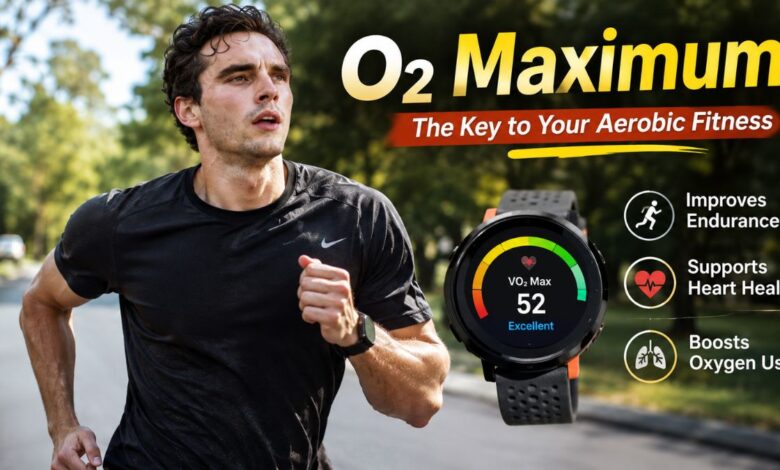
O2 Maximum, more accurately known as VO₂ max or maximal oxygen uptake, measures the highest rate at which the human body can consume oxygen during intense physical exercise. It is one of the most established indicators of cardiorespiratory fitness, reflecting the combined performance of the heart, circulation, lungs, and working muscles.
Although the measurement was once primarily associated with elite endurance athletes and exercise laboratories, it has become increasingly familiar through smartwatches, fitness applications, and preventive healthcare.
Its significance extends beyond sporting performance. Medical research has established a strong association between cardiorespiratory fitness and long-term health outcomes.
However, VO₂ max is neither a diagnosis nor a complete assessment of physical health. Understanding its value requires distinguishing measurable physiology from popular fitness claims.
What Is O2 Maximum?
O2 Maximum describes the body’s maximum oxygen consumption during demanding exercise. The established scientific notation is VO₂ max, where V̇ represents volume per unit of time, O₂ represents oxygen, and max indicates the highest attainable rate.
As exercise intensity increases, muscles need more energy. Oxygen supports aerobic energy production, allowing muscle cells to generate adenosine triphosphate (ATP).
The body’s ability to sustain this process depends on several connected functions:
- The respiratory system exchanges oxygen and carbon dioxide.
- The cardiovascular system transports oxygen-rich blood.
- Red blood cells carry oxygen through hemoglobin.
- Working muscles extract oxygen from circulating blood.
- Muscle cells use oxygen to support aerobic energy production.
VO₂ max reflects the integrated capacity of these processes rather than the performance of a single organ.
The measurement is commonly expressed in milliliters of oxygen per kilogram of body weight per minute (mL/kg/min).
For example, a person weighing 70 kilograms with a VO₂ max of 40 mL/kg/min has an absolute oxygen consumption of approximately 2.8 liters per minute at that measured maximum.
This distinction between absolute and body-weight-adjusted oxygen consumption becomes important when comparing individuals of different sizes.
The Scientific History of VO₂ Max
The scientific development of maximal oxygen uptake testing predates modern fitness technology.
British physiologist A. V. Hill and his collaborators influenced early twentieth-century investigations of muscular exercise, oxygen consumption, and physical performance.
Their research helped establish the principle that oxygen uptake has a physiological upper limit during increasingly demanding exercise.
Over subsequent decades, exercise scientists developed more sophisticated methods to measure respiratory gases, cardiovascular responses, and exercise capacity.
Researchers including Bruno Balke, Robert Bruce, and Kenneth Cooper contributed to the development and wider use of exercise testing and physical fitness assessment.
The importance of aerobic fitness eventually extended from sports science into preventive medicine.
A major development came in 1989, when Steven Blair and colleagues published influential research in JAMA examining physical fitness and mortality among men and women.
In 2016, the American Heart Association published a scientific statement recommending greater attention to cardiorespiratory fitness in clinical practice.
That statement described fitness as a potentially valuable clinical vital sign, reflecting its importance beyond athletic competition.
The history of VO₂ max therefore reveals a significant transition: a measurement developed to investigate physical performance became a tool for understanding broader patterns of human health.
How O2 Maximum Is Measured
Laboratory Exercise Testing
Direct laboratory assessment is the reference method for determining maximal oxygen uptake.
During a supervised test, an individual exercises on a treadmill or stationary bicycle while wearing a mask connected to respiratory gas-analysis equipment.
The workload gradually increases as specialized instruments measure oxygen consumption and carbon dioxide production.
Depending on the testing purpose and clinical setting, additional measurements may include heart rate, blood pressure, and electrocardiographic activity.
The test continues until an appropriate endpoint is reached.
Researchers and exercise physiologists examine the recorded responses to determine the highest oxygen uptake achieved and whether the evidence supports classifying it as a true maximum.
VO₂ Max Versus VO₂ Peak
These terms are closely related but not always interchangeable.
VO₂ max traditionally refers to maximal oxygen consumption supported by appropriate physiological criteria, such as a plateau in oxygen uptake despite increasing workload.
VO₂ peak refers to the highest oxygen consumption recorded during a particular exercise test, even when the criteria for confirming a true maximum are not met.
This difference matters because some individuals stop exercising because of muscular fatigue, discomfort, or another limiting factor before showing a clear oxygen-consumption plateau.
In clinical settings, peak oxygen uptake can still provide valuable information about functional capacity.
Smartwatch Estimates
Consumer wearable devices have made aerobic fitness monitoring more accessible.
Some smartwatches estimate VO₂ max using combinations of heart rate, movement patterns, exercise speed, and personal information.
These estimates can help monitor longer-term changes.
Nevertheless, they are not equivalent to direct laboratory measurements.
Environmental conditions, inaccurate heart-rate readings, exercise intensity, medications, and individual physiological differences can influence the estimates.
A smartwatch result should therefore be interpreted as a fitness estimate rather than a definitive medical measurement.
What Determines a Person’s O2 Maximum?
Several physiological and personal characteristics influence maximal oxygen uptake.
Cardiovascular Function
The heart’s ability to pump blood is a major determinant of oxygen delivery during exercise.
Cardiac output is the amount of blood the heart pumps each minute.
During demanding exercise, cardiac output increases to help supply active muscles with oxygen.
Endurance training can improve cardiovascular performance, including the heart’s capacity to deliver blood during intense activity.
Muscular Adaptation
Muscles must also extract and use the oxygen delivered to them.
Endurance training can increase mitochondrial content, oxidative enzyme activity, and other adaptations involved in aerobic metabolism.
These changes help explain why improving aerobic fitness requires more than simply breathing faster.
Age and Biological Differences
VO₂ max generally declines with advancing age, although the rate of change varies considerably.
Differences in heart function, muscle mass, activity levels, and other physiological characteristics influence individual measurements.
Population reference values also vary by sex and age.
Consequently, comparing two people without considering relevant characteristics can produce misleading conclusions.
Genetics and Training History
Inherited physiological traits contribute to differences in aerobic capacity and responses to exercise training.
However, genetics does not determine an unchangeable fitness score.
Regular physical activity, training intensity, exercise consistency, and recovery all affect aerobic performance.
What Is Considered a Good O2 Maximum Score?
No universal VO₂ max value defines good health.
A score should be interpreted using appropriate reference standards that consider age, sex, and testing methodology.
An endurance athlete may record a substantially higher value than a recreationally active adult, but that difference does not automatically establish that the athlete is healthier in every respect.
VO₂ max is also influenced by how a person exercises. For example, treadmill and cycling tests can produce different results, particularly among individuals unfamiliar with one activity.
The most informative interpretation considers three questions:
- How does the measurement compare with an appropriate reference population?
- How has it changed over repeated assessments?
- Does the result agree with the person’s actual exercise capacity and broader health status?
A lower-than-expected measurement may justify reviewing activity habits or discussing the result with a qualified healthcare professional. It does not, on its own, establish the presence of cardiovascular disease.
Why O2 Maximum Matters for Long-Term Health
One of the most important developments in exercise science has been the recognition that aerobic fitness carries information about health risks.
Research has consistently associated higher cardiorespiratory fitness with lower rates of cardiovascular disease and premature mortality.
The American Heart Association’s 2016 scientific statement emphasized that fitness can improve risk assessment beyond several conventional clinical indicators.
This finding is particularly important for people who do not participate in competitive sports.
A person’s ability to perform sustained physical activity can reflect functional capacity that traditional measurements, such as body weight alone, do not fully capture.
However, observational associations should not be mistaken for guarantees.
A higher VO₂ max does not make someone immune to illness. Smoking status, blood pressure, metabolic health, inherited risks, and many other factors remain important.
The strongest interpretation is that aerobic fitness provides meaningful additional information within a comprehensive health assessment.
How to Improve O2 Maximum Through Exercise
Improving aerobic capacity requires repeated physiological demands followed by sufficient recovery.
Different training approaches can produce useful adaptations.
Build a Consistent Aerobic Foundation
Moderate-intensity exercise provides an accessible starting point for many adults.
Brisk walking, cycling, swimming, and similar activities can strengthen aerobic fitness when performed consistently.
The US Centers for Disease Control and Prevention recommends that adults generally aim for at least 150 minutes of moderate-intensity aerobic activity per week, or 75 minutes of vigorous activity, or an equivalent combination.
The guidance also recommends muscle-strengthening activities on at least two days each week.
These recommendations support overall health, although an individualized program may be needed to maximize VO₂ max.
Introduce Interval Training Appropriately
Interval training alternates periods of greater effort with lower-intensity recovery.
Research indicates that appropriately prescribed high-intensity interval training can improve cardiorespiratory fitness.
A program’s effectiveness depends on the participant’s starting fitness, exercise intensity, session duration, and recovery.
Intervals are not necessarily superior for every individual.
People beginning an exercise routine may benefit more from developing consistent, manageable activity before adding demanding sessions.
Use Progressive Training
The human body adapts to repeated exercise demands.
As fitness improves, workloads that were initially challenging may become easier.
Progressive training introduces manageable increases in duration, frequency, or intensity.
The goal is to create a sufficient training stimulus without accumulating excessive fatigue.
Sudden increases in demanding exercise can create unnecessary injury or health risks, particularly for previously inactive individuals.
Protect Recovery and Consistency
Adaptation depends on the relationship between training stress and recovery.
Adequate sleep, sufficient food intake, hydration, and proper rest support consistent training.
A more demanding workout is not automatically more productive.
For many people, a sustainable training routine will produce better long-term results than repeated periods of excessive effort followed by inactivity.
O2 Maximum and Athletic Performance
VO₂ max is especially relevant to sports that require sustained aerobic energy production.
Distance running, road cycling, cross-country skiing, rowing, and other endurance activities depend heavily on the body’s ability to transport and use oxygen.
Yet VO₂ max alone cannot explain elite performance.
Two athletes with similar maximum oxygen uptake may demonstrate different results because of differences in movement economy, sustainable exercise intensity, tactical decisions, and sport-specific ability.
For distance runners, running economy describes the oxygen or energy required to maintain a particular speed.
An athlete who uses less energy at a given pace may perform more efficiently, even with a VO₂ max similar to another competitor.
The ability to sustain a high proportion of maximal aerobic capacity is also important.
This explains why the athlete with the highest measured oxygen uptake does not necessarily win every endurance competition.
VO₂ max establishes an important physiological ceiling, but performance depends on how effectively an athlete operates beneath it.
O2 Maximum and Blood Oxygen Saturation Are Different
A frequent misunderstanding involves confusing VO₂ max with oxygen saturation.
Blood oxygen saturation, often displayed as SpO₂, estimates the percentage of hemoglobin binding sites occupied by oxygen in arterial blood.
VO₂ max measures how much oxygen the body consumes during intense exercise.
These are fundamentally different measurements.
A person may have a normal resting oxygen saturation and relatively low cardiorespiratory fitness.
Similarly, a well-trained athlete’s high VO₂ max does not mean their resting oxygen saturation must be higher than that of another healthy adult.
Understanding this distinction prevents inappropriate interpretations of smartwatch and pulse-oximeter readings.
Common Misconceptions About O2 Maximum
Higher Is Always Better
Higher aerobic capacity is generally beneficial, but it should not be pursued without considering individual health, training demands, and recovery.
Extremely demanding training isn’t necessary for everyone to gain substantial health benefits.
A Single Reading Defines Fitness
One measurement offers limited insight without context.
Testing conditions, exercise modality, physiological variability, and measurement uncertainty can influence results.
Repeated measurements under similar conditions are generally more useful for tracking progress.
Breathing Exercises Alone Can Maximize VO₂ Max
Breathing practices may have specific uses, including respiratory muscle training.
However, improving maximal oxygen consumption generally requires adaptations across the cardiovascular and muscular systems.
Breathing exercises alone should not be presented as a substitute for appropriate aerobic exercise.
Weight Loss Always Means Better Fitness
Because relative VO₂ max is divided by body mass, weight changes can alter the reported number even without a proportional change in absolute oxygen consumption.
A higher relative score therefore does not always mean the heart and muscles have become physiologically more capable.
This mathematical distinction matters most when evaluating training results.
What the Future Holds for O2 Maximum Testing
Developments in wearable sensors and exercise-data analysis are increasing public access to aerobic fitness estimates.
Devices can now provide longitudinal information that previously required specialized testing environments.
However, accessibility creates new responsibilities.
Fitness estimates must be interpreted in light of their accuracy, population-specific limitations, and the consequences of misleading results.
Laboratory testing remains important when precise physiological assessment is required.
For everyday fitness monitoring, consumer devices may provide useful trends without replacing professional evaluation.
The broader significance of this technology is not merely the ability to display another number.
It is the opportunity to help people understand their physical capacity and maintain regular activity over time.
Conclusion
O2 Maximum is far more than a performance statistic displayed on a fitness tracker.
Scientifically known as VO₂ max, it provides valuable insight into the integrated capacity of the cardiovascular, respiratory, and muscular systems.
Decades of exercise research have established its importance in endurance performance and demonstrated meaningful associations between cardiorespiratory fitness and long-term health.
Its limitations are equally important. Measurement methods differ, individual results require context, and no single fitness score provides a complete picture of health.
For most people, the practical lesson is straightforward: developing and maintaining aerobic fitness through consistent, appropriately challenging physical activity is more valuable than pursuing an impressive number without understanding what it represents.
(FAQs)
1. What does O2 Maximum mean?
O2 Maximum commonly refers to VO₂ max, the highest rate at which the body can consume oxygen during intense exercise. It is an established indicator of aerobic capacity and cardiorespiratory fitness.
2. Is O2 Maximum the same as oxygen saturation?
No. VO₂ max measures oxygen consumption during exercise, while SpO₂ estimates the percentage of oxygen-saturated hemoglobin in arterial blood. The measurements serve different purposes.
3. Can beginners improve their VO₂ max?
Yes. Previously inactive adults can often improve aerobic fitness through regular exercise. The amount of improvement depends on individual physiology, training habits, and starting fitness.
4. How accurate are smartwatch VO₂ max readings?
Smartwatch estimates can help monitor fitness trends, but their accuracy varies across devices, individuals, and exercise conditions. Direct laboratory gas analysis provides a more precise assessment.
5. Does a higher VO₂ max mean a longer life?
Population research links higher cardiorespiratory fitness to lower mortality risk. However, VO₂ max does not predict an individual’s lifespan and should not be interpreted in isolation from other health factors.