
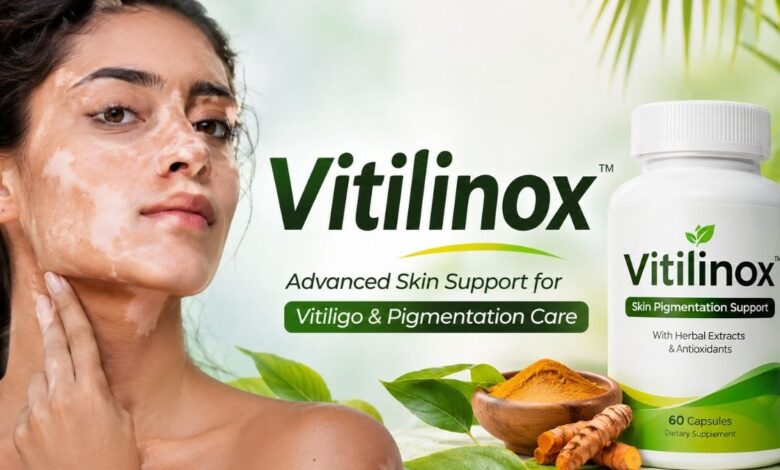
Vitilinox is a commercial name associated with dermatology and skincare, not a celebrity, individual, or medically recognized condition. Its documented history connects it to Curatio Health Care, an Indian dermatology company whose business was acquired by Torrent Pharmaceuticals in 2022. Although websites describe Vitilinox as a possible solution for vitiligo and skin pigmentation concerns, available corporate documentation does not establish a verified current formula, reliable clinical results, or an authorized retail product.
The distinction matters. A registered commercial name can have a legitimate corporate history without proving that every medical or cosmetic claim associated with it is accurate. Understanding Vitilinox therefore requires examining its original trademark records, its place within the pharmaceutical industry, and the difference between scientifically supported skin treatments and promotional promises.
What Is Vitilinox?
Vitilinox is a trademarked name appearing in Indian corporate records associated with cosmetics and pharmaceutical product categories. It has attracted online attention because of its apparent connection with vitiligo, a chronic condition in which areas of skin lose their natural pigmentation.
The most substantial documentary evidence comes from a formal scheme of arrangement involving Curatio Health Care (I) Private Limited and Torrent Pharmaceuticals Limited. In the accompanying intellectual-property schedule, Vitilinox appears under two separate trademark application numbers: 3794236 in Class 3 and 3794237 in Class 5.
Those classifications provide useful context. Class 3 broadly covers cosmetics and related personal-care products, while Class 5 includes pharmaceuticals and certain medical preparations. Registration within either class does not independently establish a product’s clinical effectiveness, manufacturing status, or regulatory approval.
Websites describing Vitilinox have presented it in different ways, including as a topical skincare formulation and a nutritional supplement. These descriptions cannot automatically be reconciled into a single established product identity.
The available evidence supports the existence of the commercial name. It does not establish that all products advertised under that name are identical.
The Corporate History Behind Vitilinox
The commercial history of Vitilinox begins with Curatio Health Care (I) Private Limited, a company established in India in 2005 with activities spanning dermatology, cosmetology, and related healthcare products.
Trademark information records an application date of April 2, 2018, for Vitilinox under the cosmetics category. This offers a documented starting point for the brand name, but it should not be confused with an official product launch.
Businesses frequently register names before introducing products, and some trademarks never become commercially successful brands. The available filings do not establish when Vitilinox first reached customers, whether a specific formulation was manufactured at scale, or who originally developed its proposed ingredients.
A significant corporate development followed in 2022.
Torrent Pharmaceuticals, a major Indian pharmaceutical company, agreed to acquire Curatio in September 2022. Its annual report confirms that the transaction was completed on October 14, 2022, with a purchase consideration of ₹2,000 crore.
Curatio’s portfolio included more than 50 brands marketed in India, particularly within cosmetic dermatology. The acquisition strengthened Torrent’s position in that sector. A subsequent amalgamation was approved by the National Company Law Tribunal on May 17, 2023.
Vitilinox’s appearance in the trademark schedule is significant because it confirms a corporate connection independent of current promotional websites.
Nevertheless, Curatio’s acquisition value must not be presented as Vitilinox’s value. Verified financial data for Vitilinox as an individual brand has not been publicly established through the documents reviewed.
Why Vitilinox Became Associated With Vitiligo
The connection between Vitilinox and vitiligo is understandable from the name and the skincare-focused context in which it appears. However, similar language is not a substitute for evidence of a product’s intended medical use.
Vitiligo is a chronic autoimmune disorder that causes areas of the skin to lose pigmentation. According to the US National Institute of Arthritis and Musculoskeletal and Skin Diseases, the condition develops when the immune system attacks melanocytes, the cells that produce skin pigment.
The resulting patches may affect the face, hands, feet, limbs, and other body areas. Hair growing within affected regions can also lose color. Vitiligo is not contagious, and people may experience substantially different patterns of pigment loss.
For someone living with the condition, the practical question is whether a treatment can stop new patches from appearing or restore pigmentation in existing ones.
Online marketing for Vitilinox sometimes mentions melanocyte support, antioxidant ingredients, and improved skin appearance. Yet those phrases describe proposed effects rather than independently demonstrated clinical outcomes.
An ingredient with antioxidant properties does not automatically restore melanocyte function. Similarly, reducing dryness or improving skin appearance does not necessarily mean an autoimmune pigment disorder has been treated.
That distinction is central to evaluating the claims made about Vitilinox.
What Do We Know About the Ingredients?
No complete, independently authenticated ingredient specification for a single current Vitilinox product was established through the corporate and medical records reviewed.
Online descriptions mention different ingredients and product forms, including botanical extracts, vitamins, antioxidants, and moisturizing substances. Without a verified manufacturer-issued formulation, however, assigning those ingredients to a definitive Vitilinox recipe would be misleading.
A credible product specification should provide the formulation, ingredient quantities where appropriate, manufacturing details, directions for use, and relevant safety warnings.
These details are especially important when a product is advertised for skin conditions requiring medical assessment.
The difference between a topical cream and an oral supplement is not minor. Each has different exposure routes, possible adverse effects, dosing considerations, and regulatory requirements.
Until a specific formulation can be authenticated, statements about Vitilinox’s exact contents should remain provisional.
Does Scientific Research Support Vitilinox?
The central evidentiary problem is straightforward: no independently verified, product-specific clinical trial establishing the effectiveness of Vitilinox for vitiligo was identified in the research reviewed for this article.
That does not demonstrate that every product using the name is ineffective. It means claims of reliable repigmentation, particular success rates, or lasting medical benefits have not been substantiated to the standard required for confident reporting.
There is also an important potential source of confusion.
A differently named product, Vitilinex, appears in published research concerning herbal preparations and phototherapy for vitiligo. A PubMed-indexed study investigated Vitilinex alongside narrowband ultraviolet-B treatment.
That study does not validate Vitilinex. Similar names do not establish identical formulations, manufacturers, or clinical effects.
Any promotional claim relying on clinical research should identify the precise product studied, its ingredients, its trial design, and the outcomes measured.
Without those connections, citing research into another formulation creates an appearance of scientific support that the evidence does not justify.
How Vitilinox Compares With Established Vitiligo Treatments
Modern dermatology offers several treatment approaches for vitiligo, although none provides a guaranteed permanent cure.
The American Academy of Dermatology explains that treatment can aim to restore pigmentation, slow progression, and prevent new patches. Results depend on factors including the type of vitiligo, affected body areas, disease activity, and individual response.
Recognized approaches include:
- Topical corticosteroids: Prescription medications that may help restore color in selected patients but require careful use because of potential adverse effects.
- Topical calcineurin inhibitors: Treatments such as tacrolimus or pimecrolimus, which dermatologists may use for certain affected areas.
- Narrowband UVB phototherapy: Supervised light treatment intended to encourage repigmentation.
- Ruxolitinib cream: A prescription Janus kinase inhibitor approved by the US Food and Drug Administration for nonsegmental vitiligo in eligible patients aged 12 and older.
- Selected surgical procedures: Options for certain patients with stable disease when other approaches have not produced satisfactory results.
These treatments differ in their evidence base, risks, suitability, and availability.
Ruxolitinib provides a useful example of how a product-specific claim can be evaluated.
In two trials supporting the FDA’s 2022 approval, about 30% of patients receiving ruxolitinib cream achieved at least a 75% improvement in facial pigmentation scores after 24 weeks, compared with about 10% receiving the comparison cream. These results reflect a defined treatment, study population, and assessment period—not a promise that every patient will respond.
No equivalent verified trial evidence was established for Vitilinox.
Marketing Claims and the Problem of Verification
A website bearing the Vitilinox name has displayed promotional assertions about customer satisfaction, user numbers, natural ingredients, and clinical testing.
Those figures and claims should be treated as marketing representations, not verified medical or commercial facts. The sources reviewed did not include independent evidence supporting the advertised customer numbers, satisfaction percentages, or dermatological endorsements.
This illustrates a wider issue in online skincare marketing.
A polished website and confident language can create the impression of medical credibility, but neither proves that a product has undergone controlled testing.
Before-and-after images and customer testimonials are also insufficient on their own to establish effectiveness. Changes in lighting, concurrent treatments, disease activity, and differences between individuals can affect the appearance of results.
A trustworthy medical claim should be traceable to a clearly identified formulation and meaningful clinical evidence.
Safety, Side Effects, and Regulatory Questions
It would be inaccurate to describe Vitilinox as universally safe or entirely free from side effects without knowing the formulation being evaluated.
Topical skincare preparations can sometimes cause irritation, redness, itching, or allergic reactions. Supplements can introduce additional concerns, including interactions with medicines or exposure to excessive quantities of particular ingredients.
These are general product-related considerations, not confirmed adverse reactions specifically attributed to Vitilinox.
The distinction between trademark registration and pharmaceutical authorization is equally important. The Indian trademark documentation establishes a commercial record; it does not establish approval by the US FDA or another medical regulator.
No verified US FDA approval for a vitiligo medicine called Vitilinox was established in this review.
Consumers should therefore be cautious about descriptions such as “clinically proven,” “FDA approved,” or “guaranteed repigmentation” unless the exact product and supporting documentation can be identified.
For anyone already receiving treatment for vitiligo, adding an unfamiliar product without checking its ingredients could complicate an established treatment plan.
Price, Availability, and Product Authenticity
A reliable standard retail price and an independently confirmed authorized seller for a current Vitilinox formulation could not be established.
An online domain containing a brand name does not, by itself, demonstrate a relationship with the original trademark applicant or its corporate successor.
Before purchasing, consumers should establish who is legally responsible for manufacturing and supplying the product.
Important details include the manufacturer’s identity, complete ingredient list, batch information, expiry date, recommended use, and applicable regulatory details.
The absence of these details does not automatically establish misconduct. However, it does prevent a meaningful assessment of product quality and authenticity.
Conclusion
Vitilinox has a documented commercial identity, but its available medical evidence is much less substantial than some online descriptions suggest.
The corporate record establishes a connection with Curatio Health Care and Torrent Pharmaceuticals’ subsequent acquisition of that business. It does not establish the effectiveness, availability, or precise composition of every product currently promoted under the Vitilinox name.
The most consequential unanswered questions concern the verified formulation, accountable manufacturer, regulatory status, and product-specific clinical evidence.
Until those questions are resolved, Vitilinox should not be represented as a scientifically established treatment for vitiligo. Its trademark history is verifiable; its therapeutic claims require considerably stronger proof.
For readers seeking to understand or manage vitiligo, that distinction is more valuable than an unsupported promise of restored pigmentation.
(FAQs)
What is Vitilinox mainly known for?
Vitilinox is a trademarked commercial name associated with dermatology and skincare. It appears in corporate records connected with Curatio Health Care and Torrent Pharmaceuticals. Online descriptions also link it to vitiligo and pigmentation-related skincare.
Who originally registered Vitilinox?
The documented Indian trademark applications identify Curatio Health Care (I) Private Limited as the original applicant. Torrent Pharmaceuticals subsequently acquired Curatio’s business in October 2022.
Can Vitilinox permanently cure vitiligo?
No verified clinical evidence shows that Vitilinox permanently cures vitiligo. Medical authorities also state that no current treatment guarantees a cure, although certain therapies can restore pigmentation or reduce disease progression.
Are Vitilinox and Vitilinex the same product?
They should not be assumed to be the same product. Vitilinex appears in published research on herbal formulations and phototherapy, while Vitilinox is documented separately in trademark records. The available evidence does not establish that they share a manufacturer or formulation.
Is Vitilinox safe to use?
The safety of a specific Vitilinox formulation cannot be established without authenticated ingredient information and appropriate supporting evidence. Anyone considering it for an existing skin condition should have a qualified healthcare professional review the product details.


