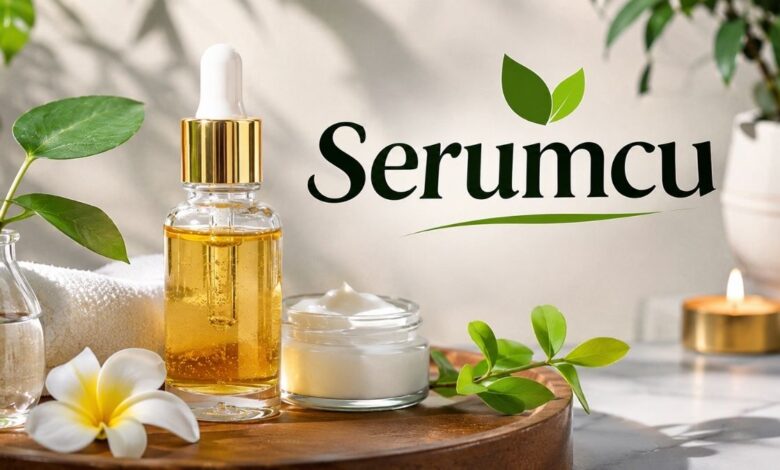
Serumcu is a name associated with online skincare information, facial serums, and beauty-related discussions rather than an independently verified celebrity or public personality. The website using this name describes itself as a source of skincare education, product insights, and ingredient guidance. Elsewhere, Serumcu has been presented as a facial serum promising hydration, brighter skin, and improved texture. However, independently verified product specifications, manufacturing details, and clinical evidence supporting those specific claims have not been established. Understanding Serumcu therefore requires distinguishing a skincare information website from a commercially manufactured cosmetic product.
What Is Serumcu?
Serumcu appears in skincare-related online content, where it is associated with facial serums, cosmetic ingredients, and everyday beauty routines. Its meaning depends on the context.
The website Serumcu.com describes its purpose as helping readers understand skincare products, ingredients, and routines. Its published information emphasizes educational material, product insights, and accessible skincare guidance.
That description establishes the website’s stated editorial purpose. It does not, by itself, establish that Serumcu is a registered cosmetics manufacturer or that a commercially available facial serum has undergone independent testing.
This distinction matters because a skincare publication, a cosmetics retailer, and a cosmetics manufacturer are three different businesses. A website can provide useful information about hyaluronic acid or vitamin C without developing, manufacturing, or selling products containing those ingredients.
For someone encountering the name for the first time, the most reliable approach is to establish exactly what is being discussed: a website, a product, a descriptive term, or a particular service.
The Origin and Meaning of Serumcu
The word’s structure suggests a connection to Turkish.
In Turkish, the suffix -cı, -ci, -cu, or -cü, with corresponding consonant variations, commonly forms words describing people associated with a profession, activity, or product.
Combined with serum, the name can loosely suggest someone associated with serums. However, this linguistic interpretation does not establish the origin of a particular business or trademark.
There is another important distinction. In some Turkish medical contexts, serum refers to an intravenous infusion. Consequently, informal uses of serumcu may concern people associated with IV treatments rather than facial skincare.
These meanings should not be confused.
A facial serum is applied to the skin, while an intravenous infusion delivers fluid directly into the bloodstream. The products, clinical considerations, and professional responsibilities are entirely different.
The Website Behind the Serumcu Name
Serumcu.com presents itself as an educational website for people interested in skincare ingredients, product selection, and beauty routines.
Its About Us page identifies several areas of interest, including ingredient education, skincare guidance, product insights, and helping readers make informed choices.
The website also describes its content creators as skincare enthusiasts, writers, and researchers.
Although those statements communicate the site’s intended identity, publicly accessible descriptions do not establish each contributor’s qualifications or independently verify the scientific review process behind its articles.
The website’s published content also extends beyond skincare into other subjects, suggesting a broader editorial scope.
The important distinction is between what a website says about its mission and what independent evidence confirms about its activities.
A declared commitment to research-based information is positive, but it does not replace external verification of professional credentials, product testing, or manufacturing standards.
Is Serumcu an Actual Skincare Product?
An article published by Bilium News on May 16, 2026, describes Serumcu as a lightweight facial serum associated with hydration, brightness, and improved skin texture. It also refers to ingredients including hyaluronic acid, vitamin C, peptides, antioxidants, and botanical extracts.
Those descriptions are claims reported in the article, not independently established details of a verified product formulation.
The available evidence does not adequately identify a named manufacturer, provide a complete ingredient declaration, verify active-ingredient concentrations, or confirm clinical testing for a specific product sold under the Serumcu name.
This means readers should avoid assuming that every ingredient mentioned in promotional descriptions is necessarily present in a single manufactured formulation.
A reliable cosmetic product normally provides information that allows consumers to identify what they are purchasing, including its manufacturer or responsible business, ingredient list, quantity, and relevant usage information.
Until these details are confirmed, Serumcu is more accurately described as a skincare-associated name than a clinically validated facial serum.
Understanding the Ingredients Associated With Serumcu
The ingredients frequently mentioned in discussions of Serumcu are established components of modern skincare. Dermatological research can examine their general properties, even when the composition of a particular branded product remains uncertain.
Hyaluronic Acid and Skin Hydration
Hyaluronic acid is widely used in skincare because it attracts and retains water.
In topical formulations, it acts as a humectant, helping support moisture retention in the skin’s outer layers. Better hydration can temporarily reduce the appearance of fine dehydration lines and make skin feel smoother.
Research discussed by established medical publications, including Harvard Health, supports the usefulness of hyaluronic acid in products intended to improve skin hydration.
A critical point is that a hydrating serum is not automatically a replacement for moisturizer. Moisturizers often contain additional ingredients that help reduce water loss from the skin.
Vitamin C and Uneven Skin Tone
Vitamin C is an antioxidant used in cosmetic products intended to address uneven skin tone, pigmentation, and certain visible effects of environmental exposure.
Dermatological guidance identifies topical vitamin C as an ingredient that may help reduce dark spots and support collagen-related skin functions.
Its effectiveness depends on factors including formulation, concentration, stability, and regular use.
Vitamin C is also sensitive to environmental conditions such as light and heat. Packaging and storage can therefore affect a formulation’s stability.
A product claiming to contain vitamin C should ideally disclose the specific ingredient form and provide suitable directions for use.
Niacinamide and the Skin Barrier
Niacinamide, a form of vitamin B3, is another commonly researched skincare ingredient.
It is used in products designed to support skin barrier function and improve the appearance of uneven tone, redness, and texture.
Although generally well tolerated, concentration and individual skin sensitivity still matter.
There is no reliable basis for assuming that niacinamide is present in a particular Serumcu-branded formulation without an identifiable ingredient label.
Peptides and Botanical Ingredients
Peptides appear in many cosmetic products marketed for firmness and visible signs of aging. However, different peptides have different properties, and the presence of the word peptides does not establish clinical effectiveness.
Botanical extracts present another challenge. Plant-derived ingredients may offer useful cosmetic properties, but their natural origin does not guarantee safety or effectiveness.
Some fragrance components and botanical substances can trigger irritation or allergic reactions.
The lesson is straightforward: ingredient identity, formulation quality, concentration, and skin compatibility matter more than a fashionable ingredient list.
What Facial Serums Can Realistically Achieve
Facial serums are generally designed to deliver particular ingredients through relatively lightweight formulations.
Depending on their composition, they may help with hydration, uneven pigmentation, skin texture, and the appearance of fine lines.
Not all serums do the same thing.
A hyaluronic acid serum primarily addresses hydration. A vitamin C formulation may target pigmentation and provide antioxidant benefits. Products containing retinoids have different uses, limitations, and irritation risks.
Medical skincare guidance recognizes that serums can provide additional benefits beyond basic moisturizing, while emphasizing that they are not substitutes for every other part of a skincare routine.
This is where cosmetic marketing frequently becomes less precise than dermatology.
Terms such as radiance, renewal, and anti-aging describe broad cosmetic ambitions. They don’t specify exactly which biological changes a product produces.
Claims of visible improvement should be evaluated against the formulation, available evidence, and the timeframe in which results were measured.
How to Use a Facial Serum Properly
A facial serum can be incorporated into a simple skincare routine without introducing numerous additional products.
Dermatologists generally recommend keeping routines manageable and avoiding unnecessary combinations of active ingredients.
For an ordinary facial serum, a typical routine may include:
- Gentle cleansing: Remove surface dirt, excess oil, and cosmetic residue without aggressive scrubbing.
- Serum application: Apply the product according to its specific instructions, usually before a heavier moisturizer.
- Moisturizing: Use a suitable moisturizer to support hydration and the skin barrier.
- Daily sun protection: Apply broad-spectrum sunscreen with SPF 30 or higher when appropriate for daytime exposure.
- Monitoring tolerance: Introduce new products cautiously and discontinue those causing concerning reactions.
Not every serum should be used twice daily. Some active ingredients require different schedules, and particular formulations may be unsuitable for certain skin conditions.
Where Serumcu itself is concerned, specific directions should not be treated as verified until they can be connected to an identifiable product and its actual formulation.
Why Skincare Safety Matters More Than Marketing
Cosmetic products can irritate even when their ingredients are commonly used.
People with eczema, rosacea, sensitive skin, or a history of allergic reactions may require particular care when introducing new formulations.
The American Academy of Dermatology recommends testing unfamiliar skincare products on a small area before applying them more widely. Its guidance says to observe the test area over several days for signs of a reaction.
If a product produces substantial redness, swelling, persistent burning, or other concerning symptoms, continued application may worsen the problem.
Products intended to improve cosmetic appearance differ from treatments for established dermatological conditions.
Persistent acne, significant pigmentation changes, unexplained rashes, and other medical concerns may require assessment by a qualified healthcare professional.
Consumers should be particularly cautious of advertising that promises guaranteed results, universal suitability, or dramatic improvements without supporting clinical evidence.
How to Evaluate Serumcu Claims Before Buying Anything
When a skincare name circulates online without clearly established product information, consumers should verify the seller and the product independently.
Several details are especially useful:
- Manufacturer identity: The business responsible for producing or marketing the cosmetic product.
- Complete ingredient list: The actual formulation, not a general list of popular skincare ingredients.
- Product identification: Packaging, size, batch information, and other appropriate details.
- Evidence for claims: Testing or research relevant to the specific formulation, not merely studies about individual ingredients.
- Seller transparency: Clear business contact information, pricing, and appropriate return policies.
- Directions and precautions: Instructions suitable for the ingredients and intended users.
These checks do not guarantee that a product will work for everyone. They do, however, help distinguish traceable commercial products from vague descriptions built around familiar beauty terminology.
The Broader Significance of Serumcu
Serumcu illustrates a common challenge in online beauty information: a name can take on several meanings before its underlying commercial or professional identity is clearly documented.
One article may describe a cosmetic formula. Another may discuss a skincare website. A third may approach the name through its linguistic meaning.
If these interpretations are combined without verification, readers may leave believing a particular manufacturer, product history, or clinical evidence has been established when it has not.
That uncertainty should be acknowledged rather than filled with invented details.
You can explain the benefits of hyaluronic acid, vitamin C, and other cosmetic ingredients without claiming that an unidentified product delivers those benefits.
Similarly, an educational website can be discussed based on its published content without attributing unsupported qualifications, commercial achievements, or a founder’s personal history to it.
This separation of evidence from assumption matters especially when the subject involves products applied to the body.
Conclusion
Serumcu is best understood as a name associated with skincare information and serum-related content, not as a verified celebrity or a demonstrably established cosmetic formulation. Its online presence can be documented, and its linguistic structure can be explained, but important questions about the existence and composition of a specific branded facial serum remain unresolved.
The ingredients discussed in connection with the name—particularly hyaluronic acid, vitamin C, and niacinamide—have legitimate roles in skincare. Their recognized properties, however, do not independently validate claims made about Serumcu.
For readers interested in skincare, the most useful approach is to favor transparent ingredient information, reliable dermatological guidance, appropriate sun protection, and products suited to individual skin needs.
The difference between an appealing skincare name and a trustworthy skincare product ultimately comes down to evidence.
(FAQs)
What is Serumcu?
Serumcu is a name associated with an online skincare information website and discussions of facial serums. It can also mean something different in Turkish medical contexts. It is not independently established as the name of a particular celebrity.
Is Serumcu a genuine skincare brand?
The Serumcu website is publicly accessible and describes a skincare education mission. However, independent verification of a dedicated cosmetic manufacturing business or a specific commercially available serum under the same name remains insufficient.
What ingredients are associated with Serumcu?
Published descriptions mention hyaluronic acid, vitamin C, antioxidants, peptides, and botanical extracts. These should be treated as reported ingredients rather than a verified formulation until an authentic product label or manufacturer declaration is available.
Can Serumcu help improve skin appearance?
Certain serum ingredients can support hydration, improve uneven skin tone, and address some visible signs of aging. However, there is insufficient independently verified evidence to establish those outcomes for a particular Serumcu product.
Is Serumcu safe for sensitive skin?
The safety of any cosmetic formulation depends on its actual ingredients, concentrations, and the individual’s skin response. Without a verified ingredient list, Serumcu can’t be responsibly described as universally safe for sensitive skin.