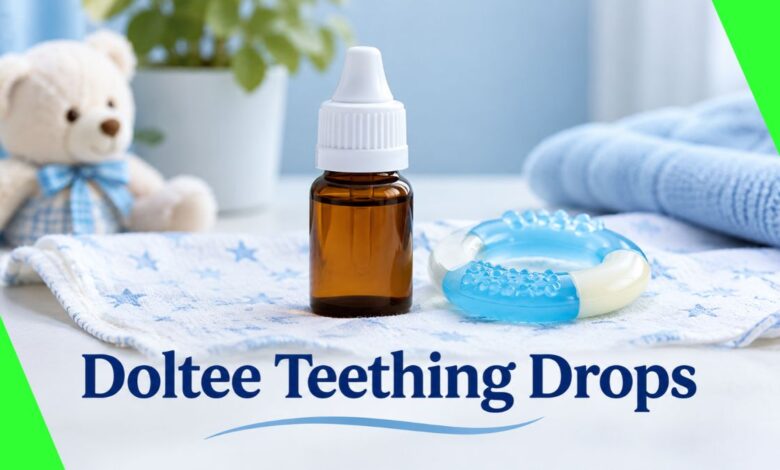
Doltee Teething Drops is a medicinal preparation marketed in Pakistan for temporary relief of gum discomfort associated with teething in babies and young children. The product is associated with W. Woodward Pakistan and is commonly listed in a 10 ml bottle. Reported ingredients include lignocaine, methyl salicylate, phenyl carbinol, and menthol.
Although the preparation is promoted for soothing sore gums, its ingredients deserve careful attention. International medical authorities caution against routine use of certain medicated teething preparations in infants because their potential risks may outweigh their limited benefits. Doltee should therefore not be treated as an automatically safe remedy simply because it is marketed for babies.
This article examines Doltee Teething Drops, their reported composition, intended benefits, and important safety considerations. It also explains how established pediatric guidance approaches teething discomfort.
What Are Doltee Teething Drops?
Doltee Teething Drops is a branded oral preparation intended for topical application to sore gums during teething. Unlike an ordinary nutritional supplement, it contains pharmacologically active ingredients, including a local anesthetic.
The product has a documented connection to Pakistan’s pharmaceutical market. A Drug Regulatory Agency of Pakistan notification dated July 13, 2012 listed Doltee drops under W. Woodward, Karachi, in a 10 ml presentation.
That historical government document establishes that the product was commercially recognized at the time. It does not, by itself, verify the product’s current registration status, manufacturing specifications, or suitability for every infant.
Several Pakistani pharmaceutical retailers continue to identify Doltee as a Woodward product. However, retail availability should not be confused with independent clinical evidence establishing its safety or effectiveness.
The distinction matters particularly for medicines used inside an infant’s mouth, where some of the preparation can be swallowed.
Doltee Teething Drops Ingredients and Composition
The formulation reported by Pakistani retailers combines ingredients intended to provide numbing, cooling or supporting effects.
One pharmacy listing provides the following concentrations:
- Lignocaine hydrochloride monohydrate — 0.37%
- Methyl salicylate — 0.02%
- Phenyl carbinol — 0.20%
- Menthol — 0.06%
These figures come from a commercial product description rather than a newly verified manufacturer-issued package insert. Parents should check the actual bottle and accompanying leaflet because formulations, labeling and instructions can change.
Lignocaine: The Local Anesthetic
Lignocaine, also called lidocaine, is a local anesthetic that temporarily reduces nerve signaling in the area where it is applied.
In a teething preparation, it is intended to reduce sensations of pain or irritation in the gums.
However, a chemical’s ability to numb tissue does not mean a teething product provides meaningful clinical benefits.
The amount applied, the concentration, the child’s age, and the possibility of swallowing all affect medication safety.
Methyl Salicylate: A Salicylate Ingredient
Methyl salicylate belongs to the salicylate family of compounds and is used in certain pain-relieving preparations.
Its presence in an infant oral product deserves attention because salicylate-containing oral preparations have faced significant safety restrictions in some countries.
The United Kingdom’s Medicines and Healthcare products Regulatory Agency has advised against topical oral salicylate preparations for people younger than 16.
That regulatory position should not be misrepresented as a specific Pakistani prohibition against Doltee. Nevertheless, it raises a legitimate question about the appropriateness of salicylate-containing preparations for infants.
Phenyl Carbinol and Menthol
Phenyl carbinol is another name for benzyl alcohol, a substance used in pharmaceutical formulations for functions that can include preservation or formulation support.
Its precise role in Doltee should be confirmed against the manufacturer’s current product documentation.
Menthol produces a cooling sensation by interacting with sensory receptors. That sensation can make an affected area feel temporarily cooler without necessarily treating the underlying source of discomfort.
The combined presence of these substances makes it essential to evaluate the complete preparation rather than assume that each ingredient is harmless at every concentration or age.
How Do Doltee Teething Drops Work?
Doltee is marketed as a treatment that helps soothe tender gums during tooth eruption.
The proposed mechanism is mainly linked to lignocaine’s local anesthetic action. When an appropriate amount of a lignocaine-containing preparation contacts the gum, the medicine may temporarily reduce sensation in the affected tissue.
Menthol contributes a cooling effect.
These mechanisms help explain the product’s intended purpose. They do not prove how consistently Doltee relieves infant teething pain, how long any relief lasts, or whether its benefits outweigh its risks.
No sufficiently documented, product-specific clinical trial establishing Doltee’s safety and efficacy in infants was identified in the reviewed authoritative sources.
This lack of verified product-specific evidence is an important limitation.
A medicine can have a well-understood active ingredient without possessing strong clinical evidence for every condition, formulation, or age group in which it is marketed.
Are Doltee Teething Drops Safe for Babies?
Safety is the most consequential question surrounding Doltee.
The US Food and Drug Administration (FDA) advises against using products containing lidocaine or benzocaine to treat teething pain in infants and young children. Its guidance explains that topical numbing medicines offer little or no demonstrated benefit for teething and may carry serious risks.
The FDA has specifically warned that oral viscous lidocaine products can cause seizures and other life-threatening complications when improperly administered or accidentally swallowed.
Those warnings concern the use of lidocaine-containing oral medicines and should not be interpreted as proof that Doltee itself has caused the same outcomes. The formulation and concentration of individual products may differ.
Nevertheless, Doltee’s reported lignocaine content makes professional assessment particularly important.
Why Excessive Use Is a Concern
Young children may swallow medication placed inside their mouths. Repeated applications can also increase exposure.
Numbing the mouth or throat can potentially interfere with normal swallowing and protective responses, depending on the product and extent of exposure.
The FDA’s findings support a cautious approach to oral local anesthetics in infants.
Parents should not increase the quantity or frequency of any medicated teething preparation simply because the baby remains unsettled.
The Additional Salicylate Question
Doltee’s reported methyl salicylate content adds another reason to be cautious.
In a historical safety review, the UK’s MHRA examined the risks of salicylate-containing oral treatments after a serious suspected adverse reaction involving excessive use of a choline salicylate gel.
The agency subsequently advised against topical oral salicylate products for children younger than 16.
The case involved a different formulation from Doltee, so the exact risk cannot automatically be transferred between products.
Even so, parents should consult a qualified pediatrician or pharmacist before considering Doltee for a baby. Non-medicinal measures are generally preferred.
Understanding the Symptoms of Teething
The first primary teeth commonly begin appearing at approximately six months of age, although normal timing varies considerably.
Some infants experience almost no discomfort. Others have periods of gum sensitivity, increased chewing, and behavioral changes.
According to the NHS, possible signs include:
- Red or tender gums where a tooth is emerging
- Increased drooling
- Chewing or gnawing on objects
- Mild irritability
- Disrupted sleep
- A slightly raised temperature below 38°C
Teething is a normal developmental process, not an illness.
Symptoms That Should Not Automatically Be Blamed on Teething
Parents sometimes attribute fever, persistent diarrhea or significant feeding difficulties to erupting teeth.
That assumption can delay medical assessment of an unrelated condition.
The NHS states that no evidence supports diarrhea as a symptom caused by teething. A temperature of 38°C or above should not simply be dismissed as ordinary teething.
Persistent vomiting, unusual drowsiness, breathing difficulties, dehydration or a child appearing seriously unwell also require medical attention.
A baby can be teething and experiencing a separate illness at the same time.
What Medical Authorities Recommend Instead
Current clinical guidance generally favors simple methods of relieving gum discomfort before considering medicines applied directly to the mouth.
Gentle Gum Massage
A caregiver can gently massage the baby’s gums using a clean finger.
This provides local pressure without introducing a medicated substance.
It is one of the practical measures recommended by the American Academy of Pediatrics and recognized in FDA guidance.
Chilled Teething Rings
A clean, firm teething ring gives an infant something safe to chew.
Some rings can be chilled in a refrigerator according to the manufacturer’s directions.
A frozen teether should be avoided because an excessively cold or hard surface may injure delicate gum tissue.
Teething rings should also never be tied around a baby’s neck.
Age-Appropriate Pain Relief
If discomfort is substantial, a healthcare professional may recommend an appropriate infant formulation of paracetamol or ibuprofen.
Eligibility depends on the baby’s age, weight, health, and the specific medicine. Ibuprofen also has additional precautions in some medical circumstances.
Parents should follow the product’s official instructions and obtain professional guidance rather than estimate a dose.
These treatments are not interchangeable with medicated gum drops.
How Should Parents Approach Doltee Teething Drops?
Some online descriptions include instructions for applying small quantities of Doltee to the gums.
However, commercial instructions cannot substitute for an independently verified, current manufacturer leaflet or individual medical advice.
Because the product reportedly contains lignocaine and methyl salicylate, this article does not recommend a specific number of drops or daily application frequency for infants.
Before considering the preparation, a caregiver should confirm:
- The active ingredients and concentrations shown on the actual package.
- Whether the product is currently authorized for the child’s age and intended use.
- The recommended route of administration and any applicable warnings.
- Whether the baby has allergies, medical conditions, or medicines that could affect safety.
- Whether a safer, non-medicinal approach would be sufficient.
The safest course is to seek advice from a qualified pediatrician or pharmacist before using Doltee for infant teething.
If an infant develops breathing difficulties, seizures, loss of consciousness, unusual severe drowsiness, or other alarming symptoms after exposure, seek emergency medical care.
Doltee Teething Drops Price and Availability in Pakistan
Doltee is commonly advertised as a 10 ml product through Pakistani medicine retailers.
Its commercial history can be traced to the 2012 government pricing notification, which recorded a historical maximum retail price of Rs. 20 for a 10 ml pack.
That figure is historical and must not be presented as its current selling price.
More recent retailer listings show different prices and availability information. Individual stock levels may also change without notice.
A reliable contemporary price requires confirmation from a licensed pharmacy.
Parents should be particularly careful about buying medicines from unverified sellers or relying on incomplete product descriptions that omit safety information.
Why Online Product Descriptions Need Careful Reading
A recurring problem with medicine information online is the failure to distinguish between the symptoms of a condition, the advertised benefits of treatment, and actual adverse reactions.
Some Doltee retailer descriptions list increased drooling, irritability and interrupted sleep under headings related to side effects.
Those complaints are also commonly associated with teething itself. Their appearance on a retail page does not establish that they are adverse reactions caused by the medicine.
This distinction is medically significant.
Likewise, describing a product as gentle or specially formulated for infants is a marketing claim, not independent proof of clinical safety.
Reliable medicine information should identify the formulation, approved age range, contraindications, administration instructions, and documented adverse effects.
Where that information is absent or unclear, assumptions should not fill the gap.
Conclusion
Doltee Teething Drops has an identifiable history in Pakistan’s pharmaceutical market and is marketed for temporary relief of infant teething discomfort.
Its reported composition, particularly lignocaine and methyl salicylate, deserves more scrutiny than the reassuring language often found in retail descriptions.
While the ingredients have recognized pharmacological properties, the reviewed sources provide insufficient independent evidence of the safety and effectiveness of the specific Doltee formulation in infants.
Guidance from the FDA, NHS and MHRA supports prioritizing non-medicinal comfort measures and seeking professional advice before using medicated oral teething products.
For parents, the central question is not whether a preparation can temporarily numb the gums, but whether its benefits justify the risks for their particular child.
Editorial Verification
This article was prepared using publicly accessible information from the Drug Regulatory Agency of Pakistan, the US Food and Drug Administration, the UK Medicines and Healthcare products Regulatory Agency, NHS infant-teething guidance, and Pakistani pharmacy product listings.
The historical government record establishes the product’s commercial association with W. Woodward. Ingredient percentages come from retailer descriptions and should be checked against current manufacturer documentation.
No independent, product-specific clinical trial sufficient to establish Doltee’s safety and efficacy in infants was verified during this review.
(FAQs)
What is Doltee Teething Drops used for?
Doltee is marketed for temporary relief of gum pain and discomfort associated with teething. Its reported lignocaine content is intended to provide local anesthetic effects.
Who makes Doltee Teething Drops?
The product is associated with W. Woodward Pakistan. A 2012 Pakistani government notification independently identifies Doltee drops under W. Woodward, Karachi.
Can Doltee Teething Drops be given to a newborn?
Doltee should not be given to a newborn without explicit assessment and direction from a qualified clinician. Its suitability for newborns has not been established by the evidence reviewed here.
Are Doltee Teething Drops effective?
The reported ingredients have recognized pharmacological actions, but that does not demonstrate that Doltee itself provides clinically meaningful teething relief. Product-specific clinical effectiveness has not been independently established in the sources reviewed.
Do Doltee Teething Drops contain lidocaine?
Pakistani product listings identify lignocaine hydrochloride, another name for lidocaine hydrochloride, as one of the ingredients. The current composition should be checked against the actual manufacturer’s label.
What is the safest way to relieve teething discomfort?
For most babies, gentle gum massage and an appropriately designed chilled teething ring are suitable first approaches. Persistent or substantial discomfort should be discussed with a healthcare professional.